

Colourful slitherers earn renown
Red garters included in scientific journal

Advertisement
Read this article for free:
or
Already have an account? Log in here »
To continue reading, please subscribe:
Monthly Digital Subscription
$1 per week for 24 weeks*
- Enjoy unlimited reading on winnipegfreepress.com
- Read the E-Edition, our digital replica newspaper
- Access News Break, our award-winning app
- Play interactive puzzles
*Billed as $4.00 plus GST every four weeks. After 24 weeks, price increases to the regular rate of $19.95 plus GST every four weeks. Offer available to new and qualified returning subscribers only. Cancel any time.
Monthly Digital Subscription
$4.99/week*
- Enjoy unlimited reading on winnipegfreepress.com
- Read the E-Edition, our digital replica newspaper
- Access News Break, our award-winning app
- Play interactive puzzles
*Billed as $19.95 plus GST every four weeks. Cancel any time.
To continue reading, please subscribe:
Add Free Press access to your Brandon Sun subscription for only an additional
$1 for the first 4 weeks*
*Your next subscription payment will increase by $1.00 and you will be charged $16.99 plus GST for four weeks. After four weeks, your payment will increase to $23.99 plus GST every four weeks.
Read unlimited articles for free today:
or
Already have an account? Log in here »
Hey there, time traveller!
This article was published 08/09/2011 (5332 days ago), so information in it may no longer be current.
WINNIPEG — A bright red garter snake shocked some Manitoba Hydro workers up north a few years ago.
Now, the flaming scarlet slitherer is famous.
It’s documented in Copeia, the official publication of the American Society of Ichthyologists and Herpetologists.
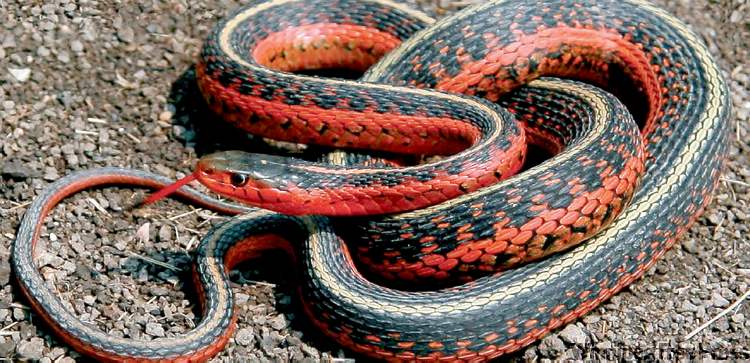
“It’s very big,” said University of Manitoba graduate student Jonathan Wiens, who co-authored the study as part of his master’s degree research.
It was inspired by strange snake sightings up north.
“Manitoba Hydro initially contacted people at the university because they had employees say ‘Hey, I think there’s a funny-coloured snake up here.’ “
Wiens, who earned a master’s degree in wildlife biology, spent the next three summers studying the colourful snakes on the upper Nelson River and the east side of Lake Winnipeg.
“It was a neat opportunity,” said Wiens. “I was able to do this research in an area of the province never studied before,” he said. “No one had gone up to northern Manitoba to look for snakes,” he said.
“There’s been a lot of research around Narcisse,” the Manitoba community north of Winnipeg that’s home to dens housing tens of thousands of garter snakes. “No one had ever gone to the northern range” of where garter snakes live, said Wiens, who did. “They’re not a species that does well in the cold.”
In the extreme north of the garter snake’s range, their numbers thin out, said Wiens.
In other words, you don’t find them in the thousands like you do in the snake pits around Narcisse. “I handled 500 snakes in three years,” he said.
“One out of every 20 I caught was this red colour.”
The really red snakes won’t come as a surprise to everyone.
“Some First Nations residents have known about these red snakes for some time, but biologists are just describing these variants and interpreting their significance,” said Randy Mooi, curator of zoology at the Manitoba Museum, who co-authored the study.
Some people from Berens River have a general knowledge of the red snakes, said Mooi. But there is no expert or Snake Whisperer among them, he said.
“… A person would know of them in a general sort of way or know of ‘someone’ who had seen one,” said the curator. Most of the First Nations residents he spoke to seem to be frightened of the snakes, he said.
Wiens wants to know why the species of garters — which come in several colours including brown, blue and blonde — also appear in flaming red.

“Is it a genetic mutation?” Maybe it’s a defence mechanism to keep predators away, he said.
Snakes, which are aquatic, are sought after by fish and mammals like minks and otters, as well as ravens and other birds, said Wiens.
“They’re an important prey species — a red snake showing up might surprise a predator,” said Wiens. “I’m guessing it might be one benefit — an unusual colour throws off the predator to get away.” He’s now working for the province as a researcher and hopes another scientist can solve the reptilian riddle.
“The door is open for research.”
carol.sanders@freepress.mb.ca
Carol Sanders
Legislature reporter
Carol Sanders is a reporter at the Free Press legislature bureau. The former general assignment reporter and copy editor joined the paper in 1997. Read more about Carol.
Every piece of reporting Carol produces is reviewed by an editing team before it is posted online or published in print — part of the Free Press‘s tradition, since 1872, of producing reliable independent journalism. Read more about Free Press’s history and mandate, and learn how our newsroom operates.
Our newsroom depends on a growing audience of readers to power our journalism. If you are not a paid reader, please consider becoming a subscriber.
Our newsroom depends on its audience of readers to power our journalism. Thank you for your support.
Carol Sanders
Legislature reporter
Carol Sanders is a reporter at the Free Press legislature bureau. The former general assignment reporter and copy editor joined the paper in 1997. Read more about Carol.
Every piece of reporting Carol produces is reviewed by an editing team before it is posted online or published in print — part of the Free Press‘s tradition, since 1872, of producing reliable independent journalism. Read more about Free Press’s history and mandate, and learn how our newsroom operates.
Our newsroom depends on a growing audience of readers to power our journalism. If you are not a paid reader, please consider becoming a subscriber.
Our newsroom depends on its audience of readers to power our journalism. Thank you for your support.
Advertisement Advertise With Us
Advertisement Advertise With Us