

Man’s charter rights died with him: WRHA
Sinclair kin slams legal argument

Advertisement
Read this article for free:
or
Already have an account? Log in here »
To continue reading, please subscribe:

Digital Subscription
One year of digital access for only $205*
- Enjoy unlimited reading on winnipegfreepress.com
- Read the E-Edition, our digital replica newspaper
- Access News Break, our award-winning app
- Play interactive puzzles
*First annual payment billed as $205.00 + GST for one year. This annual subscription will automatically renew at $233.00 + GST every 52 weeks (10% off the regular annual price of $259.35). Offer available to new and qualified returning subscribers only. Cancel any time.
To continue reading, please subscribe:
Add Free Press access to your Brandon Sun subscription for only an additional
$1 for the first 4 weeks*
- Enjoy unlimited reading on winnipegfreepress.com
- Read the E-Edition, our digital replica newspaper
- Access News Break, our award-winning app
- Play interactive puzzles
*Your next Brandon Sun subscription payment will increase by $1.00 and you will be charged $17.95 plus GST for four weeks. After four weeks, your payment will increase to $24.95 plus GST every four weeks.
Read unlimited articles for free today:
or
Already have an account? Log in here »
Hey there, time traveller!
This article was published 20/10/2011 (5444 days ago), so information in it may no longer be current.
Family of a man who died after languishing in a Winnipeg emergency room shouldn’t be able to sue Winnipeg health authorities, lawyers argue — because the man is already dead.
In a court motion, lawyers for the Winnipeg Regional Health Authority asked a judge to dismiss most of a $1.6-million lawsuit brought against the WRHA, the Government of Manitoba, and 13 other people on behalf of the family of Brian Sinclair.
Sinclair died in 2008 after waiting more than 34 hours for care in a Health Sciences Centre emergency waiting room.
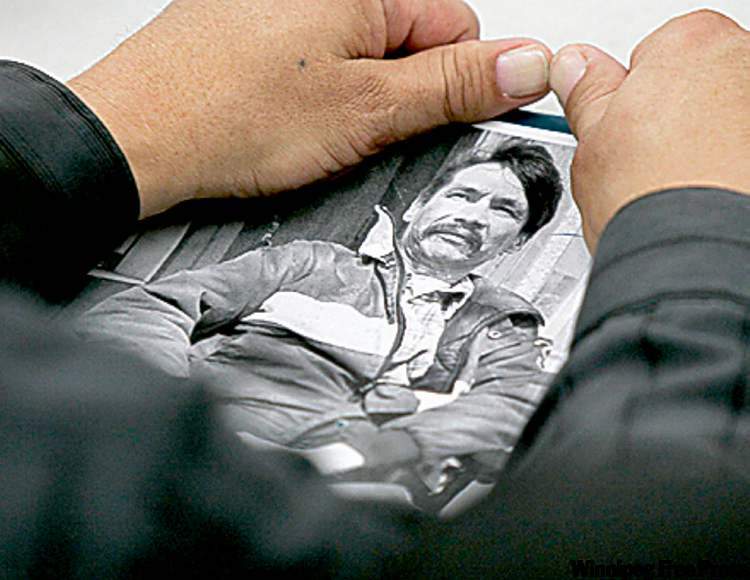
The health authority argues that if a person who claims their charter rights have been violated dies while pursuing a claim, the claim cannot continue.
“The allegations are that when Brian Sinclair attended the emergency department of Health Sciences Centre, he was in need of medical treatment that was not provided within a reasonable time frame as a result of which he died,” documents filed on behalf of the health authority say. “It is alleged that this failure constituted a breach of his charter rights… but the jurisprudence is clear that the charter rights of a deceased person cannot be enforced by his estate because those rights are personal and terminate with the death of the individual.”
The lawyers also ask the court to dismiss claims that Sinclair’s privacy rights under the Charter of Rights and Freedoms were violated because they say those rights also don’t apply after his death. They also want the court to dismiss part of the lawsuit that demands the authority cover his family’s legal costs in relation to the upcoming inquest into his death.
Sinclair’s family called the health authority’s legal move “absurd, intolerable and cruelly ironic,” in their own court documents filed Wednesday.
“By the very act of depriving Mr. Sinclair of his right to life, the WRHA deprived him of his ability to sue and thereby immunized itself from liability for fatally breaching his charter rights,” the documents state. “The charter should not be interpreted in a way that would preclude holding a state authority accountable under the charter when it unlawfully deprives a person of his or her right to life.”
Legal scholars said it’s not surprising that lawyers for the WRHA would use the tactic. But University of Manitoba constitutional law Prof. Karen Busby noted the rule has previously applied only when the person died from causes unrelated to their claim, such as someone suing the government for violating equality rights before dying of old age.
“There isn’t a single case where the right being invoked is the right to life, and it was affected because you died,” Busby said. “I think an argument can be made that the rule shouldn’t apply in this case.”
In the political arena, Progressive Conservative health critic Myrna Driedger had stronger words for the legal tactic. “I think it’s absolutely appalling,” she said Wednesday.
She also accused the governing NDP of backing away from any responsibility for the incident.

“It happened under their watch and they’ve stopped at nothing to avoid accountability with Brian Sinclair’s death,” Driedger said.
Both the health authority and the government should do more to learn from the tragic incident, Driedger said. “This is just a shameful, shameful step to take when they should be trying much harder to get to the bottom of what happened and why it happened and then fix it so that it doesn’t happen again,” she said.
— with files from Larry Kusch and The Canadian Press
melissa.martin@freepress.mb.ca
Melissa Martin
Reporter-at-large
Melissa Martin reports and opines for the Winnipeg Free Press.
Every piece of reporting Melissa produces is reviewed by an editing team before it is posted online or published in print — part of the Free Press‘s tradition, since 1872, of producing reliable independent journalism. Read more about Free Press’s history and mandate, and learn how our newsroom operates.
Our newsroom depends on a growing audience of readers to power our journalism. If you are not a paid reader, please consider becoming a subscriber.
Our newsroom depends on its audience of readers to power our journalism. Thank you for your support.
Melissa Martin
Reporter-at-large
Melissa Martin reports and opines for the Winnipeg Free Press.
Every piece of reporting Melissa produces is reviewed by an editing team before it is posted online or published in print — part of the Free Press‘s tradition, since 1872, of producing reliable independent journalism. Read more about Free Press’s history and mandate, and learn how our newsroom operates.
Our newsroom depends on a growing audience of readers to power our journalism. If you are not a paid reader, please consider becoming a subscriber.
Our newsroom depends on its audience of readers to power our journalism. Thank you for your support.
Advertisement Advertise With Us
Advertisement Advertise With Us