

Cal Murphy dead at age 79
Advertisement
Read this article for free:
or
Already have an account? Log in here »
To continue reading, please subscribe:

Digital Subscription
One year of digital access for only $205*
- Enjoy unlimited reading on winnipegfreepress.com
- Read the E-Edition, our digital replica newspaper
- Access News Break, our award-winning app
- Play interactive puzzles
*First annual payment billed as $205.00 + GST for one year. This annual subscription will automatically renew at $233.00 + GST every 52 weeks (10% off the regular annual price of $259.35). Offer available to new and qualified returning subscribers only. Cancel any time.
To continue reading, please subscribe:
Add Free Press access to your Brandon Sun subscription for only an additional
$1 for the first 4 weeks*
- Enjoy unlimited reading on winnipegfreepress.com
- Read the E-Edition, our digital replica newspaper
- Access News Break, our award-winning app
- Play interactive puzzles
*Your next Brandon Sun subscription payment will increase by $1.00 and you will be charged $17.95 plus GST for four weeks. After four weeks, your payment will increase to $24.95 plus GST every four weeks.
Read unlimited articles for free today:
or
Already have an account? Log in here »
Hey there, time traveller!
This article was published 18/02/2012 (5334 days ago), so information in it may no longer be current.
WINNIPEG — Cal Murphy, one of the most influential figures in the history of the Winnipeg Blue Bombers and the Canadian Football League, has died at the age of 79.
TSN is reporting the former head coach and general manager of the Bombers, a member of the club’s hall of fame and the Canadian Football Hall of Fame, died on Saturday.
Born in Winnipeg in 1932, Murphy’s family moved to Vancouver where he starred at Vancouver College and the University of British Columbia and later turned to coaching football – a profession that would dominate his adult life. Murphy began his long association with the CFL in 1974 under the legendary Eagle Keys with the B.C. Lions, and six games into 1975 was named head coach. Fired after the 1976 season, Murphy then joined the Montreal Alouettes as an assistant under Marv Levy in 1977 before moving on to the Edmonton Eskimos, where he was part of that franchise’s dynasty of 1978-82.
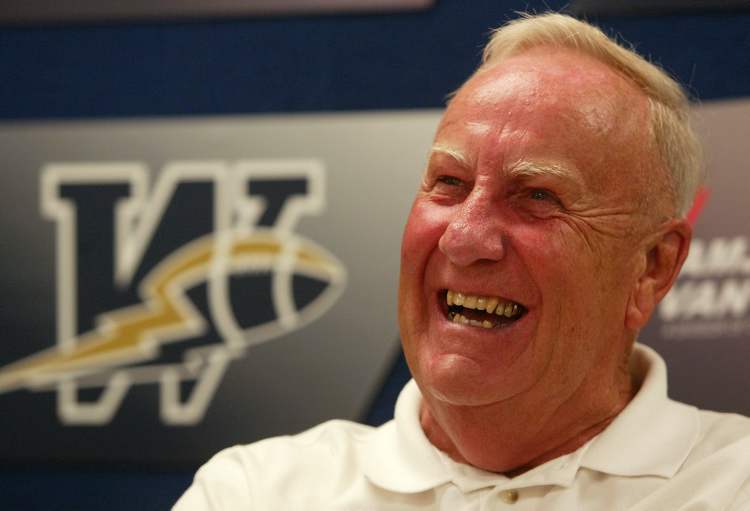
In 1983, then Bombers GM Paul Robson hired Murphy as Winnipeg’s head coach and in his first year at the helm he guided the club to an 11-7 record and was named the CFL’s Coach of the Year. One season later Murphy and the Bombers were Grey Cup champs, as Winnipeg trounced Hamilton in the Grey Cup to end a 22-year championship drought. He was named the CFL’s coach of the year for a second straight season.
It was the beginning of a dominant run for Murphy and the Bombers as they would win three titles from 1984-90, the first with “Kindly Cal” as the coach and the last two with him serving as general manager with Mike Riley on the sidelines.
Murphy would also play a critical role in Winnipeg’s landing the 1991 Grey Cup Game and the model used for that championship game was soon adopted by the league as a blueprint.
In 1992, Murphy was to return to the sidelines as coach when he suffered a heart attack and needed emergency bypass surgery that kept him alive before a last-second donor became available. Even in recovery at a hospital in London, Ont., Murphy would be in constant contact with interim head coach Urban Bowman and assistant GM Lyle Bauer, often calling with game-plan advice.
He returned to coach the Bombers again and in 1993 helped guide the team to the Grey Cup before losing to the Edmonton Eskimos. Murphy would serve as head coach and GM until the end of the 1996 season, when he was replaced by Jeff Reinebold.
But his time in the CFL did not end there as he moved on to the Saskatchewan Roughriders, serving as offensive co-ordinator and then head coach and later worked with the Chicago Enforcers of the XFL and the Frankfurt Galaxy of NFL Europe. He had been serving as a scout for the Indianapolis Colts prior to his death.
Murphy and his wife Joyce had seven children and had been living in Regina.
He was inducted into the Bomber hall of fame in 2002, the Canadian Football Hall of Fame in 2004 after winning nine Grey Cups; one with Montreal, five with Edmonton and three with the Winnipeg. He is second only to Bud Grant in Bomber history for wins as a head coach with 86 and posted a sparkling .627 winning percentage.
Related Articles
Peers share memories, many sides of Cal Murphy


Advertisement Advertise With Us
History
Updated on Sunday, February 19, 2012 12:19 AM CST: More info.
Updated on Sunday, February 19, 2012 12:34 AM CST: More info.
Updated on Sunday, February 19, 2012 9:14 AM CST: Corrects number of wins in last paragraph