

Handi-Transit stirs users’ fears
Cancellation, no-show penalties may rise
Advertisement
Read this article for free:
or
Already have an account? Log in here »
To continue reading, please subscribe:
Monthly Digital Subscription
$1 per week for 24 weeks*
- Enjoy unlimited reading on winnipegfreepress.com
- Read the E-Edition, our digital replica newspaper
- Access News Break, our award-winning app
- Play interactive puzzles
*Billed as $4.00 plus GST every four weeks. After 24 weeks, price increases to the regular rate of $19.95 plus GST every four weeks. Offer available to new and qualified returning subscribers only. Cancel any time.
Monthly Digital Subscription
$4.99/week*
- Enjoy unlimited reading on winnipegfreepress.com
- Read the E-Edition, our digital replica newspaper
- Access News Break, our award-winning app
- Play interactive puzzles
*Billed as $19.95 plus GST every four weeks. Cancel any time.
To continue reading, please subscribe:
Add Free Press access to your Brandon Sun subscription for only an additional
$1 for the first 4 weeks*
*Your next subscription payment will increase by $1.00 and you will be charged $16.99 plus GST for four weeks. After four weeks, your payment will increase to $23.99 plus GST every four weeks.
Read unlimited articles for free today:
or
Already have an account? Log in here »
Hey there, time traveller!
This article was published 05/03/2012 (5172 days ago), so information in it may no longer be current.
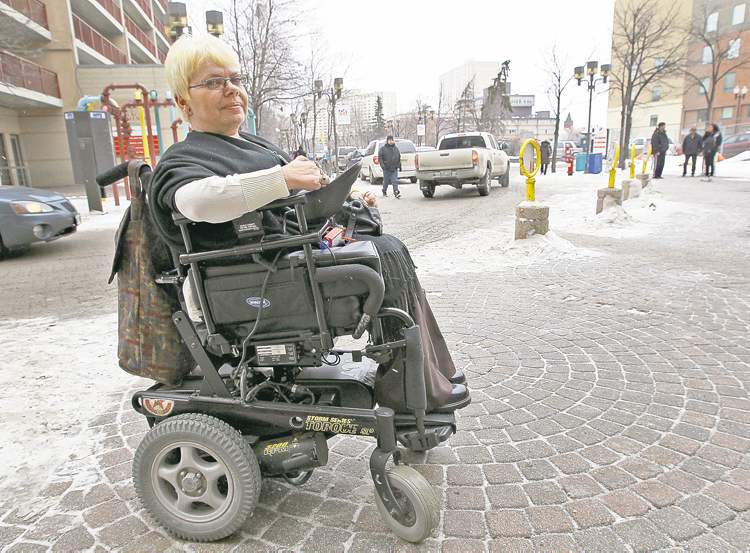
Proposed sweeping changes to fees and penalties in the city’s Handi-Transit system could make it much tougher and more expensive for wheelchair-bound Terry McIntosh and other users to get around the city.
When McIntosh goes to work, she relies on Handi-Transit, Winnipeg’s public transportation service for people with disabilities.
The 49-year-old McIntosh has used a wheelchair her entire life and is a Handi-Transit subscriber — someone who uses the service for the same trip, scheduled at the same time, at least three times per week.

But if newly proposed changes to Handi-Transit’s cancellation policy come into effect, McIntosh fears her commute may become more expensive and less flexible.
Handi-Transit released a policy draft on its website in February that would see higher financial penalties for riders who are marked as not showing up for their trips and less leeway for trip cancellation.
Because McIntosh sometimes has to attend last-minute meetings at work, her file has been marked with “quite a few” cancelled trips and no-shows, she said.
No-show is Handi-Transit’s term for instances in which users are counted as not being at the designated pickup location when the driver arrives, or when users cancel trips less than 30 minutes before the assigned pickup time.
In addition to fees, users who rack up too many no-shows or owe Handi-Transit more than $30 may have their access to the service restricted or suspended, the Handi-Transit website states.
If the new policy is adopted, changes could include charging more money for each no-show and instituting fees for some cancellations. The policy would also count any cancellation within 90 minutes of the scheduled pickup as a no-show instead of the current 30 minutes.
McIntosh said no-shows and cancellations aren’t enough of a problem to warrant such changes, and she argued that many of the proposals would have a negative effect on Handi-Transit users.
“It’s supposed to be the same as regular transit,” she said. “Would you cut anybody else off because they were five minutes late getting to their bus stop?”
Allowing users less time to cancel without penalty is likely to cause increased financial hardship for many users, said Handi-Transit user Myrna Donald.
“I think they need to consider the population,” Donald said. “For some employees, they just need as much flexibility as people who take the bus. And it’s very difficult for many people with illnesses or disabilities to even get a job and to maintain a job.”
Neither Handi-Transit nor city hall was willing to explain or even discuss the proposals.
Handi-Transit management did not respond to repeated telephone requests for interviews from the Free Press. A city spokeswoman said she couldn’t provide the number of no-shows and cancellations, nor could she confirm which parts of the draft are new.
Nick Ternette, chairman of the Manitoba League of Persons with Disabilities transportation committee and a member of the city’s Handi-Transit policy advisory committee, said Handi-Transit officials think the changes will save money and make the system more efficient.
Ternette, a longtime social activist who has run for mayor five times, said response from users of the service to the proposal has been mixed, but he thinks many of the changes will improve the system.
One proposed change may even put cash back into riders’ pockets, Ternette said: If a Handi-Transit user goes on 20 trips without incurring any no-show or cancellation fees, the user will get a credit.
But some Handi-Transit users countered that while the incentive is nice, it’s not going to deter people from cancelling when it is unavoidable.
People who use the service often have medical appointments that run late, Donald said.
“What are you going to do — leave the X-ray waiting room because you have to get a ride? You’re in the situation where you don’t know if it’s going to be 90 minutes. You don’t have full control,” she said.
Scheduling pickup based on expecting appointments to run late can mean sitting around for hours, Donald said, and because of their health conditions, some users can’t always schedule extra time into their trips.
There will always be people who cancel at the last minute, said Handi-Transit customer Ken Shaehtay.
The transportation service knows “who does the majority of the cancellations and they’re penalizing everybody because of it. I don’t think that’s right,” Shaehtay said.
Diane Driedger, the provincial co-ordinator for the Manitoba League of Persons with Disabilities, said users have complained to her about receiving no-shows when they did show up.
That’s happened to 22-year-old Scott Best, who said drivers don’t always alert customers to their arrival. Best, who’s blind, said it’s unjust to consider him a no-show when the driver didn’t tell him his ride had arrived.
Driedger said some users are concerned the harsher penalties will cost them more money for no-shows they shouldn’t have received.
Ternette said the draft policy will be open to public feedback for several months before going to city council for approval. There would be a three-month period before any changes take effect, to give Handi-Transit time to inform users, he said.
hilary.roberts@freepress.mb.ca
Cancellation
policy stiffer
HANDI-TRANSIT has released a draft of its new no-show and cancellation policy, including penalties for cancelling a trip between 11 a.m. the day before pickup and the scheduled pickup time.
— One or two cancellations out of 10 trips: warning letter.
— Three to five cancelled trips out of 10: penalties of the cost of two to four adult fares, plus $10.
Some cancellations would be exempt from these fees:
— A trip cancelled due to inclement weather identified by Handi-Transit, or a cancellation because only one part of a return trip could be scheduled, or because Handi-Transit was able to accommodate a user’s request for a different pickup time after the schedule was made.
— Two trips (or one return trip) within a calendar month cancelled at least three hours before pickup time; two trips to work (or one return trip) within a calendar month cancelled because of meetings or shift changes.
No-shows
NO-SHOW penalties have been imposed for trips cancelled less than 30 minutes before the planned pickup time, but the new policy stipulates a no-show is any cancellation within 90 minutes of the planned pickup time.
— First no-show: no change to the current warning letter.
— Second to fourth no-show: penalties of the cost of two to four adult cash fares.
— Fifth no-show and each no-show thereafter: The current fee is $15 per no-show. The proposed policy would increase this penalty to $19.80, the cost of four adult cash fares, plus $10.
— Subscribers with more than four no-shows or cancellations in a month will have their subscription revoked and won’t be eligible to subscribe again for 12 months. After having a subscription revoked twice, the user won’t be eligible for the subscription service any longer and will have to schedule trips one at a time.
— Source: Handi-Transit February 2012 draft cancellation and no-show policy, which can be found at: http://winnipegtransit.com/en/handi-transit/whats-new-at-handi-transit
What is Handi-Transit?

IT’S Winnipeg’s public transportation system for people with disabilities or chronic illnesses that limit their ability to use standard transit.
Eligible passengers: people unable to walk 175 metres outdoors, patients on dialysis, people who are legally blind, those who require the temporary or ongoing use of a scooter or wheelchair, or people diagnosed with Alzheimer’s disease or dementia.
Passengers may appeal any penalties to Handi-Transit.
— Source: Handi-Transit website