

Premier blasts Tories for failing to boost health, education
Advertisement
Read this article for free:
or
Already have an account? Log in here »
To continue reading, please subscribe:

Digital Subscription
One year of digital access for only $205*
- Enjoy unlimited reading on winnipegfreepress.com
- Read the E-Edition, our digital replica newspaper
- Access News Break, our award-winning app
- Play interactive puzzles
*First annual payment billed as $205.00 + GST for one year. This annual subscription will automatically renew at $233.00 + GST every 52 weeks (10% off the regular annual price of $259.35). Offer available to new and qualified returning subscribers only. Cancel any time.
To continue reading, please subscribe:
Add Free Press access to your Brandon Sun subscription for only an additional
$1 for the first 4 weeks*
- Enjoy unlimited reading on winnipegfreepress.com
- Read the E-Edition, our digital replica newspaper
- Access News Break, our award-winning app
- Play interactive puzzles
*Your next Brandon Sun subscription payment will increase by $1.00 and you will be charged $17.95 plus GST for four weeks. After four weeks, your payment will increase to $24.95 plus GST every four weeks.
Read unlimited articles for free today:
or
Already have an account? Log in here »
Hey there, time traveller!
This article was published 29/03/2012 (5286 days ago), so information in it may no longer be current.
The federal budget will make it “very challenging” for Manitoba to protect basic services such as health and education, Premier Greg Selinger says.
Speaking to reporters today, Selinger criticized Ottawa for failing to increase health and education transfers to the province for a third consecutive year.
He said it will make Manitoba’s own budgeting process more difficult. Manitoba tables its economic blueprint on April 17. “We’re going to protect front-line services to people at the same time as we moderate growth and expenditure,” he pledged.
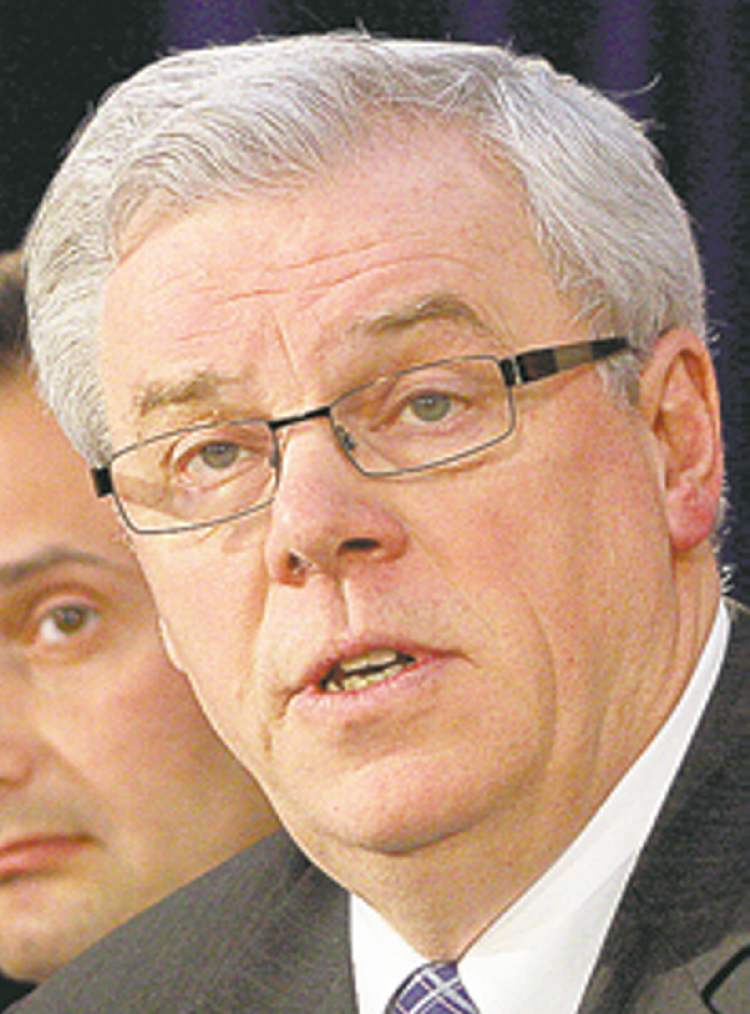
Selinger was also critical of planned changes to Old Age Security pensions, saying it will hurt seniors and put more pressure on provincial treasuries. “We think that being able to retire at 65 with dignity is very important,” he said.
Selinger called Ottawa’s decision to spend $275 million on new schools and literacy programming and other supports to First Nations education “a modest improvement.” But he was disappointed that the money was being spread over three years when the needs on First Nations “are very immediate.”
“It’s not going to have as much impact as we had anticipated,” the premier said, noting there is now a funding gap of $3,500 per student between kids on and off reserve in Canada.
On the federal government’s controversial streamlining of environmental regulations, Selinger took a wait and see approach.
“Provinces have for years been calling on a more efficient process of making environmental decisions so that we can move forward with clean energy projects like Hydro,” he said, adding that Ottawa need not duplicate what provinces are already doing. “As long as (the proposed change) protects the environment and can be more efficient, we would be generally supportive of that.”
At the City of Winnipeg, deputy mayor Justin Swandel (St. Norbert) said he was disappointed by what he described as a weak commitment to municipal infrastructure.
“When it comes to our infrastructure deficit, we’re being hit by $300 million of construction inflation every year. This budget maybe has $3 million for Winnipeg,” said Swandel, placing the city’s total infrastructure deficit at least $3 billion. “If the federal government and provincial governments do not wake up to the fact municipalities can not fix this on their own, this country is going to hell in a handbasket.”
The $3-million figure is Winnipeg’s estimated share of a $150-million kitty for community centre improvements, said city council finance chairman Scott Fielding (St. James). He said the city may also be in line to receive part of a $27-million federal commitment to urban Aboriginal development – and perhaps some cash for sewage-treatment upgrades as part of an unspecified pledge to protect Lake Winnipeg.
Fielding, who is considering a run for the leadership of Manitoba’s Progressive Conservatives, said he was pleased with the federal Tory budget.
“Is it everything we wanted? No, but we think it’s a step in the right direction,” he said.
Fielding and Swandel said it’s unclear whether the federal plan to eliminate the penny will have any effect on jobs at the Royal Canadian Mint in Winnipeg. It’s also unclear how many Winnipeg jobs will be affected by a plan to eliminate approximately 19,000 federal public-service positions, said Robyn Benson, regional executive vice-president for the Public Service Alliance of Canada.
She said her union is more concerned about program cuts such as the $56-million reduction to the Canadian Food Inspection Agency’s budget. “What inspections will not be done?” she mused, speculating food safety could suffer as a result.
In a similar vein, Shauna MacKinnon of the left-of-centre Canadian Centre for Policy Alternatives described Ottawa’s latest spending plan as an “ideologically budget” that makes needless changes to old-age benefits.
“Canada’s greatest success story on the poverty front has been reductions to seniors’ poverty. We are reversing that trend,” she said. The budget also does not do enough Aboriginal education and completely misses an opportunity to alleviate housing shortages, she added.
On the other side of the ideological coin, Winnipeg Chamber of Commerce president Dave Angus said he would have preferred to see more aggressive spending cuts in the budget, along with a more aggressive timetable toward returning to a balanced budget.
“It was definitely a balanced approach,” said Angus, who praised commitments to innovation. “There are pockets within this budget that will be helpful but it’s difficult to judge, because it wasn’t prefaced with a bold vision of what they want to accomplish.”
Derek Nepinak, grand chief of the Assembly of Manitoba Chiefs, said there were some positive initiatives in the budget for aboriginal people.
“I think parts of it could be characterized as goodwill gestures towards addressing some of the substantial issues that we have in Manitoba,” Nepinak said.
larry.kusch@freepress.mb.ca
bartley.kives@freepress.mb.ca

Advertisement Advertise With Us
Advertisement Advertise With Us