

National Research Council cuts deep
Laying off 54 employees, selling buildings on Ellice
Advertisement
Read this article for free:
or
Already have an account? Log in here »
To continue reading, please subscribe:
Digital Subscription
One year of digital access for only $1.44 a week*
- Enjoy unlimited reading on winnipegfreepress.com
- Read the E-Edition, our digital replica newspaper
- Access News Break, our award-winning app
- Play interactive puzzles
*Billed as $5.77 plus GST every four weeks. After 52 weeks, price increases to the regular rate of $19.95 plus GST every four weeks. Offer available to new and qualified returning subscribers only. Cancel any time.
To continue reading, please subscribe:
Add Free Press access to your Brandon Sun subscription for only an additional
$1 for the first 4 weeks*
- Enjoy unlimited reading on winnipegfreepress.com
- Read the E-Edition, our digital replica newspaper
- Access News Break, our award-winning app
- Play interactive puzzles
*Your next Brandon Sun subscription payment will increase by $1.00 and you will be charged $17.95 plus GST for four weeks. After four weeks, your payment will increase to $24.95 plus GST every four weeks.
Read unlimited articles for free today:
or
Already have an account? Log in here »
Hey there, time traveller!
This article was published 18/04/2012 (5177 days ago), so information in it may no longer be current.
The National Research Council has laid off more than a third of its Winnipeg scientific staff and announced its intent to sell both its buildings on Ellice Avenue.
An NRC vice-president was in Winnipeg Monday to announce the layoff of 54 employees and the winding down of magnetic resonance imaging and related technology work that has been ongoing for many years, sources said.
“Facilities at 435 and 445 Ellice will be vacated and are to be sold,” said NRC vice-president Roman Szumski in an announcement sources made available to the Free Press. “Remaining staff will continue to work in the medical-device portfolio, led by general manager Paul Wiebe, and relocated to a new facility in Winnipeg when a suitable location is found.”
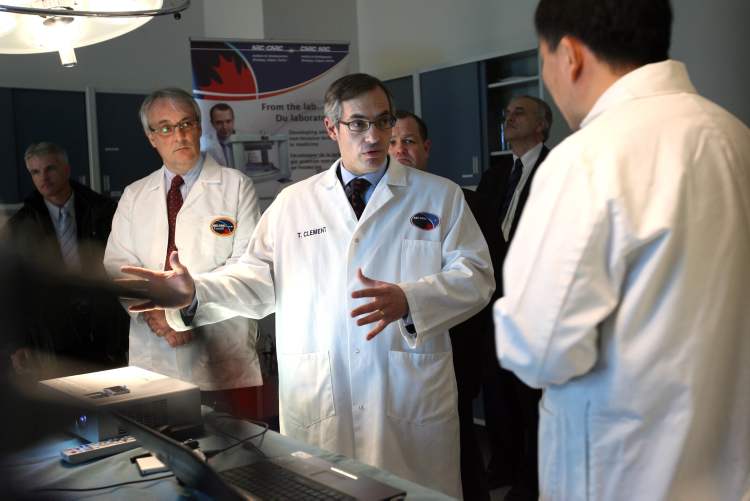
Winnipeg’s NRC operations, known as the Institute for Biodiagnostics, had about 130 employees last September when about 20 positions were eliminated.
A spokesman for the National Research Council in Ottawa would not confirm details Tuesday, but did say “an announcement had been made” at the Winnipeg operation.
The shakeup at the NRC has been expected for some time. Sources said the transformation will mean less pure research and development work and more commercialization.
One Winnipeg executive who works closely with the NRC put it this way: “It will be industrial R and D for hire.”
The NRC decision will be tough for Winnipeg, another technology industry executive said.
“The city is clicking its heels over a water park and IKEA, but this is big stuff. This is a kick in the teeth for the city.”
Sources said the NRC’s Industrial Research Assistance Program (NRC-IRAP) will not be affected by the layoffs. That program provides technical and business advice, financial assistance and access to national and international networks for small and medium-size enterprises.
The NRC’s research in Winnipeg on MRIs produced some significant commercial spinoffs over the years.
Among other things, it was responsible for the development of original technology behind IMRIS Inc., the successful city medical-device company. IMRIS generated about $52 million in revenue last year selling its sophisticated, one-of-a-kind surgical-theatre MRI devices to hospitals around the world.
Ian Smith, the former director general for the NRC in Winnipeg, said last September the NRC’s Winnipeg scientists have been working for several years to develop low-field, high-performance magnetic resonance systems that could sell for one-tenth the cost of conventional MRIs. Tuesday’s announcement would seem to put an end to that project.
“We were expecting big changes, but we didn’t know it would be that big or that quick,” said Gary Brownstone, executive director of The Eureka Project, a business incubator at the University of Manitoba’s Smartpark. “But it sounds consistent with the overall mantra of cost rationalization (at the NRC).”
No one was expecting the NRC would sell its buildings, however. Most of the top floor of the main building, which opened in the early 1990s, is leased to private-sector companies and organizations such as the Information and Communications Technologies Association of Manitoba.
“I guess the NRC did not want to be a landlord,” said one Winnipeg executive who works in the sector.

In 2005, a second building was completed. The 55,000-square-foot structure, about half the size of the older building, was completed at a cost of about $11.2 million.
It houses Biomedical Commercialization Canada, a business incubator, but has never been completely filled.
The NRC shakeup is a significant move, said Tracey Maconachie, executive director of the Life Sciences Association of Manitoba, but he believes it could still work out for the city.
“These changes are going to be challenging, but there could be great opportunities with a more focused approach for Manitoba and Canada as a whole with the work that is being done at the NRC.”
— with files from Melissa Martin martin.cash@freepress.mb.ca