

This oak is old, but 500 years old?
Question marks around stately survivor
Advertisement
Read this article for free:
or
Already have an account? Log in here »
To continue reading, please subscribe:
Digital Subscription
One year of digital access for only $1.44 a week*
- Enjoy unlimited reading on winnipegfreepress.com
- Read the E-Edition, our digital replica newspaper
- Access News Break, our award-winning app
- Play interactive puzzles
*Billed as $5.77 plus GST every four weeks. After 52 weeks, price increases to the regular rate of $19.95 plus GST every four weeks. Offer available to new and qualified returning subscribers only. Cancel any time.
To continue reading, please subscribe:
Add Free Press access to your Brandon Sun subscription for only an additional
$1 for the first 4 weeks*
- Enjoy unlimited reading on winnipegfreepress.com
- Read the E-Edition, our digital replica newspaper
- Access News Break, our award-winning app
- Play interactive puzzles
*Your next Brandon Sun subscription payment will increase by $1.00 and you will be charged $17.95 plus GST for four weeks. After four weeks, your payment will increase to $24.95 plus GST every four weeks.
Read unlimited articles for free today:
or
Already have an account? Log in here »
Hey there, time traveller!
This article was published 27/04/2012 (5146 days ago), so information in it may no longer be current.
SOURIS — No one will know for sure until the old oak tree crashes to the ground, gets chainsawed in half, and someone counts the rings.
Until then, this town will keep boasting it has Manitoba’s oldest tree at 500 years of age.
“Since I’ve been in Souris, they’ve been saying it’s a 500-year-old tree, and I’ve been here since 1958,” said Jim Ludlam, who has been on the local parks board dating back to 1980.
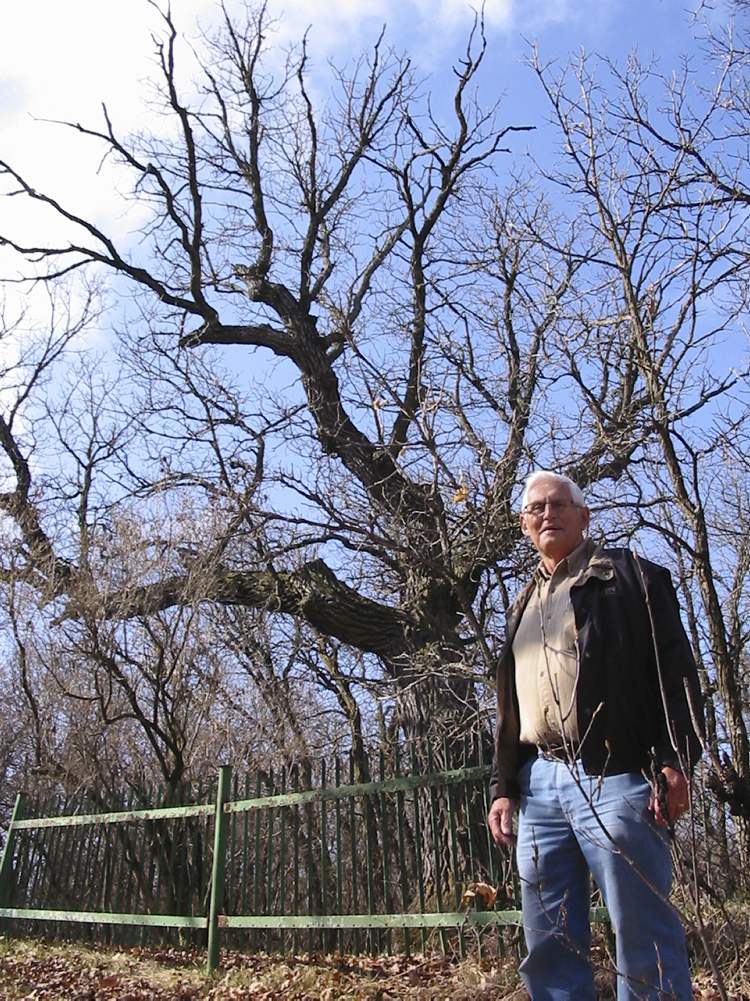
But whether that’s true, “I don’t think anyone really knows,” he said.
The Manitoba Forestry Association says the estimate is anecdotal and based on written documentation. Except no one was keeping those kind of records half a millennium ago, or even 200 years ago. The only way to prove the claim would be to bore a hole into the tree and count the rings. But oak is too hard to make a borehole.
Ken Fosty, now a City of Winnipeg arborist, visited the oak two years ago for the Manitoba Forestry Association. He doubts the oak is over the five-century mark.
“I’d say it’s coming onto 200 years old. That’s as good as it gets in Manitoba. We’re not British Columbia,” where redwoods and sequoias live for 1,000 years, he said.
That would still make it Manitoba’s oldest tree. “I’ve measured spruce trees in the Duck Mountains and they’re about 140 years old,” he said. “It’s a classic Halloween tree, with its big, gnarly branches.”
The old oak tree stands for something else in Manitoba. It’s part of our rich heritage of trees. Manitoba is the only Prairie province with oak trees.
That may explain the fascination early settlers had with oaks. Pioneers named no fewer than 10 towns and villages that still exist in Manitoba after the robust acorn-bearer: Oakbank, Oak Bluff, Oakburn, Oak Lake, Oakland, Oakner, Oak Point, Oak River, and Oakville. Île des Chênes (“Oak Island”) makes 10. You could also throw in Oak Hammock Marsh.
By comparison, Saskatchewan has just one “oak” place name, Oakshela, and it isn’t clear whether the name has anything to do with the tree. (Take that, Roughrider fans. We have more oak trees than you.)
There are 11 species of oak in Canada but Manitoba has only one, the burr oak, said Carol Graham, a former forester with Manitoba Agriculture.
Burr oak is excellent for firewood, producing high BTU levels. It is an extremely hard, strong wood that’s good for making furniture. It’s comparable in appearance to alder wood, a popular wood in cabinetry.
However, there is a learning curve with burr oak.
“It developed a stigma as an erratic wood because it’s a tight-grained wood that can twist and warp. It took people a while to learn to properly dry it so it would stay stable in a finished product,” said Graham.
Bears love acorns. A Pine Falls resident reported having three bears up three different oak trees in his yard at one time last August. Deer will dig through the snow to get last autumn’s acorn harvest. You don’t have to take a poll to find out what squirrels think.
If you should find a stand of oak trees in Canadian Shield country, it may have been planted by humans. Aboriginal people are believed to have planted oak trees to make jewelry from the acorns.

The old oak tree in Souris is nearly on the western limit of the range for oak trees. It’s in the town’s Victoria Park along Plum Creek, where it merges with the Souris River. Oak trees do line the Prairie rivers in Manitoba but are found farther back from the shore because flooding can kill them.
“It’s really nothing to look at,” conceded Ludlam, about the oak tree that is fenced off, and has signage and a trail leading to it.
Most of the trees surrounding the historic oak are younger, second-generations trees. Oak has a thick bark and the old-timer probably survived many fires that killed other trees, said Fosty. “They can survive grass fires. That’s their claim to fame,” he said.
Despite its age, the tree continues to grow, albeit around the middle (not unlike people). The Manitoba Forestry Association recently measured its width at 78 centimetres, up from 74 cm in 1997, and its circumference at 245 cm, an increase from 238 12 years ago.
bill.redekop@freepress.mb.ca