

Vicious cycle
Inadequate nutrition makes working on crops more difficult
Advertisement
Read this article for free:
or
Already have an account? Log in here »
To continue reading, please subscribe:

Digital Subscription
One year of digital access for only $205*
- Enjoy unlimited reading on winnipegfreepress.com
- Read the E-Edition, our digital replica newspaper
- Access News Break, our award-winning app
- Play interactive puzzles
*First annual payment billed as $205.00 + GST for one year. This annual subscription will automatically renew at $233.00 + GST every 52 weeks (10% off the regular annual price of $259.35). Offer available to new and qualified returning subscribers only. Cancel any time.
To continue reading, please subscribe:
Add Free Press access to your Brandon Sun subscription for only an additional
$1 for the first 4 weeks*
- Enjoy unlimited reading on winnipegfreepress.com
- Read the E-Edition, our digital replica newspaper
- Access News Break, our award-winning app
- Play interactive puzzles
*Your next Brandon Sun subscription payment will increase by $1.00 and you will be charged $17.95 plus GST for four weeks. After four weeks, your payment will increase to $24.95 plus GST every four weeks.
Read unlimited articles for free today:
or
Already have an account? Log in here »
Hey there, time traveller!
This article was published 08/05/2012 (5183 days ago), so information in it may no longer be current.
TAMFANOU, Niger — Three years ago, this entire agro-pastoral village in southwestern Niger packed up and moved 15 kilometres deeper into the scrubland.
The traditional way of life — farming millet and sorghum, raising sheep and goats — wasn’t yielding enough food at the old village site for this community of ethnic Gourmantche, a predominantly animist and Christian minority in Niger.
The new location for the village, far from a surface-water source, was rendered habitable by a borehole that served as the town well. The villagers of Tamfanou erected homes and storage huts, planted their fields and tended to their animals.
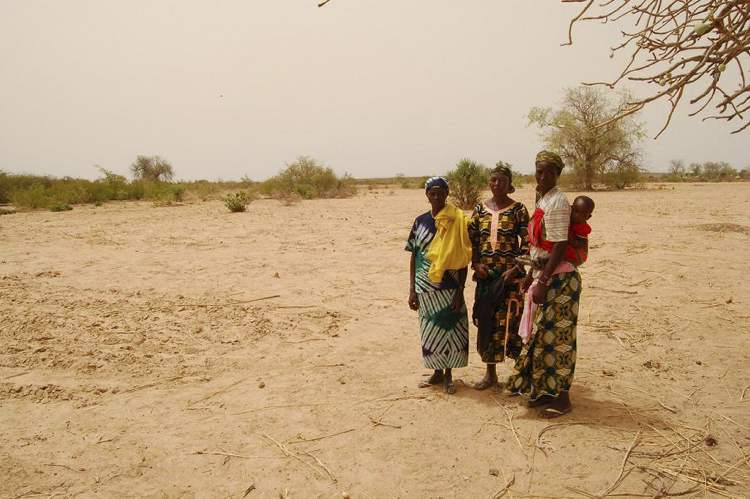
Now the men and women are growing thin, the teenagers aren’t growing tall and infants appear to be suffering from malnutrition.
The move was not to blame. Drought and crop failures in 2011 have placed this village — and others like it in Niger — in a food crisis. The people of Tamfanou are eating one or two meals a day and say they’re in poor physical shape weeks before the expected start of this year’s rainy season, when precipitation-dependent subsistence farmers begin planting.
“The hunger is one of the worst sicknesses you can have. If you are hungry, you cannot produce anything,” mother of seven Yapoa Lalé said through a translator, sitting on chalk-coloured, bone-dry soil below the shade of a tree.
She said her youngest child, Martine, keeps sucking at her breast even though she is unable to produce enough milk to feed the child. “It hurts a lot,” she said. “I am worried about her.”
The cause of this distress is well-known across the Sahel region this year. The Nigerien rainy season, historically about four months long, lasted less than three months in 2011. In villages like Tamfanou, stalks of millet dried up without bearing any grain. Some villages managed partial harvests while others did not bother to collect the barren stalks.
Without millet, the primary staple in Niger, families began selling sheep, goats and chickens to raise money to purchase grain.
Now, some families in Tamfanou have no more animals, which function as living bank accounts in agro-pastoral societies, thanks to their ability to continue yielding meat and eggs.
Other villages are adapting by cutting down trees and hauling the wood to market. This isn’t an option in Tamfanou, as all the valuable trees in the area were cut down before the move, said village leader Dalé Natchem.
He fears the worst if the 2012 crops fail.
“If this situation continues, people are going to die,” he said through a translator.
That may be avoided in Tamfanou, which has already been earmarked for a food and seed aid program by CADEV, a Catholic development and relief organization. The villagers will receive vouchers to purchase fast-growing, high-yield seeds from nearby town of Torodi — as well as food to prevent them from eating the seed before it’s planted.
The hybrid millet plants are supposed to mature in less than three months. The downside is the villagers must continue to purchase the hybrid seed. But according to leading food-security experts, the higher yield should warrant the trade-off.
Getting “more crop per drop” is one of a handful of realistic ways to improve subsistence agriculture in impoverished areas, Marc Andreini of the Water for Food Institute told a sustainability conference in Winnipeg in early May.
But even higher yields and an earlier harvest will not solve all that ails Tamfanou. The rainy season is also known as “the hunger season” because food supplies run thin before harvest — even during a normal year.
The survival margin for the village is already growing uncomfortably thin.

“We don’t have anything and we don’t know what will happen,” said Lalé.
Metres away, a single sheep gobbled up a piece of fruit fallen from a tree.
bartley.kives@freepress.mb.ca
Tamfanou is located near Niakatiré, Niger:
View Larger Map
History
Updated on Tuesday, May 8, 2012 12:15 PM CDT: Adds map.