

Securing food for Niger a risky business
Aid groups must weigh safety, access to remote areas
Advertisement
Read this article for free:
or
Already have an account? Log in here »
To continue reading, please subscribe:
Digital Subscription
One year of digital access for only $75*
- Enjoy unlimited reading on winnipegfreepress.com
- Read the E-Edition, our digital replica newspaper
- Access News Break, our award-winning app
- Play interactive puzzles
*Billed as $5.77 plus GST every four weeks. After 52 weeks, price increases to the regular rate of $19.95 plus GST every four weeks. Offer available to new and qualified returning subscribers only. Cancel any time.
Monthly Digital Subscription
$4.99/week*
- Enjoy unlimited reading on winnipegfreepress.com
- Read the E-Edition, our digital replica newspaper
- Access News Break, our award-winning app
- Play interactive puzzles
*Billed as $19.95 plus GST every four weeks. Cancel any time.
To continue reading, please subscribe:
Add Free Press access to your Brandon Sun subscription for only an additional
$1 for the first 4 weeks*
- Enjoy unlimited reading on winnipegfreepress.com
- Read the E-Edition, our digital replica newspaper
- Access News Break, our award-winning app
- Play interactive puzzles
*Your next Brandon Sun subscription payment will increase by $1.00 and you will be charged $17.95 plus GST for four weeks. After four weeks, your payment will increase to $24.95 plus GST every four weeks.
Read unlimited articles for free today:
or
Already have an account? Log in here »
Hey there, time traveller!
This article was published 09/05/2012 (5124 days ago), so information in it may no longer be current.
YATAKALA, Niger– When the first of three recent droughts hit Niger in 2005, a non-governmental organization called Samaritan’s Purse began working with Djerma and Songhay villagers living near the border with Mali.
This corner of the African nation is among the most marginal farmland in the Sahel region. During the dry season, the sandy soil around villages such as Kalmane and Yatakala is hard to distinguish from the Sahara Desert sands just a few kilometres to the north.
At first, Samaritan’s Purse helped out the villagers by distributing nutritional supplements. When another drought hit in 2009, the NGO began supplying livestock and gardening education to improve food security.
The most recent drought, in 2011, has left the area in need of actual food aid, which has already started flowing.
But there’s a new wrinkle to the relief effort in this corner of the country: A coup and civil war has destabilized neighbouring Mali and increased the danger of travelling to this area from Niamey, Niger’s capital.
The Red Cross is working with approximately 40,000 Malian refugees camped out in Niger around the town of Ayorou. Other aid groups have pulled of the town that sits within earshot of gunfire taking place across the border in Mali, where a shaky coalition of Tuareg rebels and al-Qaeda in the Islamic Maghreb now controls large chunks of sandy real estate.
About 30 kilometres to the south, Samaritan’s Purse is still working in the area — but now must travel with an armed escort.
“None of the other NGOs wanted to come here,” said John Dallmann, the organization’s Africa director. “But if we don’t go, who will?”
The logistics involved in moving sheep, goats and millet to Nigerien villages such as Kalmane and Yatakala were tremendous before war broke out in Mali. It also costs a lot for aid groups to travel to the remote area.
The Malian coup and civil war has only complicated the effort, as Nigerien soldiers are already busy patrolling the roads of its own vast northern territory to protect motorists from roving bandits and try to dissuade Libyan arms dealers, drug smugglers and human traffickers from cutting through the country.
As well, more than a dozen Westerners have been kidnapped across the Sahel in recent years before being killed or held for ransom.
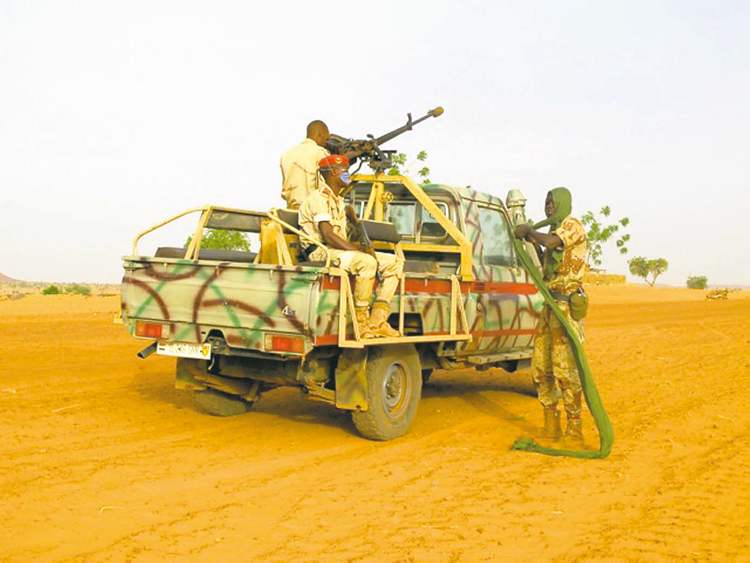
So on a brilliantly sunny Nigerien morning, nine aid workers and one journalist travelling with Samaritan’s Purse between Niamey and Yatakala were escorted by an equally large party of soldiers with Niger’s presidential guard.
NGOs usually employ ordinary gendarmes as soldiers, but instability in the region has led to a shortage of available escorts. Samaritan’s Purse, however, got a 50 per cent discount on the services of two military Toyota pickups — including one with a machine gun mounted on the back — which formed a small but curious-looking convoy with a pair of civilian Land Rovers.
Over the course of a 15-hour day, this unlikely convoy drove along orange dirt roads flanking the Niger River, crashed over small sand dunes and attracted curious stares from ordinary Nigerien townsfolk.
When the convoy stopped to get cold sodas in the city of Tera, the soldiers leapt from their pickups to stand watch at every street corner and alleyway within visual sight — just like elite soldiers do in Hollywood war movies.
Privately, some NGO employees are concerned the security is excessive. Others go the opposite route. The Christian Reformed World Relief Committee, for example, does not allow its employees to even disclose where they are working.
If more relief organizations pull out of Sahelian trouble spots this summer, a potential food crisis could spiral into a famine.
“There are particular groups that don’t want to come to Niger because they can’t go where they want,” said Tchady Harouna, an agro-foresty expert employed by the development agency CADEV.

Along with dangerous areas in the north and west of Niger, there are also concerns in the southeast, where people living in towns such as Diffa fear the terrorist group Boko Haram will cross over from Nigeria, Harouna said.
The violent group, whose name roughly translates into “Western education is wrong,” has used terrorist tactics to foment tensions between Muslims and Christians in Nigeria. The government in neighbouring Niger, where the Muslim majority and Christian minority enjoy very friendly relations, has reportedly apprehended agents of Boko Haram who tried to cross the border.
“There was a time we were afraid. There were people trying to put these sorts of ideas in our minds,” said Harouna, a Muslim working with a Catholic NGO.
“People in Niger do not want this to happen.”
bartley.kives@freepress.mb.ca