

Fortress of food
Bunkers get millet to the masses in an orderly fashion
Advertisement
Read this article for free:
or
Already have an account? Log in here »
To continue reading, please subscribe:

Digital Subscription
One year of digital access for only $205*
- Enjoy unlimited reading on winnipegfreepress.com
- Read the E-Edition, our digital replica newspaper
- Access News Break, our award-winning app
- Play interactive puzzles
*First annual payment billed as $205.00 + GST for one year. This annual subscription will automatically renew at $233.00 + GST every 52 weeks (10% off the regular annual price of $259.35). Offer available to new and qualified returning subscribers only. Cancel any time.
To continue reading, please subscribe:
Add Free Press access to your Brandon Sun subscription for only an additional
$1 for the first 4 weeks*
- Enjoy unlimited reading on winnipegfreepress.com
- Read the E-Edition, our digital replica newspaper
- Access News Break, our award-winning app
- Play interactive puzzles
*Your next Brandon Sun subscription payment will increase by $1.00 and you will be charged $17.95 plus GST for four weeks. After four weeks, your payment will increase to $24.95 plus GST every four weeks.
Read unlimited articles for free today:
or
Already have an account? Log in here »
Hey there, time traveller!
This article was published 11/05/2012 (5183 days ago), so information in it may no longer be current.
TORODI COMMUNE, Niger — In a village of adobe-style mud-brick houses, thatched-straw storage huts and thorn-bush fences, a concrete bunker with locking metal doors looks out of place.
But this structure and dozens like it across Niger may be the most important buildings in the African nation in the coming months. Behind the metal doors sit stacks of 100-kilogram bags of millet, the staple food of the Nigerien diet — and the crop that failed most spectacularly during the drought of 2011.
Over the past two weeks, development and relief organizations have begun distributing millet in villages across Niger, where roughly 80 per cent of the population relies on subsistence agriculture to survive.

There is more than enough food in Niger to feed the entire population of 16 million. The issue is the cost of millet, cowpeas, cooking oil and other staples have soared beyond the means of most ordinary villagers.
“There’s always plenty of food around during a famine. The issue is access to that food,” said Jim Cornelius, executive director of the Canadian Foodgrains Bank, a Winnipeg-based organization that uses a $20.8-million annual federal grant and $11 million worth of donations to help fund food programs run by other organizations.
The situation in Niger will not become an outright famine if non-governmental organizations can distribute food that’s already in the region, Cornelius said.
The days of actually shipping grain across the Atlantic Ocean — an inefficient, expensive practice that distorted grain markets in Africa — have given way to using donations to purchase food aid as close as possible to the recipients of that aid.
In Niger, some of the food is simply given to villagers identified as vulnerable by other people in their communities. Some is sold at a subsidized price, while some is handed out in exchange for environmental remediation work such as digging shallow holes to capture more rain water.
When the food has been shipped to storage bunkers, workers do not just show up in villages and start doling out buckets of the millet. The process is a lot more orderly than westerners may expect.
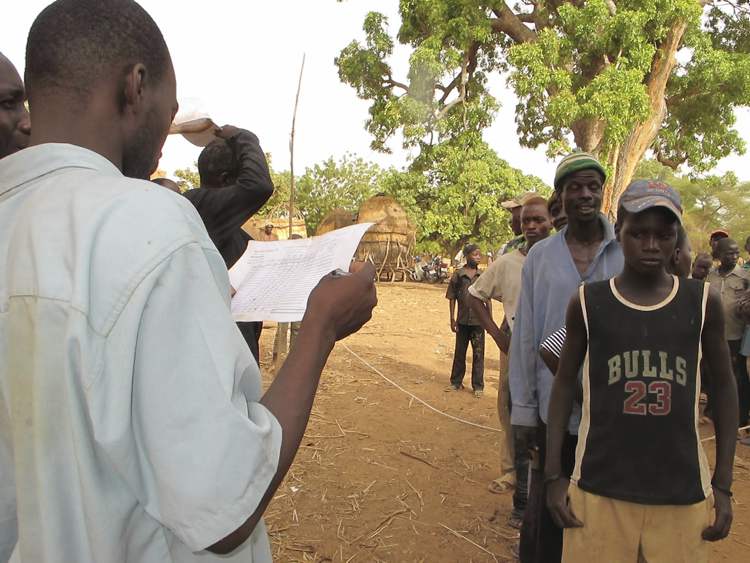
Earlier this week at a small village near the border with Burkina Faso, a distribution day began with a group of mostly young men lining up in the afternoon heat outside a concrete bunker where millet is stored.
Then a representative of an international aid organization — it will remain anonymous for security reasons — stood up to address the crowd.
“Farmers in Canada have heard of the trouble you are experiencing and are distributing food to Nigerien farmers,” said an American employed by one of the organizations funded by the Canadian Foodgrains Bank. Many of its donors are from rural areas of Ontario, Manitoba, Saskatchewan and Alberta.
After a translator repeats this message in Djerma, the tribal language in this region, murmurs of approval rise from the crowd.
The aid recipients then line up to check their names against a pre-approved list of beneficiaries. Digital photos are taken to record their identities, as few people in rural Niger have birth certificates or ID cards of any sort.
Then two men hoist a bag of millet about 15 metres to a waiting donkey wagon or motorcycle and drive off with a sack intended to feed a family for a month.
The mobilization for this food-distribution program dates back to October, when farmers reported widespread millet-crop failures due to drought and in some areas, locusts.
In December, harvest statistics confirmed widespread food shortages in Niger. Then meetings were held with community leaders in January before aid organizations decided to pursue the plan.
“To be honest, we don’t like doing any relief. It takes time and money and it stops development work,” said one Niamey-based NGO administrator, again requesting anonymity due to the potential for kidnapping.
The increasing need for food aid in a region where marginal farmland has proven even more marginal in recent years raises an even bigger question, she said.
“If it’s not sustainable for people to live off the land here, then is it wise to keep allowing them to do so?”

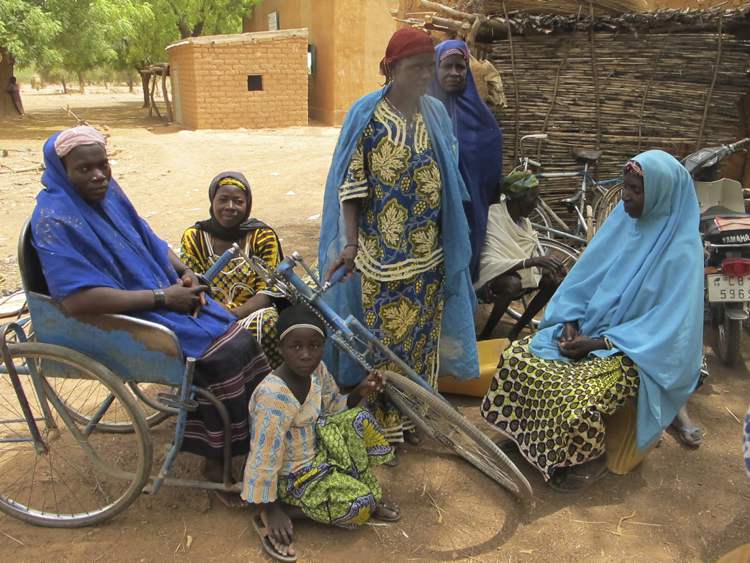
The alternative, however, would mean widespread social upheaval and quite likely deaths due to malnutrition and disease. Across Niger, people living in villages that receive food aid say the programs have prevented men from leaving in search of income for their hungry families.
“The men are still here,” said Adiza Boulkadri, a small, slender woman living in the Songhay village of Yatakala, near the border with Mali.
Until a month’s worth of millet arrived last week, her family of 13 got by on a thin porridge of millet water. Their food aid is now gone, as they shared it with neighbours who were less vulnerable but still hungry. It will be three more weeks until they get another bag.
“I’m always frustrated, but I have no choice. I have nothing,” she said.
bartley.kives@freepress.mb.ca