

Rescue helicopter a flying ICU
Advertisement
Read this article for free:
or
Already have an account? Log in here »
To continue reading, please subscribe:
Monthly Digital Subscription
$1 per week for 24 weeks*
- Enjoy unlimited reading on winnipegfreepress.com
- Read the E-Edition, our digital replica newspaper
- Access News Break, our award-winning app
- Play interactive puzzles
*Billed as $4.00 plus GST every four weeks. After 24 weeks, price increases to the regular rate of $19.95 plus GST every four weeks. Offer available to new and qualified returning subscribers only. Cancel any time.
Monthly Digital Subscription
$4.99/week*
- Enjoy unlimited reading on winnipegfreepress.com
- Read the E-Edition, our digital replica newspaper
- Access News Break, our award-winning app
- Play interactive puzzles
*Billed as $19.95 plus GST every four weeks. Cancel any time.
To continue reading, please subscribe:
Add Free Press access to your Brandon Sun subscription for only an additional
$1 for the first 4 weeks*
*Your next subscription payment will increase by $1.00 and you will be charged $16.99 plus GST for four weeks. After four weeks, your payment will increase to $23.99 plus GST every four weeks.
Read unlimited articles for free today:
or
Already have an account? Log in here »
Hey there, time traveller!
This article was published 19/06/2012 (5019 days ago), so information in it may no longer be current.
There’s a bright red flying intensive care unit in Manitoba.
The STARS (Shock Trauma Air Rescue Society) air ambulance helicopter has barely enough room for members of its medical team to keep their knees from banging the patient’s stretcher. But that highly-trained medical staff regularly overcomes the space challenges to offer speed and precision care, having responded to over 300 patient calls in Manitoba since April 2011.
“We’ve just brought the emergency room into the air, and bring it straight to the patient on the ground, on the side of the road, in the backyard, wherever they may be,” said flight nurse Rhonda Kaluzny.
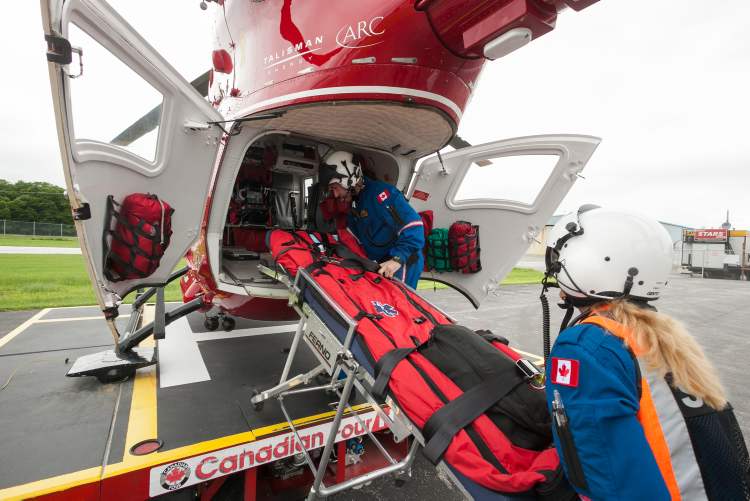
STARS is a non-profit air ambulance service with its headquarters in Alberta. The recent Winnipeg addition is based just west of the airport and has signed on to serve Manitoba until 2022.
The back compartment of the Eurocopter BK117 is about the length of a traditional ambulance, and half the width.
Jam-packed with specialized equipment hanging from the ceiling and built into the walls, there is just enough room for a patient on a stretcher and up to three medical staff team members to sit, stooped on tiny benches.
Besides the cramped workspace, the responding teams have to handle flight motion, vibration and communication issues while wearing flight helmets.
Kaluzny and flight paramedic Grant Therrien are trained in critical care response, which means they are able to complete advanced procedures such as intubation to open a patient’s airway, or injecting drugs usually available only in an emergency room.
They can do all this in a tilting helicopter while strapped into a seat.
“The biggest challenge is when a patient deteriorates and you’re in the back reaching for equipment and you’re just doing your best to keep that patient alive until you get to the hospital,” said Therrien.
Kaluzny is still nervous every time a call comes in to the team.
“It’s hard enough to get an IV into a vein correctly in an emergency room,” she said.
That common, but delicate, procedure is difficult in the tight space and motion of a flying helicopter.
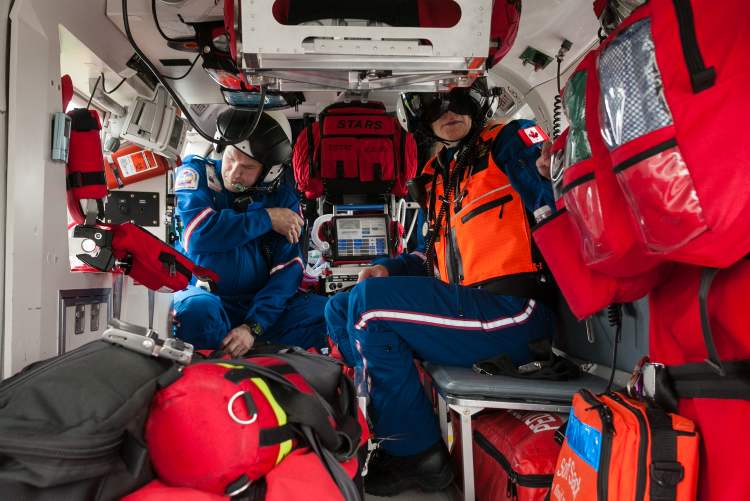
That is why the STARS medical staff goes through specialized training during which the cramped quarters and vibration are simulated.

The air ambulance is “a link in the chain in medical response,” but it’s the speed and the specialized level of care that separates the helicopter ambulance from traditional transport, Therrien said.
In Canada, up to 70 per cent of trauma deaths are in rural areas. While the population is lower in rural Manitoba, many of the calls STARS responds to are people travelling to or from urban areas, said base director Jon Gogan.
For the medical team — who work 12-hour shifts on base — the realization that their speed in responses has made a difference in patient’s survival is hugely rewarding.
On one call, said Kaluzny, there was so little time between arrival and treatment the team was removing their equipment from a patient while operating room staff prepped the patient for surgery.
“You just never know what’s going to happen, so it makes every call exciting.”