

Former quarry a hidden gem
Gravel family proves mining isn't a millstone
Advertisement
Read this article for free:
or
Already have an account? Log in here »
To continue reading, please subscribe:

Digital Subscription
One year of digital access for only $205*
- Enjoy unlimited reading on winnipegfreepress.com
- Read the E-Edition, our digital replica newspaper
- Access News Break, our award-winning app
- Play interactive puzzles
*First annual payment billed as $205.00 + GST for one year. This annual subscription will automatically renew at $233.00 + GST every 52 weeks (10% off the regular annual price of $259.35). Offer available to new and qualified returning subscribers only. Cancel any time.
To continue reading, please subscribe:
Add Free Press access to your Brandon Sun subscription for only an additional
$1 for the first 4 weeks*
- Enjoy unlimited reading on winnipegfreepress.com
- Read the E-Edition, our digital replica newspaper
- Access News Break, our award-winning app
- Play interactive puzzles
*Your next Brandon Sun subscription payment will increase by $1.00 and you will be charged $17.95 plus GST for four weeks. After four weeks, your payment will increase to $24.95 plus GST every four weeks.
Read unlimited articles for free today:
or
Already have an account? Log in here »
Hey there, time traveller!
This article was published 27/07/2012 (5163 days ago), so information in it may no longer be current.
BIRDS HILL — It’s East St. Paul gold, or so people used to call it.
The gravel business led to settlement of this rural municipality on the northeast flank of Winnipeg.
CP Rail first dug the quarry at Birds Hill in the 1870s to provide ballast for the transcontinental railway. The City of Winnipeg purchased the quarry later and used the gravel for everything from building roads and house foundations to filling sandbags. Hundreds of people were employed in the quarry at one time.
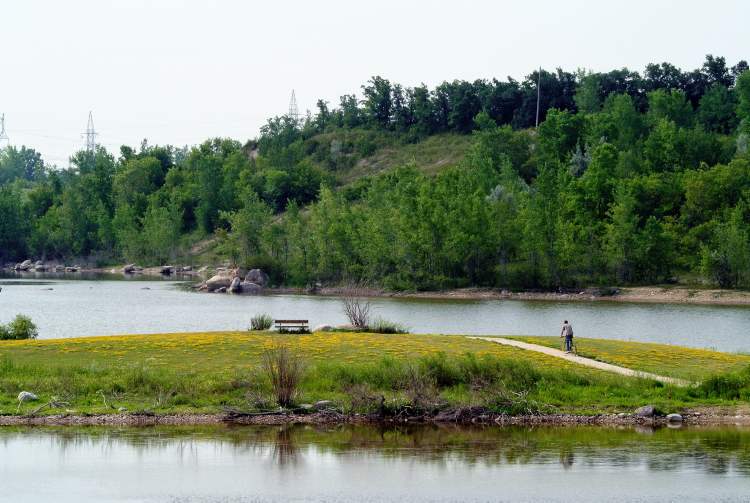
The Swistun family came later, purchasing the quarry in 1960 and operating it as Birds Hill Gravel and Stone Ltd. But Swistun brothers Bill and Don had a vision for the quarry after its operational life came to an end.
“Their vision was that you could prove to people mining doesn’t have to be a negative thing. It can be a positive thing if done right,” said Bill Swistun’s son Michael.
The brothers wanted to make the old quarry into a park. Actually, they wanted it to be more like a habitat showpiece for the community. In the mid-1980s, the family started rehabilitating the site. They sloped and stabilized cliffs, made bike and walking paths and planted trees on the north bank (the south bank maintained its natural growth). Then the family turned the park over to the municipality. The RM only pays for maintenance.
Today, Silver Springs Park is one of those hidden gems, little known outside the small community of East St. Paul.
“It’s a habitat-reclamation project,” said Van Whitehead, whose house borders one end of the park. Whitehead took the Free Press on a bike tour of the park. “People in East St. Paul are well aware of it. I don’t think it’s known much outside the municipality.”
Actually, thousands of people drive by the rear of Silver Springs Park every day on Highway 59, between Springhill Ski Park and Birds Hill Provincial Park, and never know it. It’s only recognizable from the highway by a bead of boulders strung across the rise on the west side.
Real estate development didn’t become the main industry in East St. Paul until the first new subdivision in 1979. Before that, the RM relied on the gravel industry, fur ranches (silver fox), market gardening plus the Imperial Oil refinery, which has since moved — although its site on Henderson Highway still provides tank storage.
The quarry was dug out of one of the largest hills in the area. The terrain here was formed by a glacial esker, when gravel in the form of fluvial sediments was deposited by a river inside a glacier. Today, Garven Road virtually follows the path of that old glacial river, Swistun said.
The park is a vast space. The excavation site is about 73 hectares and the south bank is 21 metres deep. That big empty space used to be gravel — more than 20 million tonnes — before the material ended up in our roads. Being close to the city, the quarry helped keep construction costs low.
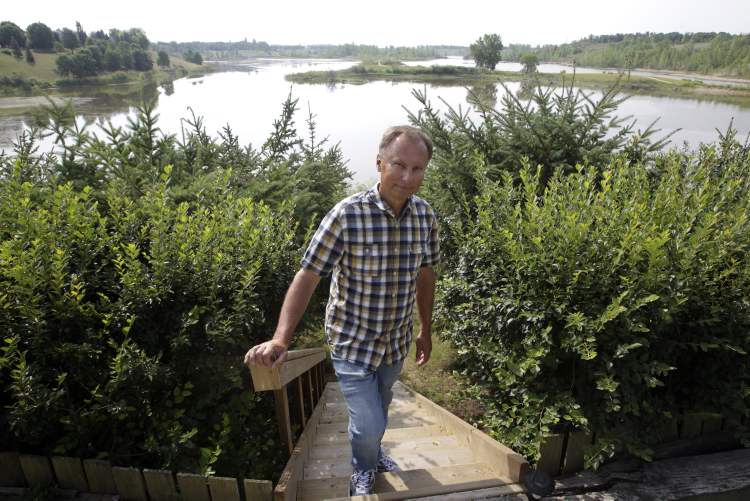
The park is also a staging area for both the Trans Canada Trail, which runs through it, and the floodway’s non-motorized recreation trail, called the Duff Roblin Parkway Trail. At the end of Garven Road on the west side of the floodway, there’s about a 40-car parking lot for people wanting to get on the floodway trail, which includes a bridge into Birds Hill Provincial Park.

“You have a lot of people who say mining is destructive, but if you want to have a modern society, you have to have mining,” said Swistun.
The Swistuns levelled the quarry bottom and sloped the sides so they wouldn’t be a danger. They had topsoil hauled into the quarry and planted native grasses and more than 1,200 trees and shrubs. They also built a causeway to an island on the lake. Inland Aggregates assisted with the rehabilitation. It started to look like a park by the 1990s. There was never a grand opening. It just slowly evolved.
People also canoe and kayak on the lake. The vegetation is an oak-aspen mix, including pin cherry and chokecherry bushes, and even horsetail, a plant species 100 million years old. There are plenty of birds, including geese and sandpipers.
The south slope is a popular tobogganing site in winter. The municipality also clears an ice-skating trail. Visitors can park along Birds Hill Road, near Neyedli Drive.
bill.redekop@freepress.mb.ca