

Plan sees CP yards as rail estate
Douglas Village would redraw map
Advertisement
Read this article for free:
or
Already have an account? Log in here »
To continue reading, please subscribe:

Digital Subscription
One year of digital access for only $205*
- Enjoy unlimited reading on winnipegfreepress.com
- Read the E-Edition, our digital replica newspaper
- Access News Break, our award-winning app
- Play interactive puzzles
*First annual payment billed as $205.00 + GST for one year. This annual subscription will automatically renew at $233.00 + GST every 52 weeks (10% off the regular annual price of $259.35). Offer available to new and qualified returning subscribers only. Cancel any time.
To continue reading, please subscribe:
Add Free Press access to your Brandon Sun subscription for only an additional
$1 for the first 4 weeks*
- Enjoy unlimited reading on winnipegfreepress.com
- Read the E-Edition, our digital replica newspaper
- Access News Break, our award-winning app
- Play interactive puzzles
*Your next Brandon Sun subscription payment will increase by $1.00 and you will be charged $17.95 plus GST for four weeks. After four weeks, your payment will increase to $24.95 plus GST every four weeks.
Read unlimited articles for free today:
or
Already have an account? Log in here »
Hey there, time traveller!
This article was published 30/07/2012 (5167 days ago), so information in it may no longer be current.
The tracks that divide Winnipeg could become a ribbon of parkland and trails that form the backbone of an innovative new neighbourhood for 8,000 people.
Douglas Village is a conceptual design created last year by University of Manitoba graduate Don Reimer as part of his professional architecture degree coursework through the Royal Architectural Institute of Canada. Reimer’s work is the first detailed plan for what the 86-hectare marshalling yards could be if the land was available for redevelopment.
“I think Winnipeg is viewed as a city without a vision,” said Reimer, who works full-time for Nejmark Architect in Winnipeg. “We do things because we like things that are economically sound right now without necessarily thinking of the future. But there are times when we surprise everyone, with The Forks, for example.”
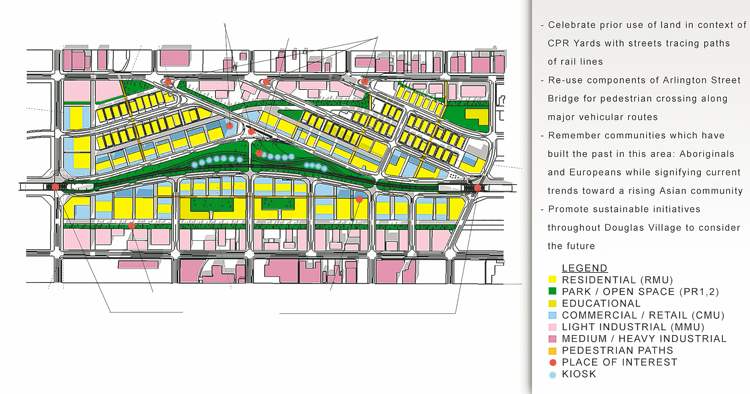
Reimer envisions a compact, dense neighbourhood where services such as doctors’ offices, shops and schools are within walking distance and where middle- and upper-class homes are nestled in with affordable units of all types — co-ops, row houses, apartment buildings, seniors units and more traditional single-family houses.
Reimer used the tracks as the spine of the design, creating a central pedestrian path and through roads that mirror the curve of the existing tracks. Parts of the iconic Arlington Bridge, now 100 years old, could be reused in new pedestrian crossings and plentiful public art would remind visitors of the land’s 130-year history as a major railway transportation hub.
Light industrial businesses would be located around the periphery of the yards, buffered by a strip of green space, and commercial and residential development would be located in the core of the neighbourhood.
The design even includes land for community gardens, a railway museum, a restaurant district, a hotel and daycares co-located with schools.
The CP main line presents one of the biggest challenges to redevelopment. Relocating it likely means moving several spur lines, and involves far more money and hassle than the already-mammoth task of moving the railway yards. Leaving the main line in place, though, means the city would still need to spend money on a series of underpasses and bridges.
Reimer suggests putting the main line underground, an admittedly large undertaking.
Since trains are the historic life of the city, another option, said Richard Milgrom, city planning professor at the University of Manitoba, could be leaving it in place and building around it, like Toronto when it developed the mixed-income neighbourhood near the St. Lawrence Market next to the Via Rail line.
Key to redeveloping the yards, especially in a slow-growth city where suburban development has historically eclipsed new projects in the core, is ensuring a new neighbourhood contributes to what’s already on either side. That includes historic Selkirk Avenue, which is already struggling to keep businesses and could be further cannibalized by another nearby commercial district.
“Planners need to consider not just what’s on the rail yard but what’s beyond that, how these things blend together,” Milgrom said. “How are we improving existing neighbourhoods by building on this land?”
maryagnes.welch@freepress.mb.ca
RETHINKING THE RAIL YARDS
IT’S a huge parcel of land — 195 hectares, including the Weston Shops — and redeveloping them could transform the city.
What would you like to see built there? Housing? Shops? Community gardens? A water park?

Come to the Free Press News Café and get creative. You’ll have a chance to discuss the issue, hear from some experts and even sketch the outline of a new neighbourhood. You can start now by downloading a map of the area posted on our website.
When: Tuesday, July 31, 6 p.m.
Where: Free Press News Café, 237 McDermot Ave. in the Exchange District.
Who: Everyone. University of Manitoba city planning Prof. Richard Milgrom and Social Planning Council of Winnipeg executive director Dennis Lewycky will kick off the discussion.
More information: wfp.to/offtherails