

Second bike fatality this year prompts calls for review
Advertisement
Read this article for free:
or
Already have an account? Log in here »
To continue reading, please subscribe:
Digital Subscription
One year of digital access for only $1.44 a week*
- Enjoy unlimited reading on winnipegfreepress.com
- Read the E-Edition, our digital replica newspaper
- Access News Break, our award-winning app
- Play interactive puzzles
*Billed as $5.77 plus GST every four weeks. After 52 weeks, price increases to the regular rate of $19.95 plus GST every four weeks. Offer available to new and qualified returning subscribers only. Cancel any time.
To continue reading, please subscribe:
Add Free Press access to your Brandon Sun subscription for only an additional
$1 for the first 4 weeks*
- Enjoy unlimited reading on winnipegfreepress.com
- Read the E-Edition, our digital replica newspaper
- Access News Break, our award-winning app
- Play interactive puzzles
*Your next Brandon Sun subscription payment will increase by $1.00 and you will be charged $17.95 plus GST for four weeks. After four weeks, your payment will increase to $24.95 plus GST every four weeks.
Read unlimited articles for free today:
or
Already have an account? Log in here »
Hey there, time traveller!
This article was published 31/08/2012 (5164 days ago), so information in it may no longer be current.
The death of a 68-year-old man has sparked calls for a review of all cycling fatalities to improve road safety.
On Wednesday, a cyclist and car collided near York Avenue and Main Street. The cyclist was taken to hospital in critical condition and later died. Police said early indications show the man was not wearing a helmet.
He’s the second cyclist killed on city streets this year. Thirty-five-year-old Violet Nelson was killed on May 23 when she collided with a vehicle and fell into the path of a semi-trailer at Main Street and Higgins Avenue.
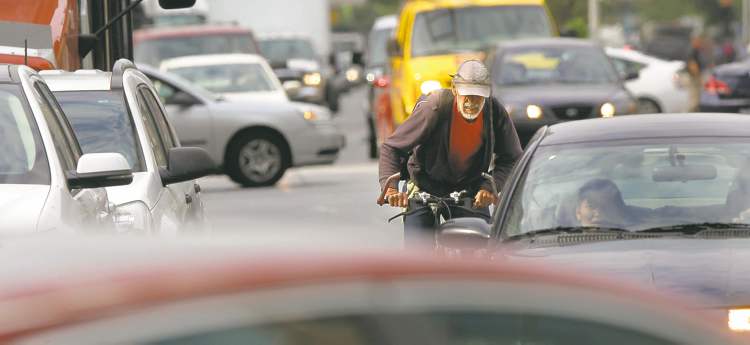
Since 2009, seven cyclists have died on Winnipeg roads.
Bike to the Future co-chairman Tom McMahon said Ontario’s chief coroner recently reviewed all cycling deaths and issued recommendations to improve public safety. He said a similar review in Manitoba could identify what caused the accidents, and whether things such as extending the paved shoulder or adding separated bike lanes could prevent injuries and deaths.
"I think it is useful and timely and important for the appropriate authority — whoever that may be — to examine what is happening. Not just fatalities but also serious injuries," McMahon said.
On average, two cyclists were killed every year from 2005 to 2010 in Manitoba. Another 220 were hurt, Manitoba Public Insurance said.
At the same time, more Winnipeggers are travelling by bike. Recent statistics compiled by Bike to the Future estimate there are close to 13,000 people travelling by bike in and out of downtown on a given day — about 47 per cent more people than in 2011.
Winnipeg police central traffic unit Staff Sgt. Rob Riffel said the number of fatal collisions involving cyclists has remained steady in the past few years. He said motorists and cyclists need to be aware they both have to share the road since anyone on a bike is likely to be seriously hurt during a collision.
"It’s just people being careless at inopportune times," Riffel said. "When you pit a cyclist against a vehicle, the vehicle is going to win."
City of Winnipeg officials said in a statement they wait for police to complete an investigation to see if any traffic-related factors contributed to a fatal collision. If so, city officials will follow up to see what improvements can be made.
For example, the city changed the pedestrian corridor at Osborne Street at Wardlaw Avenue following a number of collisions.
MPI spokesman Brian Smiley said the public insurer has partnered with local cycling groups to educate cyclists on how to make themselves visible to vehicles, the importance of helmet use and existing traffic laws. Smiley said MPI will host workshops to train cyclists on how to avoid road hazards.
He said motorists have to be patient and not squeeze by cyclists. In turn, he said cyclists have to know how to keep themselves safe.
"We know in many situations some cyclists may not be that road savvy or anticipate a potentially dangerous situation," Smiley said.
Earlier this year, the province introduced legislation that requires children under 18 to wear helmets. Adults are still exempt, but some avid cyclists such as Winnipeg Cycling Club member Henry Shorr believes that should change since head injuries can be "catastrophic."

The group plans rides within Winnipeg and outside the city, and mandates that everyone on the rides wear a helmet, Shorr said. He said some bike lanes end suddenly and much of their rides end up being on city streets since the path system is not well-developed.
"I think the city needs to do a better job of building bike paths and room for dedicated lanes for cyclists," Shorr said.
McMahon said motorists need to be better educated about what to do when they encounter a cyclist on the road or see special markings for bike lanes. He said many drivers still squeeze by cyclists instead of changing lanes, and other jurisdictions have stipulated vehicles need to give cyclists at least one metre of space when passing.
"I think we all need (safety) reminders," McMahon said. "The cyclist has a right to be on the road and feel safe."
jen.skerritt@freepress.mb.ca
Deadly cyclist collisions in Winnipeg, 2009 - 2012
History
Updated on Friday, August 31, 2012 11:09 AM CDT: Adds map
Updated on Saturday, September 1, 2012 4:06 PM CDT: corrects name of cyclist