

Film shows death of a First Nation
Ex-Lake St. Martin residents reveal woe

Advertisement
Read this article for free:
or
Already have an account? Log in here »
To continue reading, please subscribe:
Digital Subscription
One year of digital access for only $1.44 a week*
- Enjoy unlimited reading on winnipegfreepress.com
- Read the E-Edition, our digital replica newspaper
- Access News Break, our award-winning app
- Play interactive puzzles
*Billed as $5.77 plus GST every four weeks. After 52 weeks, price increases to the regular rate of $19.95 plus GST every four weeks. Offer available to new and qualified returning subscribers only. Cancel any time.
To continue reading, please subscribe:
Add Free Press access to your Brandon Sun subscription for only an additional
$1 for the first 4 weeks*
- Enjoy unlimited reading on winnipegfreepress.com
- Read the E-Edition, our digital replica newspaper
- Access News Break, our award-winning app
- Play interactive puzzles
*Your next Brandon Sun subscription payment will increase by $1.00 and you will be charged $17.95 plus GST for four weeks. After four weeks, your payment will increase to $24.95 plus GST every four weeks.
Read unlimited articles for free today:
or
Already have an account? Log in here »
Hey there, time traveller!
This article was published 10/10/2012 (5124 days ago), so information in it may no longer be current.
The film Flooding Hope: the Lake St. Martin First Nation Story releases a flood of emotion in folks who see it, says its writer and director, who grew up there.
“Some of them cried,” said Myrle Ballard, who’s shown the film to provincial officials and film-festival patrons. Her 20-minute requiem shows her community slowly washed away as decades of flood-fighting measures protecting farms, cities and cottages left Lake St. Martin residents in the drink.
“It’s to create awareness,” said Ballard, who just finished her PhD in natural resources and environmental management.
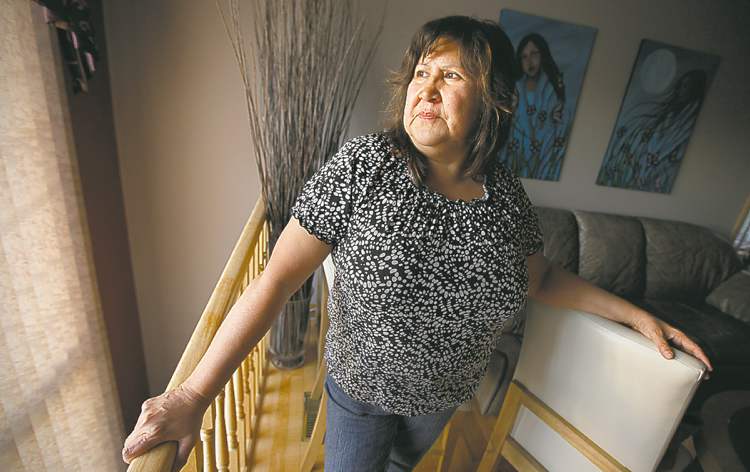
“People don’t know about what’s happening in their own backyard,” said Ballard, who witnessed the gradual drowning of her First Nation’s land base.
She’s showing the film this week at a biodiversity conference in Hyderabad, India, then sharing it with the rest of the world on the Internet.
“I’ve been documenting the stories and gathering information for the past 15 years about what’s been happening regarding the flooding downstream from the Fairford Dam.”
The film, created with the Natural Resources Institute at the University of Manitoba, shows how years of water management projects such as the dam and the Portage Diversion have affected the place and its people.
“In some years, the water would come close to the house when I was growing up.”
She remembers cattle grazing on the First Nation’s hay fields. “The landscape has completely changed,” she said. “Cattle couldn’t graze or even walk there. It’s all marsh now.”
A channel built in 2011 under emergency measures legislation that required no consultation or environmental assessment was the “last nail” in the community’s coffin, the film said. The flood of May 2011 destroyed their homes and their fishery. The community was permanently evacuated. More than a year later, 56 people are in hotels, 951 are in private accommodations and 41 Lake St. Martin evacuees have moved to the provincial evacuation site at a former radar base near Gypsumville.
On short notice, the evacuees left with no idea they’d be gone for good or their homes and everything in them would be wrecked.
“I wasn’t ready,” said one sobbing evacuee in the film.
Farmers, businesses and cottagers have received compensation but the First Nations people who lost everything remain in limbo, the film shows.
“We’re like refugees,” said one displaced resident. Living in hotels in the city for months has taken a toll, said another. “It’s not a holiday anymore… It’s very lonely and depressing.”
Seeing their devastated land base after the floodwaters receded from the First Nation was the worst, say elders in the film.

“How it hurts,” said one woman, sobbing like it’s a visceral, physical pain. “It hurts. I want to cry all the time.”
They’re caught between the federal government, which has a fiduciary responsibility for First Nations, and the province, whose water management hurt their First Nation.
Lake St. Martin leaders and elders want to build a sustainable community on higher ground between Grahamdale and Moosehorn on Highway 6, Ballard said in an interview. Instead, the province has spent $40 million on the abandoned radar base near Gypsumville to provide housing, she said. There’s nothing in the way of infrastructure there and it isn’t a suitable or sustainable land base, she said. When First Nations people complain, however, they’re portrayed as ungrateful malcontents, Ballard said.
“We didn’t create this problem.”
carol.sanders@freepress.mb.ca
Carol Sanders
Legislature reporter
Carol Sanders is a reporter at the Free Press legislature bureau. The former general assignment reporter and copy editor joined the paper in 1997. Read more about Carol.
Every piece of reporting Carol produces is reviewed by an editing team before it is posted online or published in print — part of the Free Press‘s tradition, since 1872, of producing reliable independent journalism. Read more about Free Press’s history and mandate, and learn how our newsroom operates.
Our newsroom depends on a growing audience of readers to power our journalism. If you are not a paid reader, please consider becoming a subscriber.
Our newsroom depends on its audience of readers to power our journalism. Thank you for your support.
Carol Sanders
Legislature reporter
Carol Sanders is a reporter at the Free Press legislature bureau. The former general assignment reporter and copy editor joined the paper in 1997. Read more about Carol.
Every piece of reporting Carol produces is reviewed by an editing team before it is posted online or published in print — part of the Free Press‘s tradition, since 1872, of producing reliable independent journalism. Read more about Free Press’s history and mandate, and learn how our newsroom operates.
Our newsroom depends on a growing audience of readers to power our journalism. If you are not a paid reader, please consider becoming a subscriber.
Our newsroom depends on its audience of readers to power our journalism. Thank you for your support.
Advertisement Advertise With Us
Advertisement Advertise With Us