

Valour Road Victoria Cross medals find new home at war museum
Advertisement
Read this article for free:
or
Already have an account? Log in here »
To continue reading, please subscribe:

Digital Subscription
One year of digital access for only $205*
- Enjoy unlimited reading on winnipegfreepress.com
- Read the E-Edition, our digital replica newspaper
- Access News Break, our award-winning app
- Play interactive puzzles
*First annual payment billed as $205.00 + GST for one year. This annual subscription will automatically renew at $233.00 + GST every 52 weeks (10% off the regular annual price of $259.35). Offer available to new and qualified returning subscribers only. Cancel any time.
To continue reading, please subscribe:
Add Free Press access to your Brandon Sun subscription for only an additional
$1 for the first 4 weeks*
- Enjoy unlimited reading on winnipegfreepress.com
- Read the E-Edition, our digital replica newspaper
- Access News Break, our award-winning app
- Play interactive puzzles
*Your next Brandon Sun subscription payment will increase by $1.00 and you will be charged $17.95 plus GST for four weeks. After four weeks, your payment will increase to $24.95 plus GST every four weeks.
Read unlimited articles for free today:
or
Already have an account? Log in here »
Hey there, time traveller!
This article was published 05/11/2012 (5078 days ago), so information in it may no longer be current.
A collection of all three Victoria Cross medals awarded during the First World War to residents of Winnipeg’s Pine Street, later renamed Valour Road, was unveiled today at the Canadian War Museum.
This collection was completed with the recent acquisition of the medal awarded in 1915 to Company Sergeant Major Frederick William Hall. The War Museum in Ottawa acquired the Valour Road Victoria Crosses of Lieutenant Robert Shankland and Corporal Lionel B. Clarke in 2009 and 2010 respectively.
Only 96 Victoria Crosses were awarded to Canadians in the medal’s 156-year history, making this coincidence exceptional. With the acquisition of the Hall Victoria Cross, the Canadian War Museum now has 33 Victoria Crosses in its collection, including one from the nineteenth century, 28 from the First World War and four from the Second World War.
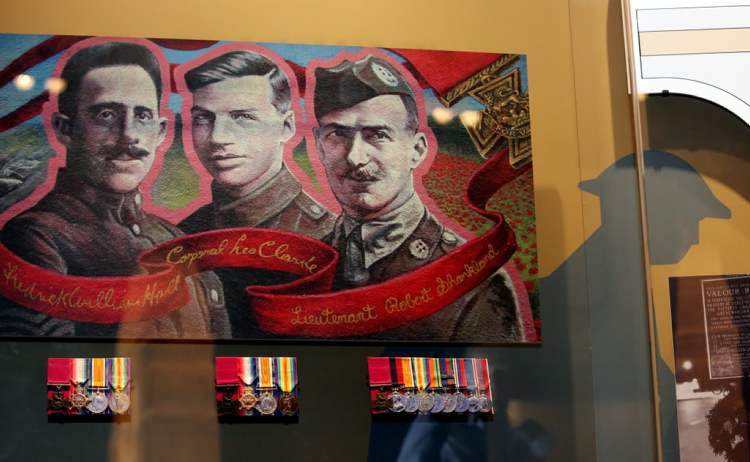
“Valour Road is remarkable for its association with three recipients of this renowned award for bravery. The three men were honoured for their heroic acts in different battles and in different years, but all were from a single block of the same residential street,” said Mark O’Neill, President and CEO of the Canadian Museum of Civilization Corporation, which operates the Canadian War Museum. “These medals belong together and so they shall remain in perpetuity, held in the name of all Canadians.”
The trio of medals will remain on permanent display in the Royal Canadian Legion Hall of Honour. In 2014, this famous trio of Victoria Cross Medals will be loaned to the Manitoba Museum in Winnipeg for a special exhibition commemorating the role of the Winnipeg Rifles and Queen’s Own Cameron Highlanders regiments during the First World War.
The Victoria Cross was introduced during the reign of Queen Victoria and remains the highest award for military valour in Britain and much of the Commonwealth including Canada, which created its own version of the Victoria Cross in 1993. The Victoria Cross is awarded “for the most conspicuous bravery, a daring or pre-eminent act of valour or self-sacrifice or extreme devotion to duty, in the presence of the enemy.”
Company Sergeant Major Frederick William Hall received the medal for his actions during the 2nd Battle of Ypres, infamous as the site of the first German gas attack on the western front. Hall was shot in the forehead and killed during a prolonged and valiant attempt to rescue a wounded comrade. The posthumous award was presented to his mother.

Corporal Clarke received his medal for valour in the face of the enemy at the Somme Front on September 9, 1916, while Lieutenant Shankland received his Victoria Cross for actions during the Battle of Passchendaele in October 1917.