

Dad unable to mark son’s grave
City forbids using limestone
Advertisement
Read this article for free:
or
Already have an account? Log in here »
To continue reading, please subscribe:
Digital Subscription
One year of digital access for only $1.44 a week*
- Enjoy unlimited reading on winnipegfreepress.com
- Read the E-Edition, our digital replica newspaper
- Access News Break, our award-winning app
- Play interactive puzzles
*Billed as $5.77 plus GST every four weeks. After 52 weeks, price increases to the regular rate of $19.95 plus GST every four weeks. Offer available to new and qualified returning subscribers only. Cancel any time.
To continue reading, please subscribe:
Add Free Press access to your Brandon Sun subscription for only an additional
$1 for the first 4 weeks*
- Enjoy unlimited reading on winnipegfreepress.com
- Read the E-Edition, our digital replica newspaper
- Access News Break, our award-winning app
- Play interactive puzzles
*Your next Brandon Sun subscription payment will increase by $1.00 and you will be charged $17.95 plus GST for four weeks. After four weeks, your payment will increase to $24.95 plus GST every four weeks.
Read unlimited articles for free today:
or
Already have an account? Log in here »
Hey there, time traveller!
This article was published 25/01/2013 (4882 days ago), so information in it may no longer be current.
Raymond Zaste still grieves for his son, whose body lies in an unmarked grave in Brookside Cemetery.
Zaste wants to place a piece of limestone taken from his home reserve of Sapotaweyak on his son Daniel’s grave, but city officials will not allow it.
“I can’t afford granite or marble like they want,” Zaste said. “I wanted to give (Daniel) a piece of our home forever.”
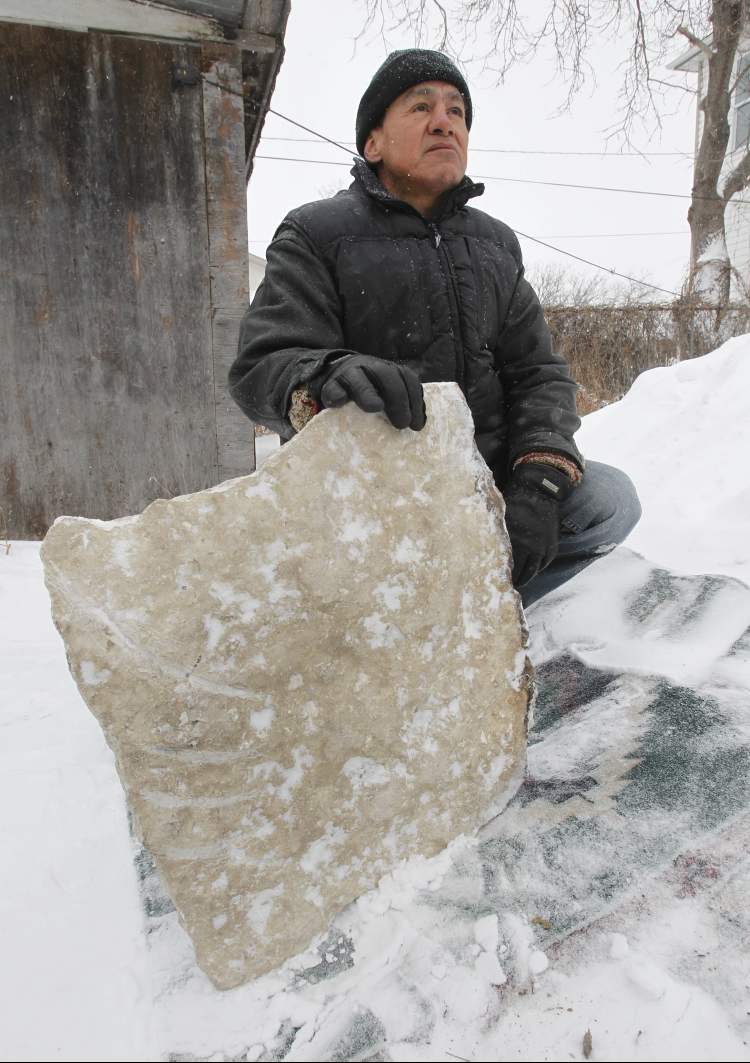
Zaste, 53, a single, unemployed father, raised Daniel and his brothers and sisters alone in the city’s North End.
Daniel died more than a year ago, on Nov. 22, 2011, of a brain aneurysm at the age of 21. He is buried in section 38 at Brookside.
It’s an isolated section close to Logan Avenue and is commonly referred to as the graveyard’s pauper section because it’s where people on social assistance are buried.
It’s also the cemetery’s green section, where people can be buried in plain wooden boxes and even in shrouds, a less-expensive option than caskets that is also considered more environmentally friendly. It reinforces the section’s reputation as the final resting place of paupers.
Jane Saxby, the city’s cemeteries administrator, said section 38 is a flat-marker section, where only low-lying markers of granite, marble or bronze can be placed.
Limestone is not allowed as a marker at any city cemetery, Saxby said, because it is too porous and breaks down faster than granite or marble.
But a stone-memorial conservation expert said he doesn’t understand the city’s rigid regulations in this regard.
Jonathan Appell, a monuments conservator in West Hartford, Conn., said marble and limestone are similar and there is not much difference between the two when it comes to deterioration.
Appell said he understand’s the city’s reluctance to allow limestone as an upright monument, but since Zaste’s marker would be lying flush with the ground, it makes little difference if it’s marble or limestone.
“With a flush marker, I really don’t know why they’d care,” Appell said.
“If (the limestone marker) erodes, you’re not going to be able to read it, but it’s not going to harm anything if it’s flat on the ground….
“If it’s a flat marker, there’s no need for that rule.”
Given Zaste’s reason for using limestone is to create a connection between his son’s grave and his home community, the city should allow it, Appell said.
The city could make a waiver allowing it, on the condition that if it erodes or there’s any damage from maintenance, the city wouldn’t be responsible, Appell said.
“Worst-case scenario, the stone becomes unreadable, but that should be the decision of the family,” he said. “That’s how I would handle it if I was in charge.”
Zaste said he found the piece of limestone about three or four years ago when a roadway was being rebuilt at Sapotaweyak, a Cree community adjacent to Pelican Rapids in the north section of Lake Winnipegosis.
He was attracted to the large rock and has kept it in an uncle’s garage.
When his son died, Zaste said he thought the stone would be the perfect marker, even though he has no money to have it engraved.

Zaste said the city’s refusal to allow him to place the stone as a marker on his son’s grave has been very troubling.
“It’s full of fossils — that’s why I liked it,” he said.
“It’s a piece of home and it should be with my son.”
aldo.santin@freepress.mb.ca
History
Updated on Friday, January 25, 2013 9:48 AM CST: replaces photo
Updated on Friday, January 25, 2013 12:20 PM CST: Tweaks wording.