

Mennonites return good for evil in town
Expelled in Soviet era, they're back to help
Advertisement
Read this article for free:
or
Already have an account? Log in here »
To continue reading, please subscribe:

Digital Subscription
One year of digital access for only $205*
- Enjoy unlimited reading on winnipegfreepress.com
- Read the E-Edition, our digital replica newspaper
- Access News Break, our award-winning app
- Play interactive puzzles
*First annual payment billed as $205.00 + GST for one year. This annual subscription will automatically renew at $233.00 + GST every 52 weeks (10% off the regular annual price of $259.35). Offer available to new and qualified returning subscribers only. Cancel any time.
To continue reading, please subscribe:
Add Free Press access to your Brandon Sun subscription for only an additional
$1 for the first 4 weeks*
- Enjoy unlimited reading on winnipegfreepress.com
- Read the E-Edition, our digital replica newspaper
- Access News Break, our award-winning app
- Play interactive puzzles
*Your next Brandon Sun subscription payment will increase by $1.00 and you will be charged $17.95 plus GST for four weeks. After four weeks, your payment will increase to $24.95 plus GST every four weeks.
Read unlimited articles for free today:
or
Already have an account? Log in here »
Hey there, time traveller!
This article was published 18/03/2013 (4929 days ago), so information in it may no longer be current.
When some Mennonites arrived in the Ukrainian village of Molochansk in 2000, local people were suspicious.
In the Russian Revolution and Second World War, the 80,000 Mennonites living in Ukraine were completely displaced: killed, or shipped to Siberian gulags, where scores died; relocated to the eastern Soviet Union, especially Kazakhstan; or escaped to the West. Mennonite buildings, but not Mennonites, are all that remain in the farming town of Molochansk, as in most other former colonies in southeastern Ukraine.
So Ukrainians feared the Mennonites wanted to reclaim the land. Instead, the visitors purchased and restored a former maedchenschule (a girls’ high school) the Mennonites once ran and called it the Mennonite Centre. (Full disclosure: My maternal grandmother went to the school. Russia generally didn’t let women attend high school, but Mennonite colonies were allowed to run their own education system.)
Then the returning Mennonites launched a benevolent society from the former school, offering social services to the poor, which included just about all the 8,000 people living today in Molochansk (formerly called Halbstadt).
Alcoholism is endemic here on a scale most of us can’t imagine. Unemployment is at acrophobic highs. Corruption is rampant, a relic of the Soviet Union years. The average monthly salary is $100 to $150. One of the programs the Mennonites launched paid for eye exams and eyewear so people could see.
For a group called Friends of the Mennonite Centre in Ukraine, it’s about giving back, but it’s also about not forgetting. The group is more cultural than religion-based, although faith imbues their charity.
With a budget of $200,000 to $300,000, the Mennonite Centre approves a couple hundred small projects each year. A little seed money can go a long way in Ukraine.
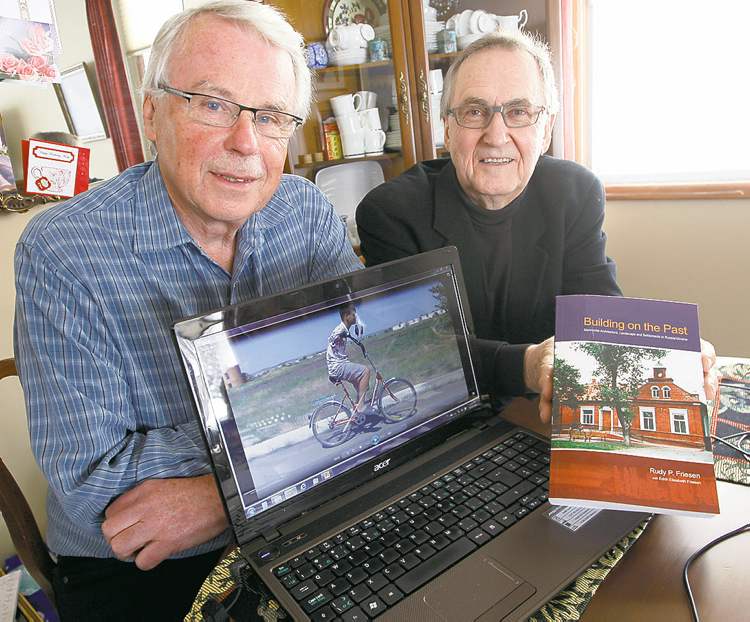
One project built a specialized bike for a youth named Sasha. Sasha lost both arms when he touched a live wire while collecting copper wire for salvage to support his mother. The centre also had a computer built that Sasha can operate with his toes. Another project helped fund a local youth’s enrolment in medical school. Numerous projects have helped people with cancer buy chemotherapy drugs. And so on.
Some regular programs include a free lunch for seniors two or three times a week. It’s often the only time some people eat meat or cheese. The centre hosts a weekly mom’s morning out or will charter a bus for an outing at the beach. It supplies coal so widows can heat their homes in winter. There have been second-hand clothing drives in Canada for the centre.

“My mom grew up in (Molochansk) and I have all these stories rattling around in my head, and I try to put places to them when I’m over there,” said Alvin Suderman, who will depart shortly with wife, Mary, for another three-month stint running the centre. The eight board members, three from Winnipeg, take turns managing the centre, which employs six full-time staff, including a night watchman to guard against break-ins.
One employee is a cook who makes “exactly the same meals as our mothers cooked. Our Mennonite foods are all from the Ukraine,” said board member and co-founder Rudy Friesen, who runs architectural firm ft3 (formerly Friesen Tokar) and authored Building on the Past: Mennonite Architecture, Landscape and Settlements in Russia/Ukraine. Harry Giesebrecht is the third Manitoba director.
Friesen said one can tell the Mennonite buildings by their Flemish bond-brick pattern: brickwork alternates from lengthwise (stretchers) to widthwise (headers). Friesen would like to see a museum in the area dedicated to the Mennonite colonies, and a hostel to accommodate more Mennonites for visits and volunteerism.
“There is a huge level of appreciation today” from Molochansk residents, Friesen said. The group’s fundraising includes annual varenecki and farmer-sausage dinners, concerts and donations. For more information, see mennonitecentre.ca.
bill.redekop@freepress.mb.ca