

Whiz kids: All it takes is creativity, ingenuity — and a little Dumpster diving
Advertisement
Read this article for free:
or
Already have an account? Log in here »
To continue reading, please subscribe:
Monthly Digital Subscription
$1 per week for 24 weeks*
- Enjoy unlimited reading on winnipegfreepress.com
- Read the E-Edition, our digital replica newspaper
- Access News Break, our award-winning app
- Play interactive puzzles
*Billed as $4.00 plus GST every four weeks. After 24 weeks, price increases to the regular rate of $19.95 plus GST every four weeks. Offer available to new and qualified returning subscribers only. Cancel any time.
Monthly Digital Subscription
$4.99/week*
- Enjoy unlimited reading on winnipegfreepress.com
- Read the E-Edition, our digital replica newspaper
- Access News Break, our award-winning app
- Play interactive puzzles
*Billed as $19.95 plus GST every four weeks. Cancel any time.
To continue reading, please subscribe:
Add Free Press access to your Brandon Sun subscription for only an additional
$1 for the first 4 weeks*
*Your next subscription payment will increase by $1.00 and you will be charged $16.99 plus GST for four weeks. After four weeks, your payment will increase to $23.99 plus GST every four weeks.
Read unlimited articles for free today:
or
Already have an account? Log in here »
Hey there, time traveller!
This article was published 29/04/2013 (4729 days ago), so information in it may no longer be current.
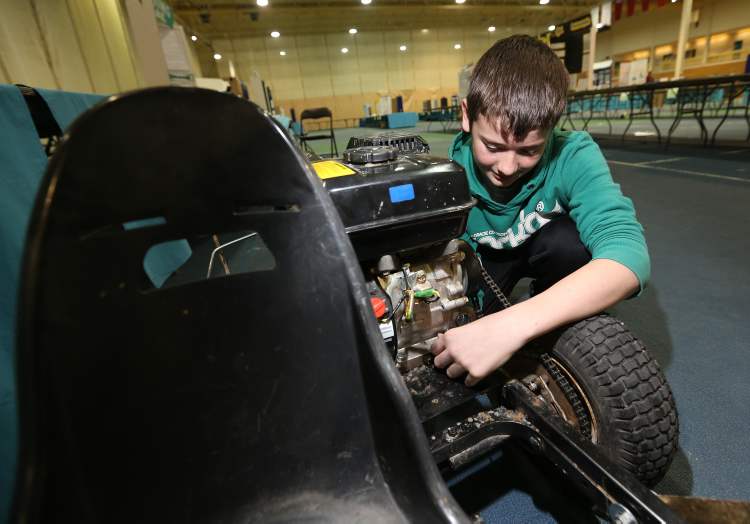
Allow Jackson Pankratz some time to scour back alleys, yard sales and his grandfather’s garage, and the 12-year-old will have a go-kart maxing out at 50 km/h ready for you in about six weeks.
The Grade 7 Linden Christian School student could be found scooting around in one of his first prototypes behind the Max Bell Centre at the University of Manitoba Sunday afternoon, basking in a bronze-medal finish at this year’s Manitoba Schools Science Symposium.
“I just like to build stuff,” he said, noting his aunt, uncle and grandpa all work as engineers.
“It runs in the family.”
Jackson began hunting for parts for the go-kart last spring, diving in Dumpsters to find an old weightlifting bench to use as a chassis, and snagging a pressure-washer at a garage sale to strip apart for its 61/2-horsepower motor.
The project was a lesson in engineering as much as it was motivation — Jackson admits he used his school’s science fair as an excuse to finish building the go-kart in January.
“I feel really happy I got it done,” he said. “Now, I get to ride it, which is the best part.”
In all, 427 students from 64 schools entered 315 projects in this year’s symposium, where there was no shortage of creativity and ingenuity.
Jackson was quick to point out his friend built a hovercraft using plywood and a leaf blower, but other projects included turning kitchen waste into energy, studying the growth of bacteria in reusable water bottles and analyzing the water quality at Little Saskatchewan First Nation following the 2011 spring flood.
About 240 medals and more than $25,000 in prizes were handed out to students, symposium co-chairman Alastair Komus said.
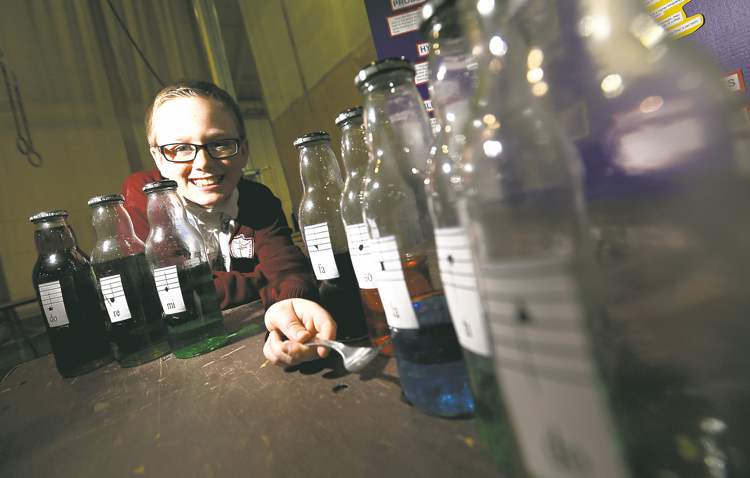
Komus, who’s served as co-chairman for the last four years, said students are more apt to take risks with their projects and push the boundaries of their creativity.
He was struck by one elementary school student, Samara McKay, who, using Styrofoam and balloons, built a snowmobile-rescue system for instances when one crashes through the ice.
The Athlone School student won best overall individual elementary prize, which came with $250.
“She identified a problem and came up with a creative solution for it. It has a very practical application and is something that is feasible,” Komus said.
“Being an elementary student, she’s taking the first, basic steps towards it. She’s getting the idea out there and getting people to think about it.”
Grade 11 St. John’s-Ravenscourt student Michael Xu was one of six students selected from the symposium to represent Manitoba at the Canada-Wide Science Fair in Lethbridge, Alta., from May 11 to 18.

Michael, along with his mentor, Dr. Sabine Mai, from CancerCare Manitoba, studied the progression of acute myeloid leukemia (AML) in mice by taking images of telomeres, found at the ends of DNA strands, and charting the data. With the data, the two were able to distinguish early blood cancer cells from progressed blood cancer cells.
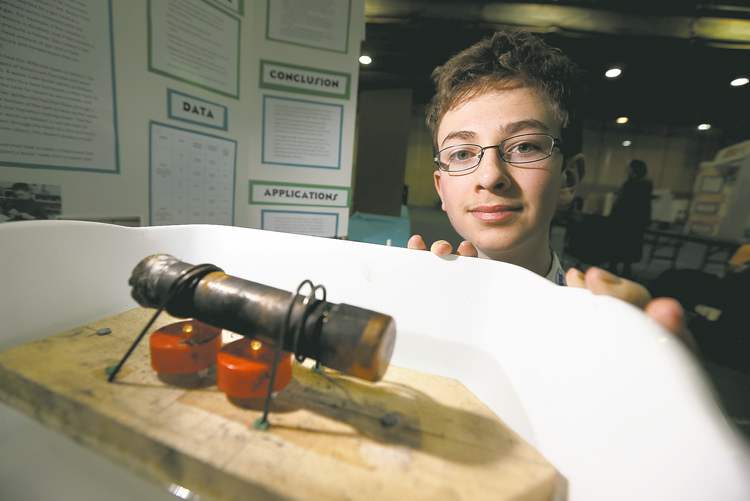
“We can see the exact stage of blood cancer (the mice are) at and stop the progression,” Michael said.
Since humans and mice share 90 to 99 per cent of their respective genetic codes, he believes the findings can be applied to human blood cancers, in turn aiding early diagnosis and creating new drugs and future treatments.
“It will be very important. Right now, there’s not an effective diagnostic tool that can clearly identify the steps blood cancer takes,” said Michael, noting the high mortality rate of AML in the first five years.
“Early diagnosis can stop the progression,” he said.
History
Updated on Monday, April 29, 2013 7:13 AM CDT: changes headline, adds photo, adds fact box