

Mount Carmel Clinic: An oasis of acceptance in a judgmental world
Facility treats community members with dignity and respect
Advertisement
Read this article for free:
or
Already have an account? Log in here »
To continue reading, please subscribe:
Digital Subscription
One year of digital access for only $1.44 a week*
- Enjoy unlimited reading on winnipegfreepress.com
- Read the E-Edition, our digital replica newspaper
- Access News Break, our award-winning app
- Play interactive puzzles
*Billed as $5.77 plus GST every four weeks. After 52 weeks, price increases to the regular rate of $19.95 plus GST every four weeks. Offer available to new and qualified returning subscribers only. Cancel any time.
To continue reading, please subscribe:
Add Free Press access to your Brandon Sun subscription for only an additional
$1 for the first 4 weeks*
- Enjoy unlimited reading on winnipegfreepress.com
- Read the E-Edition, our digital replica newspaper
- Access News Break, our award-winning app
- Play interactive puzzles
*Your next Brandon Sun subscription payment will increase by $1.00 and you will be charged $17.95 plus GST for four weeks. After four weeks, your payment will increase to $24.95 plus GST every four weeks.
Read unlimited articles for free today:
or
Already have an account? Log in here »
Hey there, time traveller!
This article was published 18/05/2013 (4761 days ago), so information in it may no longer be current.
There’s a red, heart-shaped platter of condoms on the Mount Carmel Clinic receptionist’s desk. That’s a second clue this is no ordinary medical centre.
The first is its location on north Main Street, just beyond the Higgins Avenue underpass. This is an area of impoverishment and struggle. A state-of-the-art medical facility is an oasis on the Main Street strip, a place where North End residents can see doctors, dentists and social workers. Their prescriptions are filled on-site. Children attend a licensed daycare. New Canadians learn about the laws and social customs of their chosen home in their own language. People traumatized by war receive counselling. Homeless clients aren’t hampered by a lack of a mailing address.
They have a $12-million annual budget. Most of their money comes from provincial funding. United Way funds the dental clinic, which only accepts patients who don’t have third-party insurance.
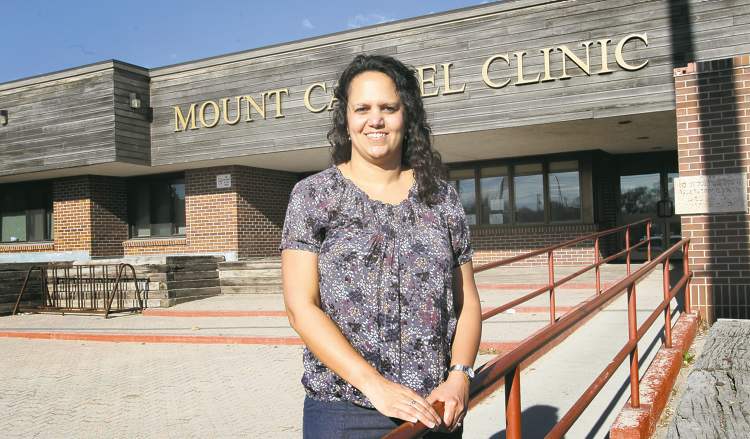
The clinic’s motto is “We meet you where you’re at. No judgment here. Just care.”
If you’re the judging sort, you’ll find plenty of ammunition at Mount Carmel. They’re trying to raise $1.3 million for a “mothering project.” Pregnant women, many of them addicts, will get trauma and addiction counselling, nutrition and food prep classes, obstetric support and parenting instruction. They will not be required to give up substance abuse.
“We treat people with dignity, respect and in a non-judgmental way,” says clinic executive director Bobbette Shoffner. “We work on a harm-reduction basis.”
Sage House, a drop-in centre and outreach program for women in the sex trade, operates under the Mount Carmel Clinic umbrella.
Clinic staff loves the unlovable, although Shoffner and her team might not put it so bluntly.
“We make sure everyone has access to the same services available throughout the city,” says Shoffner. “We try to eliminate barriers.”
She says the community is well-aware of the services offered at Mount Carmel.
“They know what we’re all about. We support moms and their new babies. We have midwives here. This is typically an underserved community with relation to health care. It’s sometimes hard to understand the system, use the system. We really get to know our clients as people.”
A foot-health clinic is a godsend to the homeless. They can come in for free. They’re checked for complications from diabetes and for other health concerns.
“For many people, their shoes are their vehicle,” the executive director says.
Mount Carmel Clinic was founded in the early 1900s by a group of Jewish professionals who wanted to provide accessible and affordable health care to immigrants. The legendary Anne Ross took the reins in 1948, and moved the clinic’s orientation from strictly ethnically based to community-oriented. In the 1960s, immigrants continued to arrive in Winnipeg, along with M©tis and aboriginals. Today, a new wave of immigrants keeps the clinic busy.
Jamal Hawandi came to Canada from Iraq 16 months ago. He worked as a social worker and interpreter at home, and is paid an honorarium to act as a community-based educator for the clinic.
“Living in a new culture is very difficult. It’s very different from the culture back home,” Hawandi says. “They need life skills, they need to understand the importance of domestic relationships, that domestic violence is against the law. They need to understand the parenting, that spanking is not acceptable here.”

Catherine Biaya is from Congo. She says many people arrive with trauma from living in war-torn regions.
“We are not social workers,” she says of the community educators. “We ask people what they need. We ask them what their strengths are.”
The buildings are clean and the staff friendly. Shoffner says certain programs are bursting at the seams and they may need to launch a capital campaign. In the meantime, they post requests for donated items on their website.
The place that doesn’t judge needs some help. They need to keep caring and that takes more than an open heart. It takes an open chequebook and a willingness to see all Winnipeggers as deserving of health care.
lindor.reynolds@freepress.mb.ca