

Cyclists enjoying special lanes
Pembina Highway stretch called unique in Canada
Advertisement
Read this article for free:
or
Already have an account? Log in here »
To continue reading, please subscribe:
Digital Subscription
One year of digital access for only $1.44 a week*
- Enjoy unlimited reading on winnipegfreepress.com
- Read the E-Edition, our digital replica newspaper
- Access News Break, our award-winning app
- Play interactive puzzles
*Billed as $5.77 plus GST every four weeks. After 52 weeks, price increases to the regular rate of $19.95 plus GST every four weeks. Offer available to new and qualified returning subscribers only. Cancel any time.
To continue reading, please subscribe:
Add Free Press access to your Brandon Sun subscription for only an additional
$1 for the first 4 weeks*
- Enjoy unlimited reading on winnipegfreepress.com
- Read the E-Edition, our digital replica newspaper
- Access News Break, our award-winning app
- Play interactive puzzles
*Your next Brandon Sun subscription payment will increase by $1.00 and you will be charged $17.95 plus GST for four weeks. After four weeks, your payment will increase to $24.95 plus GST every four weeks.
Read unlimited articles for free today:
or
Already have an account? Log in here »
Hey there, time traveller!
This article was published 29/06/2013 (4726 days ago), so information in it may no longer be current.
It was her 41st birthday on Friday, so for Jan Guise, the old “arrive alive” adage was apropos as she cycled home from work.
Guise was able to travel along the city’s first-ever buffered bike lanes as she cruised north on Pembina Highway between Plaza Drive and Chevrier Boulevard.
The lanes, along both the east and west sides of Pembina in that stretch, were officially opened Friday by Local Government Minister Ron Lemieux and Mayor Sam Katz.
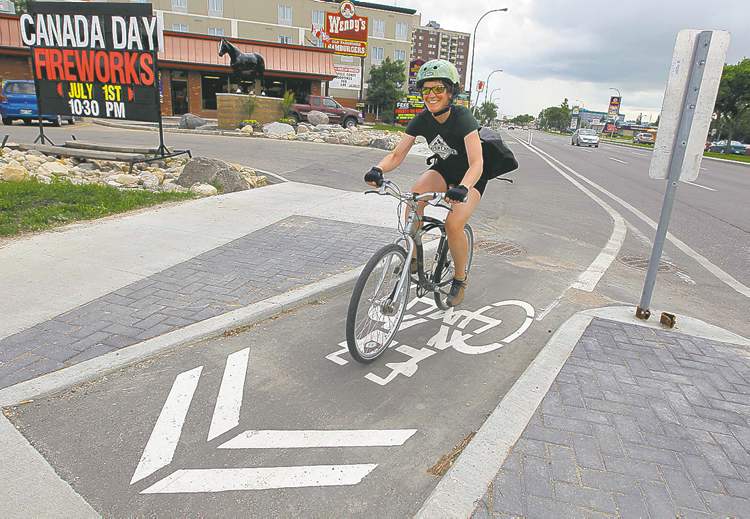
“It’s just so nice to have a dedicated lane along such a busy street. It does make me feel safer and I can go fast now,” said Guise, a librarian at the University of Manitoba. She cycles to work from her River Heights home in all conditions except snow. “I was worried about all the driveways (into businesses), that cars would be cutting in front of me, but I haven’t noticed that at all.”
The project, said to be unique in Canada, cost $4 million, including $3.5 million from the City of Winnipeg’s capital budget and $500,000 from the province’s Road Improvement Fund.
The buffered bike lanes are marked by painted lines on the pavement, with polyposts placed at regular intervals to serve as an eye-catching alert for motorists.
“This is nice, it is safe. They have the railings (polyposts), so I feel comfortable and safe while I ride,” said Jayanta Debnath, 35, a student who cycles daily from his Fort Garry home to the U of M, where he is taking his PhD in electrical engineering.
“Before, I would go by the pedestrians (on the sidewalk instead of the street). This is better, and for the community, biking is a very good option. It’s good exercise and saves money (on gas).”
A key component of the buffered bike lanes is the bus-stop-island feature. A slight incline in the paved bike path takes cyclists around bus shelters. Bicycles travel around the bus stop on a part of the sidewalk that is divided from the pedestrian side by “way-finding tactile surfaces,” which look like narrow rumble strips. The rumble strips on the pedestrian side are horizontal to alert cyclists they are on the wrong side of the sidewalk. Cyclists return to the regular bike path on the other side of the bus stops. With this system in the buffered bike lanes, cyclist and bus need never meet.

Guise said the polyposts made an immediate difference in the bike lanes.
‘It’s just so nice to have a dedicated lane along such a busy street. It does make me feel safer and I can go fast now’
— cyclist Jan Guise, who rides to work at the University of Manitoba from her River Heights home
“Before those went up, especially in the morning, a lot of vehicles would stop in these lanes to do deliveries and school buses would stop to take pickups, which was not the point (of having the bike lanes),” said Guise, who is able to take full advantage of the buffered bike lanes as she turns off Pembina onto Chevrier to head home.
“The other nice thing about them putting in these lanes is that they repaved the road.”
A joint statement from the civic and provincial governments noted the buffered bike lanes are part of the city’s Active Transportation (AT) network, including the Bishop Grandin Greenway.
ashley.prest@freepress.mb.ca