

Robyn’s burgers are nothing to beef about
Drive-in serves meatiest patties
Advertisement
Read this article for free:
or
Already have an account? Log in here »
To continue reading, please subscribe:

Digital Subscription
One year of digital access for only $205*
- Enjoy unlimited reading on winnipegfreepress.com
- Read the E-Edition, our digital replica newspaper
- Access News Break, our award-winning app
- Play interactive puzzles
*First annual payment billed as $205.00 + GST for one year. This annual subscription will automatically renew at $233.00 + GST every 52 weeks (10% off the regular annual price of $259.35). Offer available to new and qualified returning subscribers only. Cancel any time.
To continue reading, please subscribe:
Add Free Press access to your Brandon Sun subscription for only an additional
$1 for the first 4 weeks*
- Enjoy unlimited reading on winnipegfreepress.com
- Read the E-Edition, our digital replica newspaper
- Access News Break, our award-winning app
- Play interactive puzzles
*Your next Brandon Sun subscription payment will increase by $1.00 and you will be charged $17.95 plus GST for four weeks. After four weeks, your payment will increase to $24.95 plus GST every four weeks.
Read unlimited articles for free today:
or
Already have an account? Log in here »
Hey there, time traveller!
This article was published 09/08/2013 (4735 days ago), so information in it may no longer be current.
HIGHWAY 12 AND 317 JUNCTION — Before a diner leaves Robyn’s Drive-In, she makes a point of detouring around some tables so she can pass the counter on her way out.
“The food was excellent,” she says, nodding to the cooking staff in back.
Those kind of compliments aren’t unusual at Robyn’s Drive-In, about 60 kilometres northeast of Winnipeg. Owners James and Robyn Kebernik have a growing reputation for serving great hamburgers, even if they are located “in the middle of nowhere.”
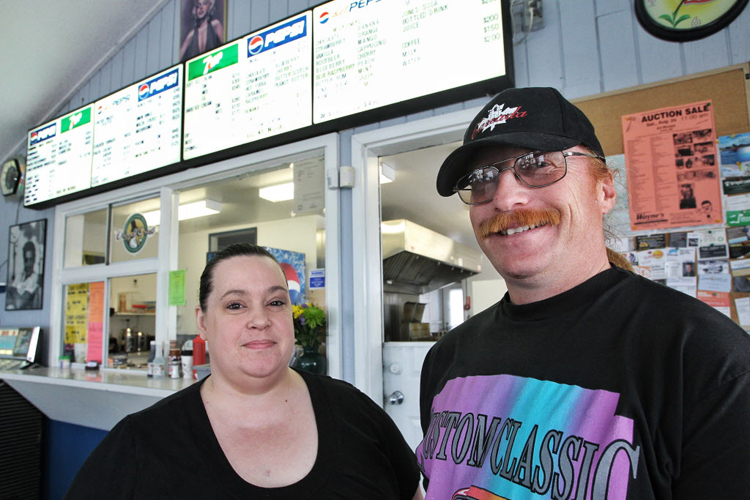
Their not-so-secret ingredient? It’s the beef cattle. They raise their own.
When BSE (bovine spongiform encephalopathy) hit in 2002, the couple saw their returns from cattle come crashing down. They struggled to find other revenue streams. When a relatively new restaurant came up for sale, they figured why not?
After all, the Kebernik family, starting with James’ parents, had been raising black Angus beef cattle for half a century, consistently obtaining the highest grades in Canada and the United States.
Meantime, Robyn, who James met through an online dating service and is from Michigan, had never been on a farm before they married in the midst of the BSE crisis. But one thing she did know was how to cook and run a restaurant. It was a way for her to make a contribution.
So they began serving beef from their farm, which they run in partnership with other family members, through the restaurant.
That was eight years ago. Some farm-to-restaurant operations also started up back in the BSE days, when the discovery of a single animal with mad cow disease closed export markets to Canadian beef. A similar restaurant was the Holy Cow in Birtle but it has closed. “We’re stubborn,” James said.
They go through about 15 cows in a season — a season being from the time the snow melts off the parking lot to the time it fills up again.
James says 15 cows “doesn’t sound like a lot but it does help out.” It equates to about 20,000 burger patties. “When you press them by hand, that’s a lot,” said Robyn.
Most hamburger meat is from poorer cuts, leaving the better cuts for the steaks. Not at Robyn’s. They use the whole cow. Their cattle are also mostly, but not entirely, grass-fed.
Their patties are meatier. They are six ounces. A lot of fast-food hamburgers are three ounces or less. As well, the meat is fresh, never more than 10 days to two weeks old, processed at the provincially inspected BJ Packers in Beausejour.
The Keberniks also boast that their product has no filler whatsoever. People would be surprised how much filler goes into the hamburgers in some chains, said James.
They use local produce whenever they can, and their buns come from the Upper Crust Bakery in Selkirk. They say Manitoba potatoes make the best french fries, and they cut all their own fries in back of the restaurant.
“We can’t get the volume discounts like a McDonald’s gets, so we have to concentrate on producing a quality product,” said James.
They use a charbroiler to cook their hamburgers, and Robyn and James are “passionate” about cooking.
“We thoroughly enjoy it,” said James.
They have about 10 part-time staff, mostly farm kids from the area. Their family helps out, too. Robyn’s Drive-In has a takeout window that brings in about 50 per cent of their business.
One steady customer is Allen Hocaluk from Brokenhead Ojibway First Nation, who lives about 10 kilometres away.
He stops by almost weekly. “Their hamburgers are great, very tasty,” said Hocaluk. “It all tastes homemade from the hamburgers to the perogies to the borscht soup.”
The biggest obstacle would seem to be their location. It’s close to the Kebernik farm but little else. They’re at the junction of highways 317 and 12, about 60 kilometres northeast of Winnipeg.

“Most people laugh that we’re in the middle of nowhere but we’re actually 20 minutes from many places” such as Lac du Bonnet, Beausejour and Selkirk, said James.
It has a strong local customer base and serves cottagers from Lac du Bonnet and Lee River.
In the news this week were British scientists who produced the first hamburger in a laboratory. The Keberniks aren’t too worried test-tube burgers are going to muscle in on their business, though.
“Ours are the real thing,” said James. Robyn’s is open from 11 a.m. to 8 p.m. Monday to Thursday, 11 a.m. to 9 p.m. Friday and Saturday, and 11 a.m. to 9 p.m. Sundays.
bill.redekop@freepress.mb.ca
History
Updated on Friday, August 9, 2013 7:54 AM CDT: Picture changed
Updated on Friday, August 9, 2013 8:04 AM CDT: Robyn's is open from 11 a.m. to 8 p.m. Monday to Thursday, 11 a.m. to 9 p.m. Friday and Saturday, and 11 a.m. to 9 p.m. Sundays.