

Why does same-sex affection draw anger?
A study by former Winnipegger hopes to find out

Advertisement
Read this article for free:
or
Already have an account? Log in here »
To continue reading, please subscribe:

Digital Subscription
One year of digital access for only $205*
- Enjoy unlimited reading on winnipegfreepress.com
- Read the E-Edition, our digital replica newspaper
- Access News Break, our award-winning app
- Play interactive puzzles
*First annual payment billed as $205.00 + GST for one year. This annual subscription will automatically renew at $233.00 + GST every 52 weeks (10% off the regular annual price of $259.35). Offer available to new and qualified returning subscribers only. Cancel any time.
To continue reading, please subscribe:
Add Free Press access to your Brandon Sun subscription for only an additional
$1 for the first 4 weeks*
- Enjoy unlimited reading on winnipegfreepress.com
- Read the E-Edition, our digital replica newspaper
- Access News Break, our award-winning app
- Play interactive puzzles
*Your next Brandon Sun subscription payment will increase by $1.00 and you will be charged $17.95 plus GST for four weeks. After four weeks, your payment will increase to $24.95 plus GST every four weeks.
Read unlimited articles for free today:
or
Already have an account? Log in here »
Hey there, time traveller!
This article was published 19/09/2013 (4746 days ago), so information in it may no longer be current.
When a Winnipeg researcher wrote Homophobic Assault: a Study of Anti-Gay Violence 30 years ago, it exposed horrific attacks against sexual minorities.
Three decades later, some folks still see red when they see two men holding hands. A Winnipeg-raised psychologist is launching a study this fall to find out why, and if there is a way to tamp down that homophobic rage.
Karen Blair plans to measure how thoughts and feelings inside the brain are subconsciously expressed by the body after seeing a same-sex public display of affection.
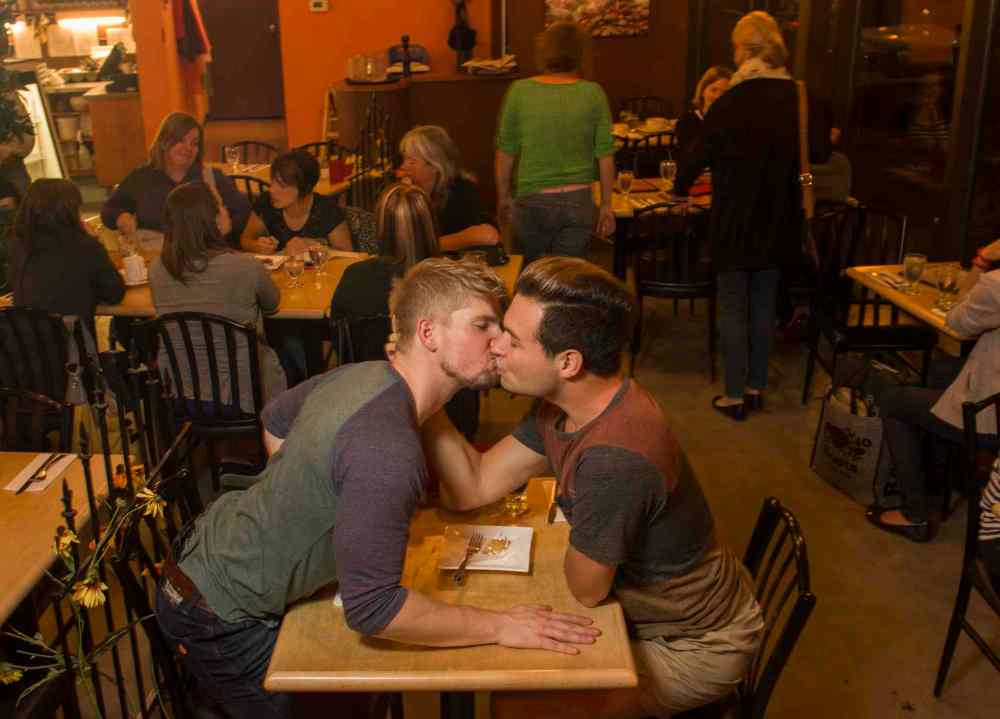
Understanding the physiology of prejudice toward sexual minorities might point to a way to reduce it and the violence they experience, said the researcher at the University of Utah in Salt Lake City.
Understanding the physical mechanisms — such as changes in levels of the stress hormone cortisol — will help to develop better interventions and educational materials to reduce hate-based crimes, said Blair. She grew up in St. Vital and earned a doctorate in social psychology from Queen’s University.
The questions she asked as a university undergraduate, when she came out as a lesbian to herself and others, led to the research she does now.
“I was in a course on relationships and the psychology of love and relationships. I kept raising my hand to ask the prof ‘Do we know if this thing works for same-sex couples?’ The answer was always ‘We don’t know — they haven’t done the study.’ Textbooks were always about heterosexual couples’ experiences. So I said ‘I guess I’ll have to do it.’ “
Blair, who studies lesbian, gay, bisexual, transgender and queer (LGBTQ) psychology, relationships, prejudice and health, is a post-doctoral fellow at the University of Utah. Her fellowship is funded by the Canadian Institutes of Health Research and covers her salary, but leaves her to her own devices to find funds to support her research.
Blair has gone online to solicit crowd-funding support for her research at www.wecanholdhands.com. Her goal is to raise $7,500 toward its estimated cost of $12,000. Blair said she’ll make up the difference. Just over $2,000 has been raised so far for the study of 120 subjects that involves lab time to measure such things as levels of cortisol, the stress hormone. It aims to understand more about how prejudiced individuals respond when they see a same-sex public display of affection.
Blair said it’s part of a larger, three-part study looking at the health benefits of shared affection between partners, especially when affection is shared in public. In general, affection is known to have positive health outcomes for people in relationships, but less is known about how affection functions when it is shared in public and even less about affection in same-sex couples, she said.
It was “discouraging” to hear some people in Steinbach oppose gay-straight alliances in school, she said. The health benefit to those struggling with their sexual orientation is feeling accepted rather than wishing they were dead and considering suicide, said Blair.
“It’s going to keep them alive. The more we create these alliances that feed into social support from friends, the better their mental and physical health will be,” said Blair. “We can back that up with research already.”
Acceptance of sexual minorities is growing, but it’s not a global reality yet, she said.
“In countries like Russia, they say something like 85 per cent agree with anti-gay propaganda laws.” Blair said her study is needed and could be put to good use in many places.

“The research is going to be relevant across the border and outside North America.”
A broad range of people are expected to participate in the study, she said. Utah is heavily populated with Mormons whose religion opposes homosexuality, but the liberal University of Utah was ranked as one of the 25 most queer-friendly campuses in 2012.
“There’s a very wide spectrum of people’s opinions here,” she said.
carol.sanders@freepress.mb.ca
Why is it that public displays of same-sex affection still bother people? Join the conversation in the comments below.
Carol Sanders
Legislature reporter
Carol Sanders is a reporter at the Free Press legislature bureau. The former general assignment reporter and copy editor joined the paper in 1997. Read more about Carol.
Every piece of reporting Carol produces is reviewed by an editing team before it is posted online or published in print — part of the Free Press‘s tradition, since 1872, of producing reliable independent journalism. Read more about Free Press’s history and mandate, and learn how our newsroom operates.
Our newsroom depends on a growing audience of readers to power our journalism. If you are not a paid reader, please consider becoming a subscriber.
Our newsroom depends on its audience of readers to power our journalism. Thank you for your support.
History of homophobia
“On Sept. 13, 1978, 31-year-old Peter Petkaw was found unconscious on the bank of the Assiniboine River with a broken skull, leg and six fractured ribs. Thirteen days later, he was pronounced dead in the hospital having succumbed to his injuries. The following six months of various community meetings, protests and public memorials demanding justice and an end to violence against gays was met by the 18-year-old John Usher receiving a life sentence in prison on Feb. 23, 1979, for the murder of Petkaw.
“On June 30, 1991, Gordon Kuhtey, 48, was murdered on the Hill. Four men in their 20s who held neo-fascist beliefs were arrested and charged for Kuhtey’s murder some five years after the incident. Multiple attempts by the gay community to erect a memorial to the victims of homophobic violence on the legislative grounds were rejected by city council. The history of the gay community in Winnipeg consists of many other accounts of violence and the victimization.”
— From Greg Kelner’s Homophobic Assault: a Study of Anti-Gay Violence, 1983: Manitoba Gay and Lesbian Archives, U of M
Has much changed?
A recent three-year national study by University of Winnipeg Prof. Catherine Taylor showed widespread homophobia and verbal and physical harassment in Canadian schools on lesbian, gay, bisexual, transgender, transsexual, two-spirit, queer and questioning students. Prof. Karen Blair at the University of Utah is trying to find out what happens to homophobics when they see same-sex displays of affection and how to mitigate their negative feelings.
Carol Sanders
Legislature reporter
Carol Sanders is a reporter at the Free Press legislature bureau. The former general assignment reporter and copy editor joined the paper in 1997. Read more about Carol.
Every piece of reporting Carol produces is reviewed by an editing team before it is posted online or published in print — part of the Free Press‘s tradition, since 1872, of producing reliable independent journalism. Read more about Free Press’s history and mandate, and learn how our newsroom operates.
Our newsroom depends on a growing audience of readers to power our journalism. If you are not a paid reader, please consider becoming a subscriber.
Our newsroom depends on its audience of readers to power our journalism. Thank you for your support.
Related Articles
Justice denied
Advertisement Advertise With Us
Advertisement Advertise With Us