

Colour Manitoba NDP-orange?
Political types dissect party's string of wins and prospects
Advertisement
Read this article for free:
or
Already have an account? Log in here »
To continue reading, please subscribe:
Digital Subscription
One year of digital access for only $1.44 a week*
- Enjoy unlimited reading on winnipegfreepress.com
- Read the E-Edition, our digital replica newspaper
- Access News Break, our award-winning app
- Play interactive puzzles
*Billed as $5.77 plus GST every four weeks. After 52 weeks, price increases to the regular rate of $19.95 plus GST every four weeks. Offer available to new and qualified returning subscribers only. Cancel any time.
To continue reading, please subscribe:
Add Free Press access to your Brandon Sun subscription for only an additional
$1 for the first 4 weeks*
- Enjoy unlimited reading on winnipegfreepress.com
- Read the E-Edition, our digital replica newspaper
- Access News Break, our award-winning app
- Play interactive puzzles
*Your next Brandon Sun subscription payment will increase by $1.00 and you will be charged $17.95 plus GST for four weeks. After four weeks, your payment will increase to $24.95 plus GST every four weeks.
Read unlimited articles for free today:
or
Already have an account? Log in here »
Hey there, time traveller!
This article was published 11/10/2013 (4623 days ago), so information in it may no longer be current.
When the dust cleared after the province’s 2011 election, political scientists began asking a vexing question: Is the NDP now Manitoba’s natural governing party?
The University of Toronto’s Nelson Wiseman, one of Canada’s best-known political scientists, posed the question recently in a paper. Now, the question infuses a new collection of empirical research, to be released next year, on Manitoba’s 2011 election, how the NDP won an unprecedented fourth majority and what that says about the province’s political culture.
“Manitoba is often thought of as being a pretty centrist place. We don’t really appreciate extremes in politics,” said the University of Manitoba’s Andrea Rounce, who edited the new collection of research along with fellow U of M political scientist Jared Wesley. “It’s a more, if not collegial, then collaborative approach. But we still see these traditional cleavages — big differences between women and men, between First Nations, a north-south divide, a Winnipeg-and-everyone-else divide.”
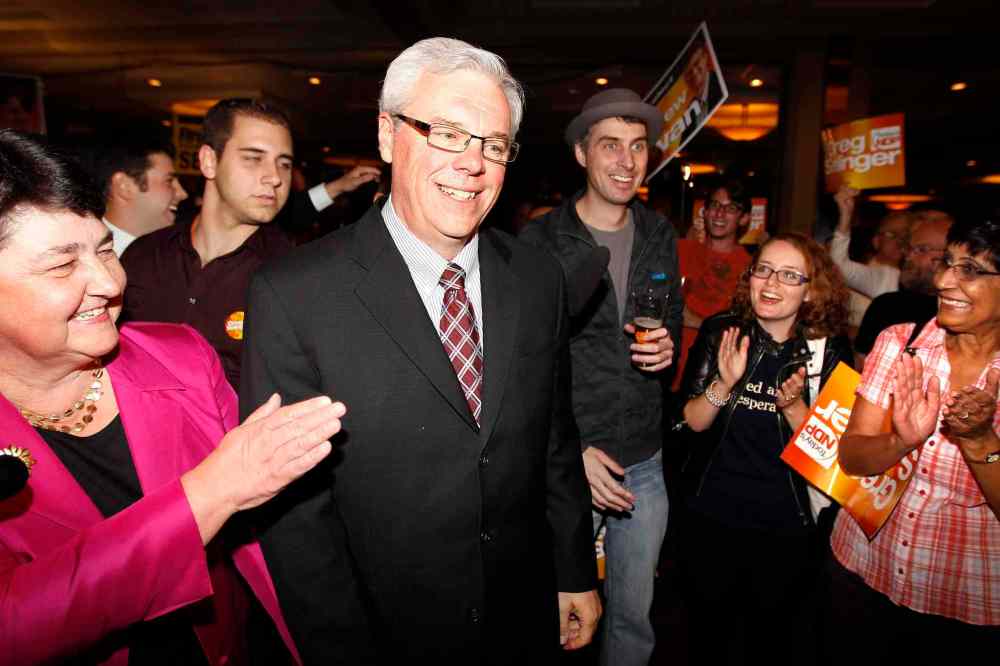
The NDP has arguably been the most successful at exploiting those divides and modelling a modern party that best mirrors Manitoba’s political culture, one of “pragmatic centrism.”
It’s the federal Liberals who first earned the title “Canada’s natural governing party,” but, in his research, Wiseman says the Manitoba NDP’s electoral record is actually better than that of the federal Liberals. Since Ed Schreyer became the province’s first NDP premier in 1969, the party has held office nearly 60 per cent of the time and typically won a higher proportion of seats than the federal Grits. The NDP has also benefited from Manitoba’s electoral geography, a stable coalition of voters that includes women, new immigrants and unions, and, more recently, the opposition’s disarray.
When the next election rolls around in 2016, a new generation of voters will have known only an NDP government in their politically conscious lives, says Wiseman.
But new polling data released over the summer and again this week by Probe Research poke holes in the notion of a natural governing party. Support for the NDP is bleeding and the Tories are even slightly ahead in battleground Winnipeg. Thanks in part to a decision to hike the PST, there is now a real possibility the NDP will lose in 2016.
“If the vote were held today, I suspect the NDP would be blown out of the water,” said Wiseman. “Notwithstanding that, you can still make the case that they are the natural governing party.”
That’s because the party’s organization is stable and it will form a strong opposition, waiting in the wings for the next election.
The new polls, plus Manitoba’s modern tradition of swapping between the Conservatives and NDP, make the notion of a natural governing party ring hollow for Kelvin Goertzen, the longtime Tory MLA for Steinbach. Goertzen said that at the height of former premier Gary Filmon’s tenure, there was similar talk about the Tories being Manitoba’s natural governing party. And Goertzen recalls a time when common wisdom held no Western Canadian could ever be prime minister.
“Whenever things have been a certain way for a long time, there’s a feeling that things can never change, and that’s often the time things actually do change,” Goertzen said.
According to new research, which includes nearly 800 surveys with Manitoba voters, there are structural factors that have helped entrench the NDP, factors touched on by several of the 10 political scientists who scrutinized the 2011 race.
‘If the vote were held today, I suspect the NDP would be blown out of the water. Notwithstanding that, you can still make the case that they are the natural governing party’
— University of Toronto’s Nelson Wiseman, one of Canada’s best-known political scientists

Manitoba is in the midst of a long-term trend toward urbanization, which tends to favour the NDP. The swing seats tend to be in Winnipeg, where the NDP dominates and where the efficiency of its operation helps the party win two-thirds of Manitoba’s seats with less than half the popular vote. And the collapse of the Liberals in recent years has also bolstered the NDP.
Wiseman points to the NDP’s ability to forge a coalition of women, aboriginals, environmentalists, gays and lesbians, visible minorities and trade unions, many of which waded into the 2011 election campaign with a barrage of anti-Tory ads. Even the thousands of civil servants, most of them concentrated in battleground Winnipeg, tend to favour the NDP, according to new data.
Again, as Goertzen notes, there is some sense the NDP’s coalition is shifting. Polls show NDP support among women is waning, and the federal Conservatives at least have done a remarkable job wooing the votes of new Canadians and ethnic communities.
The new empirical research also confirms what many have suspected — NDP sympathizers actually get out to vote on election day. That’s in contrast to many who lean right. A survey of non-voters right after the 2011 election revealed four in 10 consider themselves Progressive Conservative, Wesley said, which suggests a huge slack in the electorate that the Tories have yet to exploit.
maryagnes.welch@freepress.mb.ca
History
Updated on Friday, October 11, 2013 7:23 AM CDT: Replaces photo