

It’s a different kind of cold
In Chengdu, it's foggy, smoggy and residents say winter typically is warmer outside than inside
Advertisement
Read this article for free:
or
Already have an account? Log in here »
To continue reading, please subscribe:
Monthly Digital Subscription
$1 per week for 24 weeks*
- Enjoy unlimited reading on winnipegfreepress.com
- Read the E-Edition, our digital replica newspaper
- Access News Break, our award-winning app
- Play interactive puzzles
*Billed as $4.00 plus GST every four weeks. After 24 weeks, price increases to the regular rate of $19.95 plus GST every four weeks. Offer available to new and qualified returning subscribers only. Cancel any time.
Monthly Digital Subscription
$4.99/week*
- Enjoy unlimited reading on winnipegfreepress.com
- Read the E-Edition, our digital replica newspaper
- Access News Break, our award-winning app
- Play interactive puzzles
*Billed as $19.95 plus GST every four weeks. Cancel any time.
To continue reading, please subscribe:
Add Free Press access to your Brandon Sun subscription for only an additional
$1 for the first 4 weeks*
*Your next subscription payment will increase by $1.00 and you will be charged $16.99 plus GST for four weeks. After four weeks, your payment will increase to $23.99 plus GST every four weeks.
Read unlimited articles for free today:
or
Already have an account? Log in here »
Hey there, time traveller!
This article was published 10/12/2013 (4507 days ago), so information in it may no longer be current.
CHENGDU, China — It was 12 C as I left Chengdu on a morning in late November. (It was -14 C in Winnipeg, a difference of 26 degrees). And yet as mild as it was, and with the forecast for a high of 16 C, my translator Duanduan Liu shivered and called it “a snow day” as she drove me to the airport in her new Buick Regal.
What passes for winter in Chengdu is mild by Manitoba standards. But all the same, residents dread the arrival of snow days that portend the winter to come when the average temperature slips to 5.6 C in January and often plunges to zero, even as low as -5 C — minus five!
Cold, as every Winnipegger knows, is a relative thing. Which explains why every person in Chengdu whom I met and who had spent time in Canada said they preferred Canadian winters to Chengdu winters.
The reason? Central heating.
“In Canada, it is cold outside in winter but warm inside. In Chengdu it is warmer outside but colder inside,” said Duanduan, a dietitian who spent six years in Winnipeg studying and working.
To me, Chengdu was a warm paradise in late November, when daytime temperatures ranged between 17 C and 21 C.
I found the room at my hotel, which caters to westerners and is centrally heated, was too hot. I would turn the temperature down to 18 C each night, open the window and crank up the ventilation system to ensure comfort.
But every day when I returned, I would find the temperature raised to 22 C, the window closed and the ventilation fan turned off. It was as if staff could not believe a guest would prefer cool and fresh to warm and stuffy.
But I did, and so every evening I would have to adjust, and every morning cleaning staff would readjust.
I found the climate appealing, warm and moist, the trees densely leaved, grass a rich green, and everywhere flowers — begonias, orchids, petunias, azaleas and dahlias (the official flower).
Chengdu was recognized as “the most livable city” in China several years ago, in large part because its cuisine is superb and its new infrastructure makes it easy to get around, but mostly because of its sub-tropical climate.
The city actually is at the same latitude as Jacksonville, Fla., but because it sits on a high plain (elevation 1,600 feet compared to Winnipeg’s 781) and is surrounded by mountains that block cold fronts coming down from Siberia, it is a pleasant place to be in any of its four seasons.
Summer temperatures can hit 35 C, although 27 C is the norm, and it never is as hot as it is in Chongqing, 300 kilometres southwest, where it can hit 44 C.
If there is a drawback for Winnipeggers, it is the lack of sunshine. The moisture and moderate climate that make Sichuan province, of which Chengdu is the capital, the “land of abundance,” also make it a dark and dreary place in winter.
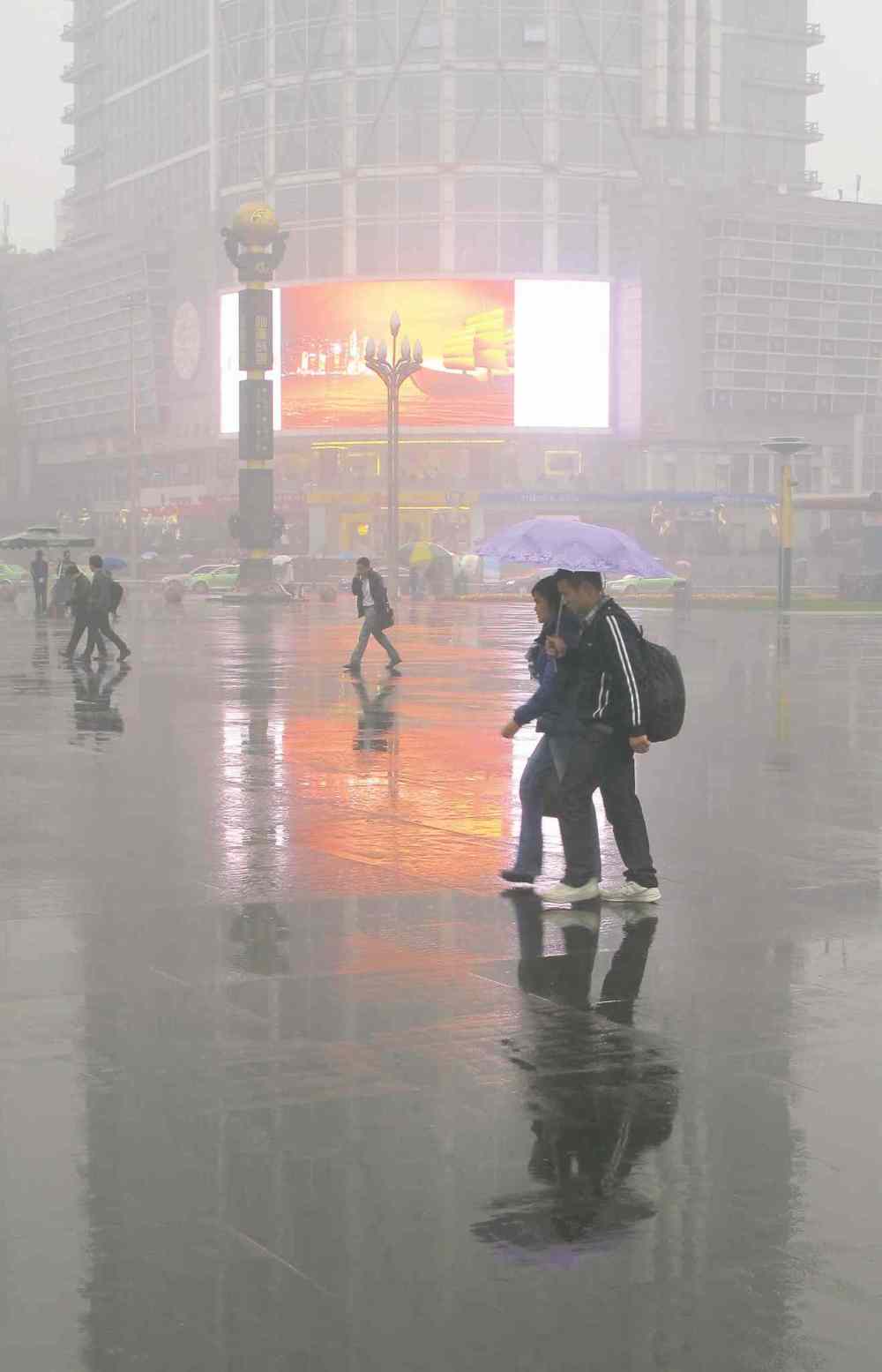
I was lucky. I had two sunny days, but usually fog hid the sun or reduced it to a pale yellow ball that was so dim, it often would not register in photographs. The only blue sky I saw over China was at 30,000 feet on my flight home.
The fog tends to hide the smog, which is always there but on most days is moderate compared with levels in other Chinese cities.
But smog levels often were higher than 100 on the air pollution index posted by the U.S. Consulate in Chengdu. An API of 100 to 200 will affect “sensitive” people but it never affected me in ways that I was aware of. Had it reached “hazardous” levels of more than 400 API, as it has done, I suspect I would have noticed.
Surprisingly, perhaps, relatively few pedestrians wore masks, although masks were more evident on the faces of cyclists and scooter drivers jostling with three million cars for the right of way on the city’s excellent roadways.
It is perhaps no accident “hot pot” is a traditional means of preparing food in Chengdu. To cook hot pot, a fire is built under a cauldron to boil water into which dinner is dumped and cooked.
You can imagine in ancient times families gathering around the hot pot for warmth and hot food. Today, hot pot is not so much a source of warmth as it is a source of heat — from fiery Sischuan pepper, which smells divine but which paralyzed my throat the one (and only) time I tried it.
The absence of central heat is intensified by concrete, the staple building material everywhere. And not just some concrete, but massive amounts needed to raise typical 30-storey and 40-storey buildings divided into hundreds of typical 100-square-metre (1,100-square-foot) apartments.

The concrete absorbs and retains cold, so much so that space heaters and reverse air-conditioners can’t dispel the chill or the damp.
One day when it was 18 C, my translator Yanjiao (Ivy) Zhang told me she had been forced to leave her parents’ apartment that morning and go outside to warm up.
“In Canada you talk about the temperature outside, not inside,” she said. (Zhang, like Liu, had spent five years in Canada studying.)
Little wonder that centrally heated department stores and supermarkets are making relics of traditional open-air markets and relegating them to a rapidly disappearing past.
gerald.flood@freepress.mb.ca
History
Updated on Tuesday, December 10, 2013 7:53 AM CST: adds video
Updated on Tuesday, December 10, 2013 1:26 PM CST: Corrects spelling of Yanjiao (Ivy) Zhang's name.