

Winnipeg’s new museum a labour of love

Advertisement
Read this article for free:
or
Already have an account? Log in here »
To continue reading, please subscribe:

Digital Subscription
One year of digital access for only $205*
- Enjoy unlimited reading on winnipegfreepress.com
- Read the E-Edition, our digital replica newspaper
- Access News Break, our award-winning app
- Play interactive puzzles
*First annual payment billed as $205.00 + GST for one year. This annual subscription will automatically renew at $233.00 + GST every 52 weeks (10% off the regular annual price of $259.35). Offer available to new and qualified returning subscribers only. Cancel any time.
To continue reading, please subscribe:
Add Free Press access to your Brandon Sun subscription for only an additional
$1 for the first 4 weeks*
- Enjoy unlimited reading on winnipegfreepress.com
- Read the E-Edition, our digital replica newspaper
- Access News Break, our award-winning app
- Play interactive puzzles
*Your next Brandon Sun subscription payment will increase by $1.00 and you will be charged $17.95 plus GST for four weeks. After four weeks, your payment will increase to $24.95 plus GST every four weeks.
Read unlimited articles for free today:
or
Already have an account? Log in here »
Hey there, time traveller!
This article was published 11/01/2014 (4606 days ago), so information in it may no longer be current.
At the end of a two-hour media tour of the Canadian Museum for Human Rights, a staff member with PCL Constructors Inc. — the museum’s principal contractor — offered journalists a branded bottle of water.
“It’s PCL water,” he shouted to journalists, milling about an exhibit hall. “Just one drink and you’ll become a believer.”
After a smattering of giggles he added: “We drank it 10 years ago and look what happened.”
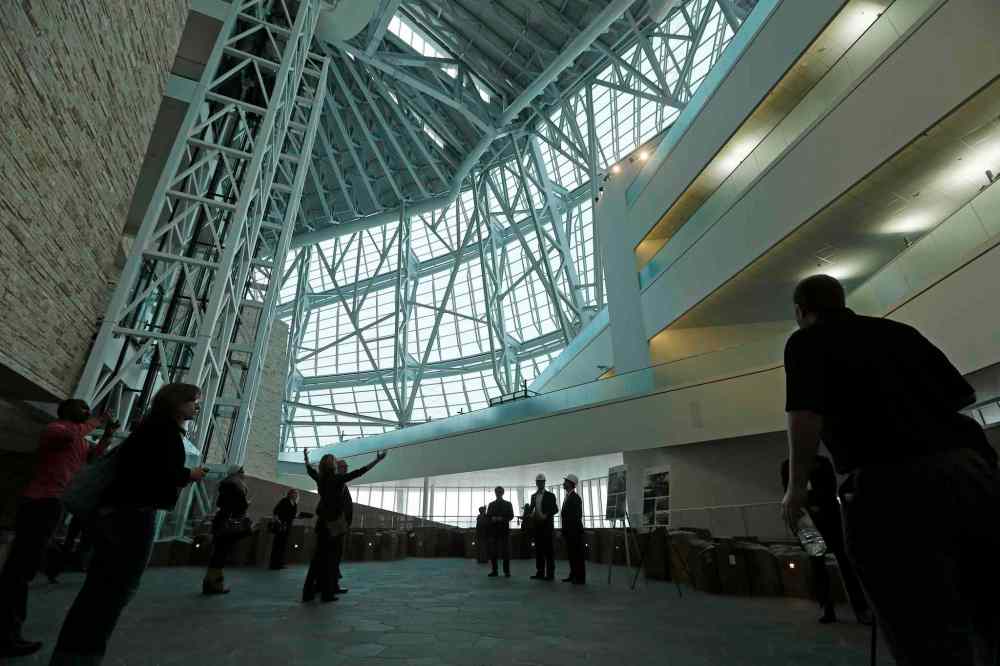
Look indeed. The much maligned, frequently doubted and profoundly misunderstood CMHR is on the precipice of becoming, finally, a going concern.
Officially, the museum won’t open until Sept. 20. That did not discourage PCL from offering journalists on Friday a first look at the more or less completed interior.
To be fair, this was not a complete tour; none of the exhibit space was open for viewing and several of the highest vantage points in the Tower of Hope were still under construction. Journalists were, however, able to get a good look at the breathtaking vantage points and nonsensical angles, pitches and elevations that distinguish this building.
Still, why a media tour and why now? Quite simply, PCL wanted to gush about what it had accomplished.
The completion of the gross majority of the public space allowed the contractor to wax poetic about the final product and the process it had undertaken to build what is easily one of the most complex structures of its kind anywhere in the world.
“This was less of a conventional building and more of a sculpture,” said Todd Craigen, the PCL executive who was CMHR construction manager for more than five years.
Notwithstanding PCL’s enthusiasm, the contractor understands there are still many people in this city, and across Canada, who would like it to be a colossal failure.
Some resent the museum is the legacy project of the late Israel Asper, who got the ball rolling on this project nearly 15 years ago. Some are offended about the cost, one-third of which is coming directly from taxpayers. And still others are offended about the esthetic of the museum itself.
Craigen said he strongly believes a visit inside a completed museum will be an antidote for many naysayers. “I think a lot of people just need to experience this building. They need to really see it in all of its glory and then they’ll understand,” he said.
Of course, PCL is hardly objective.
The people who design and build great structures have always ended up hopelessly, endlessly in love with the final product. From the engineers to electricians to the concrete mixer drivers and the iron workers who assembled the girders that hold up this improbable building, there are very few people who have laid hands on the CMHR who are ambivalent about it.
Those like Craigen who have high hopes for a higher level of public support once the museum is fully open have the comfort of knowing that despite concern over its final price tag, the CMHR has not lost its ‘wow’ factor.
When grandiose architectural concepts are mixed with taxpayer cash, there is always a high potential for the final product to lose its wow. The sponsors of these projects — usually politicians vulnerable to sudden swings in public opinion — are under relentless pressure to bring down both the cost and the complexity of the design. While many politicians hold firm, it is not unusual for great architectural ideas to die on the altar of ‘value engineering.’
That was always a concern with the CMHR. Although opinion is still split about whether the museum should have been built at all, it certainly would have aided critics if the project had been stripped and rendered to the bare bone. Opening as much less than it was designed to be would have been, simply, a self-fulfilling prophecy.

Although many taxpayers continue to question the wisdom of their efforts, CMHR CEO Stuart Murray and his political allies did not allow the breathtaking elements of the museum to be stripped away. There are missing pieces from Antoine Predock’s original design, but not enough that the museum has lost any of its elaborate appeal.
That is, however, only an assessment of the building itself. The content, which no one will see until later summer, will get an entirely separate assessment.
The tour organized by PCL did not provide enough insight to determine whether the CMHR will become the cultural icon, educational institution and a game-changing addition to Winnipeg’s skyline its sponsors so desperately want it to be.
It did, however, show clearly there is a lot of love in this building.
dan.lett@freepress.mb.ca
Dan Lett is a columnist for the Free Press, providing opinion and commentary on politics in Winnipeg and beyond. Born and raised in Toronto, Dan joined the Free Press in 1986. Read more about Dan.
Dan’s columns are built on facts and reactions, but offer his personal views through arguments and analysis. The Free Press’ editing team reviews Dan’s columns before they are posted online or published in print — part of the our tradition, since 1872, of producing reliable independent journalism. Read more about Free Press’s history and mandate, and learn how our newsroom operates.
Our newsroom depends on a growing audience of readers to power our journalism. If you are not a paid reader, please consider becoming a subscriber.
Our newsroom depends on its audience of readers to power our journalism. Thank you for your support.
More from Dan Lett on the CMHR
December 2011: Making the museum
October 2010: Glass, steel, concrete, stone… and sweat
September 2010: A portrait of the artist
Dan Lett is a columnist for the Free Press, providing opinion and commentary on politics in Winnipeg and beyond. Born and raised in Toronto, Dan joined the Free Press in 1986. Read more about Dan.
Dan’s columns are built on facts and reactions, but offer his personal views through arguments and analysis. The Free Press’ editing team reviews Dan’s columns before they are posted online or published in print — part of the our tradition, since 1872, of producing reliable independent journalism. Read more about Free Press’s history and mandate, and learn how our newsroom operates.
Our newsroom depends on a growing audience of readers to power our journalism. If you are not a paid reader, please consider becoming a subscriber.
Our newsroom depends on its audience of readers to power our journalism. Thank you for your support.
Advertisement Advertise With Us
Advertisement Advertise With Us
History
Updated on Saturday, January 11, 2014 10:08 AM CST: adds sidebar