

City considers declaring disaster
Would be eligible for financial aid to help pay cost of frozen waterlines
Advertisement
Read this article for free:
or
Already have an account? Log in here »
To continue reading, please subscribe:

Digital Subscription
One year of digital access for only $205*
- Enjoy unlimited reading on winnipegfreepress.com
- Read the E-Edition, our digital replica newspaper
- Access News Break, our award-winning app
- Play interactive puzzles
*First annual payment billed as $205.00 + GST for one year. This annual subscription will automatically renew at $233.00 + GST every 52 weeks (10% off the regular annual price of $259.35). Offer available to new and qualified returning subscribers only. Cancel any time.
To continue reading, please subscribe:
Add Free Press access to your Brandon Sun subscription for only an additional
$1 for the first 4 weeks*
- Enjoy unlimited reading on winnipegfreepress.com
- Read the E-Edition, our digital replica newspaper
- Access News Break, our award-winning app
- Play interactive puzzles
*Your next Brandon Sun subscription payment will increase by $1.00 and you will be charged $17.95 plus GST for four weeks. After four weeks, your payment will increase to $24.95 plus GST every four weeks.
Read unlimited articles for free today:
or
Already have an account? Log in here »
Hey there, time traveller!
This article was published 26/03/2014 (4507 days ago), so information in it may no longer be current.
Winnipeg might be ready for a new moniker — Disaster City.
Mayor Sam Katz confirmed city officials have considered elevating the frozen-waterlines situation from an emergency to disaster status.
The move would make the city eligible for financial assistance from Ottawa and the province.

“This winter has been extremely unique,” Katz said, adding Winnipeg has sought disaster financial assistance during recent flooding situations.
Katz said to qualify for assistance, the city has to spend about $750,000 and then additional costs would be allocated between the three levels of government.
Councillors were told reimbursing property owners for the $305 fee for thawing water pipes on private property would cost about $210,000.
The city has been accruing costs on several fronts to deal with frozen waterlines:
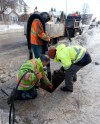
- Crews from water and waste have been working around the clock thawing frozen waterlines;
- Staff have been brought in from other departments to assist with temporary hose connections, which are being done 12 hours a day, seven days a week.
- About 40 firefighters, normally assigned to regulation enforcement, were brought in on a weekend to distribute notices to property owners in at-risk areas to leave a cold-water tap running;
- The city is absorbing the cost associated with 7,770 properties running a cold water tap 24/7, at an estimated rate of $5.40 a day per property.
The city has advised the affected property owners they could be susceptible to frozen lines until late May or early June. They could be running their cold-water taps until that time.
Coun. Paula Havixbeck estimates the city will lose $3 million in revenue from taps left running to the end of March.
“The numbers are getting up there,” Havixbeck (Charleswood-Tuxedo) said, adding she’d support seeking disaster financial assistance.
Katz said the other levels of government might argue the city is responsible for the frozen pipes, but added the move is worth considering if the costs escalate high enough.
A provincial government spokesman said much of the city’s cost to date on frozen pipes does not fit the eligibility criteria set by Ottawa for financial assistance but added Ottawa has the final decision on determining what are eligible expenses.
City hall may be getting the frozen-pipe situation under control.
The most recent update states the number of properties on the waiting list to be thawed has declined.
The city says 14 more properties reported frozen waterlines between Monday and Tuesday, increasing the number to 2,194.
But for the first time since the situation was described as an emergency, city crews were able to restore full water service to more properties (24) than were added to the list (14).
The result is the number of properties on the waiting list declined to 1,349, a drop of 10 from Monday.
“It looks very encouraging, but I just don’t want to let our guard down and have people think we’ve completely turned the corner,” said Randy Hull, Winnipeg’s emergency preparedness co-ordinator, adding the city continues to get more reports of additional properties with frozen lines — albeit in much smaller numbers.

“Certainly, it’s a positive move in the right direction.”
Hull said the city is still advising property owners in the at-risk areas, and those whose service has been restored or with temporary hoses, to continue to run a cold-water tap 24/7, adding the potential for more frozen lines will be here for several more weeks.
“We’re still very concerned the frost is creeping down,” Hull said. “There will be people with frozen taps when it’s 20 C in May. The ground will still be frozen at seven and eight feet.”
Hull said Winnipeg’s famous heavy clay soil absorbs moisture more than soils with a sandy mix and freezes rock solid, adding it simply takes longer for the frozen clay soil to thaw.
aldo.santin@freepress.mb.ca
Related Articles
Mayor, EPC thaw stance on reimbursing owners Besieged pet-shop owner quits



Advertisement Advertise With Us
Advertisement Advertise With Us