

Dead pets sad, but let’s get real
There are far greater tragedies being ignored
Advertisement
Read this article for free:
or
Already have an account? Log in here »
To continue reading, please subscribe:

Digital Subscription
One year of digital access for only $205*
- Enjoy unlimited reading on winnipegfreepress.com
- Read the E-Edition, our digital replica newspaper
- Access News Break, our award-winning app
- Play interactive puzzles
*First annual payment billed as $205.00 + GST for one year. This annual subscription will automatically renew at $233.00 + GST every 52 weeks (10% off the regular annual price of $259.35). Offer available to new and qualified returning subscribers only. Cancel any time.
To continue reading, please subscribe:
Add Free Press access to your Brandon Sun subscription for only an additional
$1 for the first 4 weeks*
- Enjoy unlimited reading on winnipegfreepress.com
- Read the E-Edition, our digital replica newspaper
- Access News Break, our award-winning app
- Play interactive puzzles
*Your next Brandon Sun subscription payment will increase by $1.00 and you will be charged $17.95 plus GST for four weeks. After four weeks, your payment will increase to $24.95 plus GST every four weeks.
Read unlimited articles for free today:
or
Already have an account? Log in here »
Hey there, time traveller!
This article was published 26/03/2014 (4512 days ago), so information in it may no longer be current.
On the front page of a newspaper, an image of a dead man or woman will spark a strong reaction.
Some readers will condemn the publication of a graphic image as exploitative or insensitive. Others will defend such a move as necessary in order to drive home the horrors of war.
It is far more unusual, however, to receive a letter or email condemning war itself.
Fighting in hockey provokes all manner of debate. So does any discussion of spanking, hazing, bullying or other forms of non-lethal violence.
And if you truly want to inflame your readership, publish a story about the death of a dog or cat, because nothing upsets a North American audience more than the unethical treatment of a house pet.
This is not a facetious statement, although it is a cynical one. The moral outrage Canadians and Americans reserve for the mistreatment of cute and cuddly domesticated creatures is nothing short of mystifying.
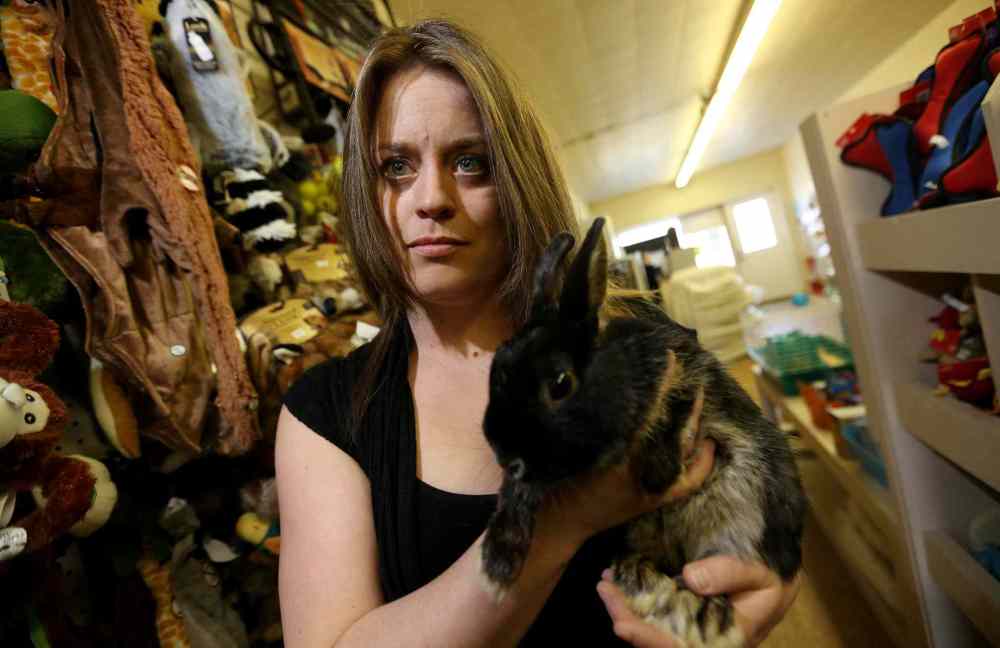
Consider the outpouring of hatred for Tanya Morgan, the soon-to-be-former owner of Pet Peripherals, a Transcona shop that’s one of thousands of Winnipeg properties deprived of water due to frozen lines.
After more than a month without water, Morgan is closing down the shop, conceding she cannot care for her animals.
She disclosed the death of 100 fish, some reptiles, one newt and several mice following her inability to ensure all the animals had enough water, sufficient humidity or could be kept sufficiently clean. Animal inspectors then descended on the shop, pursuing negligence complaints.
It may be true this pet-shop owner waited too long to seek outside help in caring for all her animals.
By no means should her actions — or inability to take action — be condoned.
But the severity of the reaction in this case is upsetting in light of the moral outrage that doesn’t accompany many other stories involving both animals and people.
The mass extinction of species taking place across the planet due to the loss of natural habitat goes mostly without comment. After all, human beings need room to live, along with somewhere to extract the timber for our houses and precious metals for our iPhones.
The loss of 90 per cent of the world’s ocean-going fish over the past few decades goes almost without mention. Who cares about overfishing when there’s always another wild stock to exploit, either deeper in the ocean or closer to one of the poles?
The acidification of those very same oceans — the most immediate effect of all that carbon dioxide building up in the atmosphere — is about to destroy aquatic ecosystems, as marine invertebrates cannot form shells.
But since you can’t cuddle up to a gastropod the way you can with a canine, who gives a periwinkle’s operculum?
On land, dogs, cats or even horses demand our sympathy. But hundreds of millions of North Americans who eat meat every day don’t seem to care about the fate of pigs raised in horrific conditions in factory farms, chickens incapable of turning around or cows fed an indigestible diet of corn feed and injected with hormones.
Animal welfare, it seems, extends only to the animals we choose to keep well within our homes. We try not to think about the ones that become sushi or stir-fry or saté skewers.
This is why supermarkets wrap up meat in tidy little styrofoam packages, devoid of any connection to anything vaguely resembling animal anatomy. Grocery chains know we don’t like to think about the fact we chow down on the dead.
But even this is nowhere near as heinous as the lack of outrage about the death of human beings.
One random example: From the 1950s to the 1970s, most of northern Manitoba’s Sayisi Dene died of homicide, exposure or abuse following the forced relocation to the town of Churchill.
It was a modern-day genocide that strangely is not part of the Manitoba public-school curriculum.
Another: The Khmer Rouge killed four million people in Cambodia in the 1970s — only three decades after the Holocaust, when the world said “never again” to genocide. Yet the mass extermination of human beings continues unabated.

In Syria, the civil war has claimed somewhere between 102,000 and 146,000 lives. In South Sudan, the recent violence has claimed about 10,000. In the Central African Republic, about 500. In Ukraine, about 100.
These statistics defy comprehension. But they are tolerated as something that simply happens somewhere else.
I’m not arguing Winnipeggers shouldn’t be concerned about animal welfare. What I am saying is this: Given the unprecedented access to information about the ecological devastation of the planet, the mistreatment of our food animals and the slaughter of our fellow humans, more moral outrage about the big picture would be useful right now.
bartley.kives@freepress.mb.ca
Why are some people more moved by animal suffering than by human suffering due to famine, war or poverty? Join the conversation in the comments below.

Advertisement Advertise With Us
Advertisement Advertise With Us
History
Updated on Wednesday, March 26, 2014 8:34 AM CDT: Adds photo, adds question for discussion