

Labour faces new challenges
Focus on changing workforce as union movement feted
Advertisement
Read this article for free:
or
Already have an account? Log in here »
To continue reading, please subscribe:
Monthly Digital Subscription
$1 per week for 24 weeks*
- Enjoy unlimited reading on winnipegfreepress.com
- Read the E-Edition, our digital replica newspaper
- Access News Break, our award-winning app
- Play interactive puzzles
*Billed as $4.00 plus GST every four weeks. After 24 weeks, price increases to the regular rate of $19.95 plus GST every four weeks. Offer available to new and qualified returning subscribers only. Cancel any time.
Monthly Digital Subscription
$4.99/week*
- Enjoy unlimited reading on winnipegfreepress.com
- Read the E-Edition, our digital replica newspaper
- Access News Break, our award-winning app
- Play interactive puzzles
*Billed as $19.95 plus GST every four weeks. Cancel any time.
To continue reading, please subscribe:
Add Free Press access to your Brandon Sun subscription for only an additional
$1 for the first 4 weeks*
*Your next subscription payment will increase by $1.00 and you will be charged $16.99 plus GST for four weeks. After four weeks, your payment will increase to $23.99 plus GST every four weeks.
Read unlimited articles for free today:
or
Already have an account? Log in here »
Hey there, time traveller!
This article was published 02/09/2014 (4181 days ago), so information in it may no longer be current.
As the workforce shifts its priorities to suit the millennial mindset, the labour movement changes along with it.
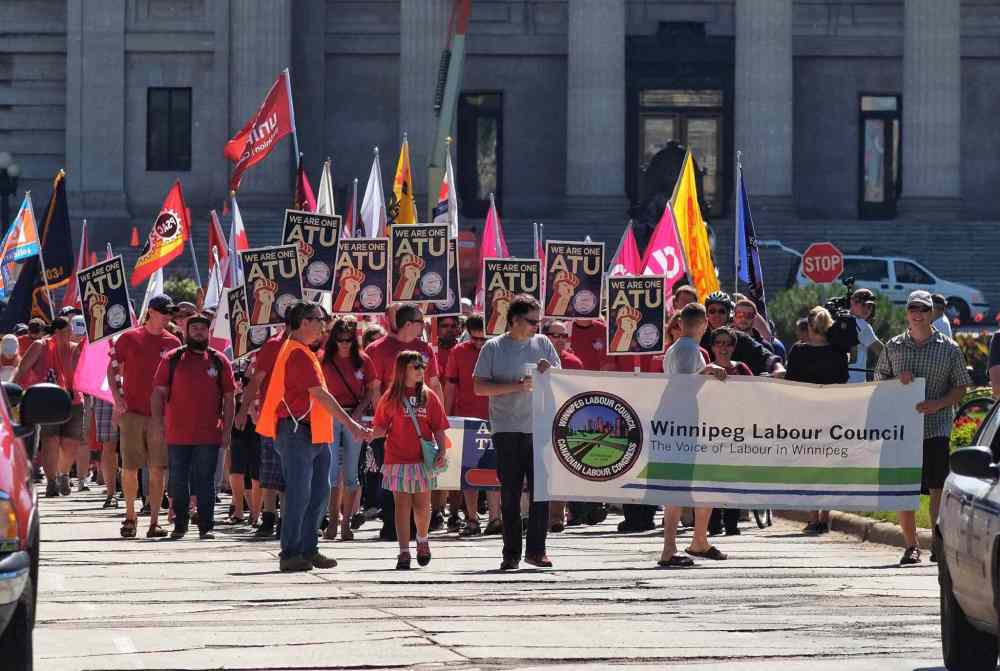
Welcome to the reality for David Sauer, president of the Winnipeg Labour Council, as he readied to march alongside workers and union members at the annual Labour Day march in Winnipeg Monday afternoon.
Manitoba’s history of a strong and determined workforce has been proudly marching in these streets for 120 years now. In recent years, whether through personal preference or staffing reshaping, there’s been a shift in membership with a younger, more transient group entering the workplace.
Sauer says the union framework still does attract the young worker, but understands the fear of moving around to where there is work has lessened.
He disputes the idea the younger worker, be it in the trades, commercial or service sector, doesn’t take any pride in earning a paycheque.
“(Young workers) move on job to job; it’s not that they don’t care about the work,” Sauer said as all the heavy union acronyms — CUPE, UFCW, MGEU, and USGE to name a few — had flags flapping in the breeze prior to Monday’s walk.
“It is a challenge, though. The history has always been that you go to one factory and you work there the rest of your life and you retire. That’s not there any longer.”
The march, which featured about 200 participants, started at Memorial Park and made its way to Vimy Ridge Park, for the annual Labour Day family picnic.
Ken Stewart is the area director for UNIFOR, Canada’s largest private-sector union with approximately 310,000 members. He says UNIFOR has started to adapt to the needs of the next generation by trying to get some health benefits for the younger, transient worker.
Those in precarious positions, say in the lower-paying service sector, need just as much help as those five to 10 years from retirement and with a full pension.
“Everyone is adapting to the changing workforce,” Stewart said. “I see younger workers struggling to find security in their jobs, and recognizing what’s going on. It’s not how it used to be for the older generations.
“Jobs are no longer careers. We have to remember that.”
Things can always be better. That was the common comment on the state of the labour movement in Manitoba. The changing workforce, the uncertainty involving corporate mergers or factory production being sent off to more cost-effective locales and the influences of government policies will always keep the labour movement on its toes, but Sauer is hopeful for the future.
There’s something to the strong history of the strong workforce in Manitoba, he says.
“We’re fortunate here, we have a very high union-density rate at around 36 per cent,” Sauer said. “If you count Quebec, which is the highest, we’re the fourth highest in Canada (only Newfoundland and Labradour and Saskatchewan have higher union densities than Manitoba).

“The history of the workforce, the General Strike in 1919, is still being built on to this day. We’re always concerned about the direction things are going in terms of the labour movement, but we’re optimistic for the future.”
John Callahan, president of the Amalgamated Transit Union (Local 1505), has worked for Winnipeg Transit for 27 years. Monday was the first time he participated in the Labour Day march.
He sums up the changing workforce and the continuing effect of the labour movement:
“The fight never ends regarding protection for workers. I don’t think that will ever change.”
adam.wazny@freepress.mb.ca
History
Updated on Tuesday, September 2, 2014 7:07 AM CDT: Replaces photo, adds slideshow