

Transit Tom: always smiling
Blog of the Week: West End Dumplings
Advertisement
Read this article for free:
or
Already have an account? Log in here »
To continue reading, please subscribe:
Monthly Digital Subscription
$1 per week for 24 weeks*
- Enjoy unlimited reading on winnipegfreepress.com
- Read the E-Edition, our digital replica newspaper
- Access News Break, our award-winning app
- Play interactive puzzles
*Billed as $4.00 plus GST every four weeks. After 24 weeks, price increases to the regular rate of $19.95 plus GST every four weeks. Offer available to new and qualified returning subscribers only. Cancel any time.
Monthly Digital Subscription
$4.99/week*
- Enjoy unlimited reading on winnipegfreepress.com
- Read the E-Edition, our digital replica newspaper
- Access News Break, our award-winning app
- Play interactive puzzles
*Billed as $19.95 plus GST every four weeks. Cancel any time.
To continue reading, please subscribe:
Add Free Press access to your Brandon Sun subscription for only an additional
$1 for the first 4 weeks*
- Enjoy unlimited reading on winnipegfreepress.com
- Read the E-Edition, our digital replica newspaper
- Access News Break, our award-winning app
- Play interactive puzzles
*Your next Brandon Sun subscription payment will increase by $1.00 and you will be charged $17.95 plus GST for four weeks. After four weeks, your payment will increase to $24.95 plus GST every four weeks.
Read unlimited articles for free today:
or
Already have an account? Log in here »
Hey there, time traveller!
This article was published 14/09/2014 (4255 days ago), so information in it may no longer be current.
THERE are few local characters as iconic as Transit Tom, the always-cheerful bus driver who has invited people to take transit andmove to the back of the bus please, since 1957. Despite the fact his heyday was 50 years ago, his name is still used interchangeably with Winnipeg Transit.
Tom was created in the late 1950s, a low point for public transportation in many North American cities.
The rolling stock of most systems was in poor shape due to wartime restrictions on the use of steel and the fact some vehicle manufacturers and related suppliers had been retooled for wartime manufacturing. The Winnipeg Electric Company (WECo), the citys privately owned transit provider, struggled to keep its fleet of aging streetcars and small buses on the road.
After the war came the development of vast new suburbs. Their sparse density was geared more toward car users than transit users, and the public began turning its back on public transportation. Still, transit was expected to provide service to these new areas even though they were money-losing routes.
Though WECo boasted about the strides it was making not only to catch up with years of lost investment, but to create a public transportation system of the future, there were many who complained it did not have the capital, or the will, to spend the money necessary to do this.
The Greater Winnipeg Transit Commission (GWTC) was formed in May 1953, when the Province of Manitoba took over the assets of WECo. The GWTC sped up the modernization of rolling stock and the expansion of service to new suburbs. It did away with streetcars in 1955 in favour of electric trolleys and more diesel buses that gave routes more flexibility. It also invested in modern garages in St. James and the North End.
Despite this investment, the bleeding of passengers continued. Through the 1920s, Winnipegs transit system averaged about 50 million paying passengers per year. This dropped to around 40 million per year during the Depression.
In 1946, a record year for transit, the number surpassed the 100-million mark before starting a steady decline. In 1954, it was down to 74 million and by 1958, just 60 million. In 2003, Winnipeg Transit had 40 million passengers, a number that rose to 50 million in 2013. To make its investment pay off and take the strain off increasingly clogged roadways, the GWTC was under pressure to win back passengers. In 1957, it rolled out a new marketing campaign that it referred to as acrusade.
John Bloomberg, chairman of the GWTC, explained:We call it a crusade rather than a campaign because all citizens stand to benefit in one way or another from its success. The public face for this crusade was a likeable bus driver named Transit Tom. The artist responsible for the character isnt known, though he was most likely designed in-house by Transits marketing department.
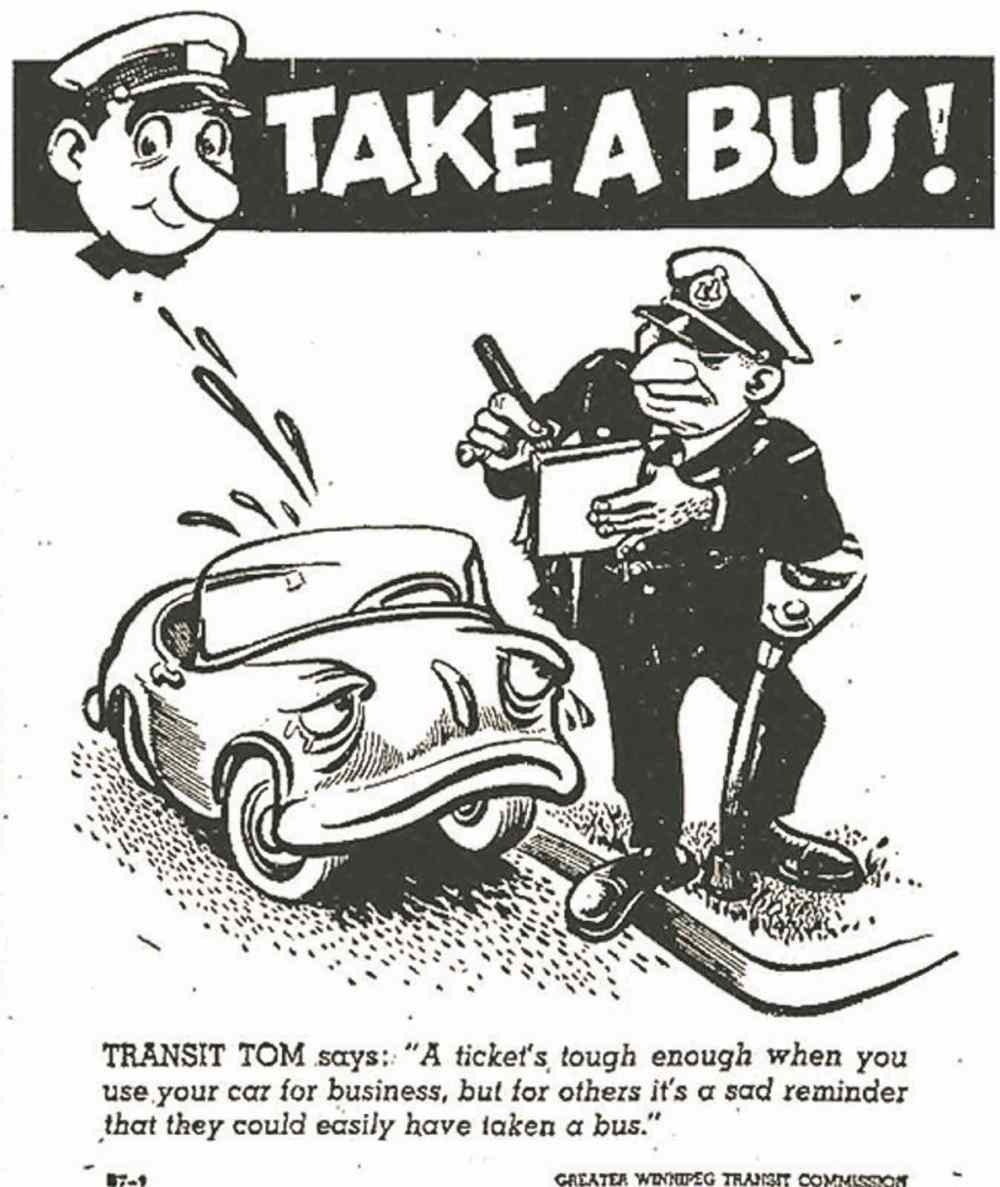
Transit Tom appeared in a series of 16 newspaper ads that appeared between September 1957 and March 1958. They featured cartoons showing a motorist in an angry, exasperated state followed by a quip from a smiling Tom.
Transit Tom Says: Hold your horses, theres only a couple of hundred people ahead of you! Could all go in five buses, but theyre all driving cars, so that means a mile of traffic up front. Set an example TAKE A BUS!
Transit Tom says: Didja ever figure what it costs to drive your car downtown apart from parking fees and fines? Stop streets, school crossings, red lights and traffic snarls all combine to devour gas and oil. Better TAKE A BUS. The crusade also consisted of radio ads, billboards and other printed material.
Within a few weeks, Transit Tom became synonymous with Winnipeg Transit. Newspaper stories, letters to the editor and ads selling everything from cars to homes, referred to the service by the cartoon characters name.
After the initial series of cartoon ads, Transit Tom turned his attention to more serious matters. He introduced new rolling stock and infrastructure projects and announced service extensions to new parts of the city. He also pointed out the economic advantages of taking the bus and touted the safety record of the system and its drivers.
The GWTC became Metro Transit in January 1961, and Toms image stuck around until 1963 before disappearing.
During the next few decades, his image popped up every now and then. A newer, fitter-looking Transit Tom was used in the late 1960s on window stickers that reminded people to move to the back of the bus. These were used off and on until the early 2000s.

In the mid-1970s his image was revived for a marketing campaign to get passengers to payexact fare only.This campaign even included a human version of Tom in television commercials. Another rebirth took place around 2010, when Winnipeg Transit began updating its street furniture. Toms 1950s image was used on route maps.
He also appears at points along the rapid transit route. In all this time, the only biographical information that appeared about Transit Tom came in a 1963 ad that touted a team of five transit operators who won a city-wide award for first aid proficiency. The title asked,Who is the Real Transit Tom?and described him asa conscientious, civic-minded citizen helping you, on the job and off.
Christian Cassidy writes about local history at his blog West End Dumplings. Check it out for more images of Transit Tom through the decades!