

The supersized schnoz
Advertisement
Read this article for free:
or
Already have an account? Log in here »
To continue reading, please subscribe:
Digital Subscription
One year of digital access for only $1.44 a week*
- Enjoy unlimited reading on winnipegfreepress.com
- Read the E-Edition, our digital replica newspaper
- Access News Break, our award-winning app
- Play interactive puzzles
*Billed as $5.77 plus GST every four weeks. After 52 weeks, price increases to the regular rate of $19.95 plus GST every four weeks. Offer available to new and qualified returning subscribers only. Cancel any time.
To continue reading, please subscribe:
Add Free Press access to your Brandon Sun subscription for only an additional
$1 for the first 4 weeks*
- Enjoy unlimited reading on winnipegfreepress.com
- Read the E-Edition, our digital replica newspaper
- Access News Break, our award-winning app
- Play interactive puzzles
*Your next Brandon Sun subscription payment will increase by $1.00 and you will be charged $17.95 plus GST for four weeks. After four weeks, your payment will increase to $24.95 plus GST every four weeks.
Read unlimited articles for free today:
or
Already have an account? Log in here »
Hey there, time traveller!
This article was published 27/09/2014 (4272 days ago), so information in it may no longer be current.
T. rex may have had the most magnificent chompers in the prehistoric world, but he’s definitely getting nosed out by a recently discovered dinosaur.
Scientists have stumbled on the remains of a 75-million-year-old, 30-foot hadrosaur — a plant-eating, duck-billed dinosaur — with a snout so huge it’s been dubbed Rhinorex condrupus, or “King Nose.”
Rhinorex’s remains were first discovered encased in sandstone in Utah’s Book Cliffs in the 1990s, then were stored and forgotten at Brigham Young University until recently, when researchers began to reconstruct the fossil and realized they’d found a brand new species.
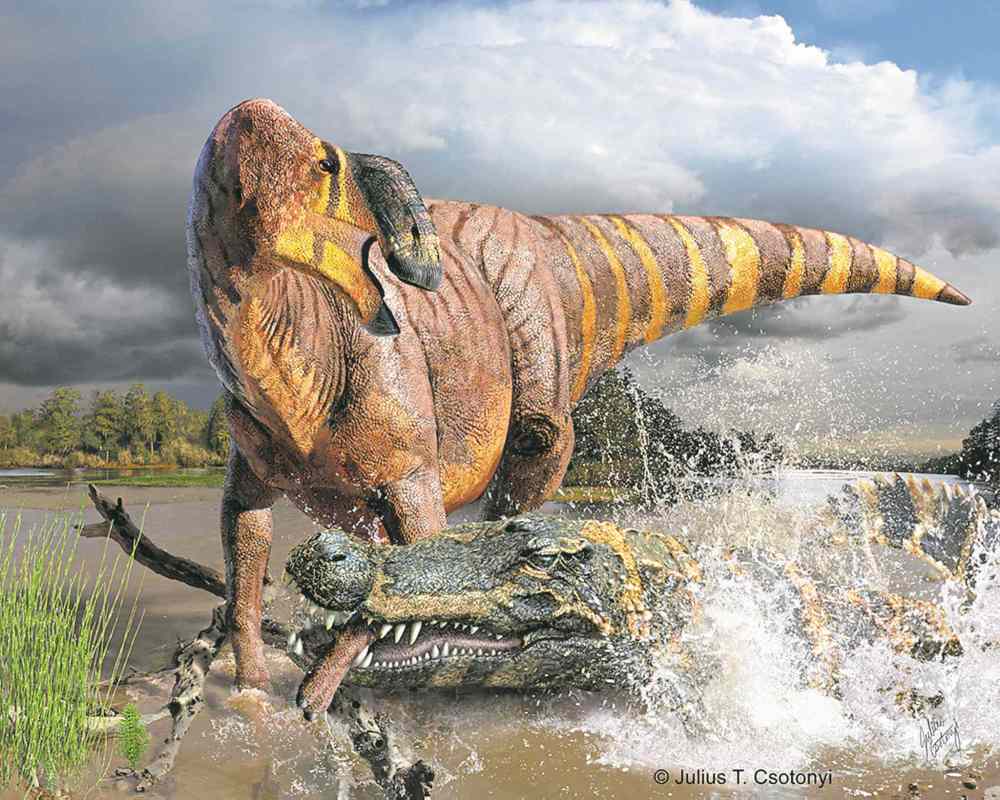
Unlike other Cretaceous hadrosaurs, usually identified by bony crests extending from their skull, Rhinorex possessed a different defining feature — a gigantic nose. Weighing in at a whopping 8,500 pounds, the swamp-dwelling beast had one of the biggest body-to-nose ratios of any dinosaur yet discovered.
So what’s up with the super schnoz? According to researcher Terry Gates from North Carolina State University: “The purpose of the big nose is still a mystery. If this dinosaur is anything like its relatives then it likely did not have a super sense of smell; but maybe the nose was used as a means of attracting mates, recognizing members of its species or even as a large attachment for a plant-smashing beak. We are already sniffing out answers to these questions.”
We are not paleontologists, but we know a huge discovery when we smell one. It’s the perfect reason to take a look back at five of the most notable noses in human history:
5) Jimmy Durante (1893-1980) — How big was Rhinorex’s super-sized beak? It was so big that, in a news release announcing the dinosaur’s discovery, the researchers described it as, and we will quote them directly, the “Jimmy Durante of dinosaurs.” Which is probably meaningless to anyone under the age of 50, which is sad, because Durante owned one of the most significant sniffers in history. A jazz musician, comedian, film and TV star, singer, radio personality and humanitarian, Durante did it all in a show business career spanning 50 years. One of the most beloved and imitated performers of the 20th century — he narrated and sang in the 1969 Christmas TV classic Frosty the Snowman — Durante was best known for constantly joking about his elongated proboscis, earning himself the nicknames “The Schnoz” or “The Great Schnozzola.” In the 1947 film It Happened in Brooklyn, Durante famously says to Frank Sinatra: “Why only last year the kids asked me to sing at their graduation exercises. I did, but I made a ghastly mistake. I didn’t sing from the heart; I sang from the nose.” When Sinatra asks how it sounded, Durante chirps: “I don’t know. The note hasn’t come out yet.” He comically mangled the English language and was famous for catchphrases like “Everybody wants ta get inta da act!” and “Goodnight, Mrs. Calabash, wherever you are.” He died Jan. 29, 1980, and, nose aside, his career was nothing to sniff at.
4) Katherine “Big Nose Kate” Elder (1850-1940) — It’s difficult to pin down the truth about this legendary character of the Old West, but she is best known as a Hungarian-born prostitute who became the longtime companion, and possibly common-law wife, of legendary gunfighter Doc Holliday, himself best known as the sidekick of famed U.S. lawman Wyatt Earp. She has been described as a “rip-roaring, hard-drinking, gun-slinging prostitute,” but we prefer reports that paint her as “a soiled dove” of the American Old West. While possessing a bulbous beak, she reportedly earned her unflattering nickname — which history tells us she accepted good-naturedly — because she had a habit of sticking her nose in other people’s business. There are more stories about Kate (most impossible to prove) than you could point a six-shooter at, but our favourite tells how she rescued her lover after he fatally stabbed a bully who was cheating at cards in Fort Griffin, Texas. The story says the bully pulled a pistol on Doc, who slashed him in self-defence, but was still arrested and locked up in a local hotel. According to the website Legends of America: ” ‘Big Nose’ Kate devised a plan to free Holliday from his confines. Setting a fire to an old shed, it began to burn rapidly, threatening to engulf the entire town. As everyone else was involved in fighting the fire, she confronted the officer guarding Holliday with a pistol in each hand, disarmed the guard and the two escaped.” Yes, they got away… by a nose.
3) Cleopatra (69 BC-30 BC) — No, we are not referring to the strikingly beautiful version of the Queen of Egypt portrayed by the gorgeous Elizabeth Taylor in the sprawling 1963 epic film. We are referring to the real Cleopatra, one of the most famous female rulers in history, the last active pharaoh of ancient Egypt and lover of Roman leaders Julius Caesar and Mark Antony. Considered one of the most beautiful women of her time, she was also the owner of one of history’s most famous noses. She is depicted on some ancient coins as frizzy-haired with a hooked nose and jutting chin. French mathematician and philosopher Blaise Pascal, who lived in the 1600s and who himself possessed an impressive snout, famously wrote: “Cleopatra’s nose, had it been shorter, the whole face of the world would have changed.” What did he mean? Well, it might have been something about how, in the ancient world, a strong nose symbolized strong character, therefore a weaker beak would have meant Cleopatra lacked the impressive nasal capacity required to change the world. But no one really knows, if you catch our subtle wordplay.
2) Tycho Brahe (1546-1601) — On the one hand, Tycho was a genius, a sixteenth-century Danish astronomer who invented the most precise viewing instruments prior to the creation of the telescope, and helped reshape our understanding of the solar system. But he was also a man with a flamboyant lifestyle that would have made Justin Bieber look like a choir boy. In 1566, at the age of 20, he lost part of his nose in a duel with fellow Danish nobleman Manderup Parsbjerg, who also happened to be his third cousin. The duel, by all accounts, was sparked by a dispute over (Why not?) a mathematical formula. For the rest of his life, this genius sported a fake nose, probably made of copper or brass, though he also likely had gold and silver noses on hand for special occasions. He lugged around a small box of paste to keep the mock nose in place. Which somehow brings us to his pet moose (although some accounts suggest it was an elk). It seems the famed astronomer kept the tame beast as a prized pet, sent it to entertain another nobleman and, after somehow consuming vast amounts of beer, it fell down the castle steps and died. You can’t make this stuff up, heaven knows.

1) Savien Cyrano de Bergerac (1619-1655) — They say Kleenex knows noses like no one knows noses, but when it comes to legendary noses, the tissue stops on the legendary honker of Cyrano de Bergerac. What you may not know is that, along with being the fictionalized hero of movies and plays, he was also a real human being, a French soldier, satirist and duelist. Portraits at the time suggest Cyrano did have a large nose, though nothing like the monstrosity bestowed upon him in fictional works. He is said to have fought countless duels while in the army, possibly because it was the best way to earn a reputation. In French poet Edmond Rostand’s famed 1897 play, he is a gifted swordsman and wordsmith racked by self-doubt over his huge honker, which foes insult at their peril. (Sample quote from Cyrano: “My nose is gargantuan! You little pig-snout, you tiny monkey-nostrils… a great nose is the banner of a great man.”) Unable to express his love for his distant cousin, Roxane, he uses his gift with words to help a traditionally handsome, albeit less articulate, friend woo her instead. Sniff!
What we are trying to say is, there have been many great noses, both large and small, real and fake, throughout history. Size has nothing to do with it. And that’s as plain as the nose on your face.
doug.speirs@freepress.mb.ca