

Scots slam perceived snub
Say role in Upper Fort Garry not given credit due
Advertisement
Read this article for free:
or
Already have an account? Log in here »
To continue reading, please subscribe:

Digital Subscription
One year of digital access for only $205*
- Enjoy unlimited reading on winnipegfreepress.com
- Read the E-Edition, our digital replica newspaper
- Access News Break, our award-winning app
- Play interactive puzzles
*First annual payment billed as $205.00 + GST for one year. This annual subscription will automatically renew at $233.00 + GST every 52 weeks (10% off the regular annual price of $259.35). Offer available to new and qualified returning subscribers only. Cancel any time.
To continue reading, please subscribe:
Add Free Press access to your Brandon Sun subscription for only an additional
$1 for the first 4 weeks*
- Enjoy unlimited reading on winnipegfreepress.com
- Read the E-Edition, our digital replica newspaper
- Access News Break, our award-winning app
- Play interactive puzzles
*Your next Brandon Sun subscription payment will increase by $1.00 and you will be charged $17.95 plus GST for four weeks. After four weeks, your payment will increase to $24.95 plus GST every four weeks.
Read unlimited articles for free today:
or
Already have an account? Log in here »
Hey there, time traveller!
This article was published 17/10/2014 (4323 days ago), so information in it may no longer be current.
While construction proceeds on the site of Upper Fort Garry, the multimillion-dollar provincial heritage park, slated to open Saturday, is already mired in criticism.
Construction workers were still pouring concrete Thursday ahead of the grand opening. And like the nearby Canadian Museum for Human Rights, the site will be far from complete when it’s officially opened. A wall of history and an interpretative centre have yet to be built.
Behind the scenes, the approved content for the fort’s history, like some of the content of the CMHR, is under attack from one of the province’s founding cultural groups.
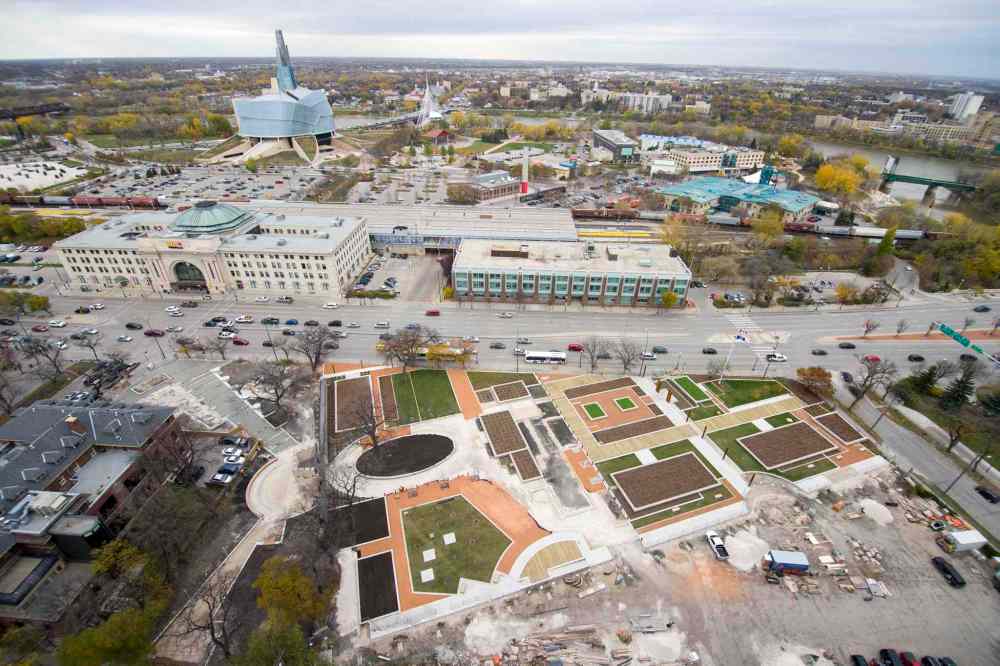
The province’s Scottish population — which founded the fort through the Hudson’s Bay Co. and maintained it for all but a single year in the 19th century — says it feels the sting of being sidelined by the official interpretation of history at the fort’s grand reopening.
Only one group, the Métis, was awarded a key cultural role in the fort’s history by virtue of a brief but tumultuous and pivotal period when the fort served as a key location for the Red River Resistance under Métis leader Louis Riel in 1869-70.
The province’s largest Scottish council, representing military, cultural, historical and clan associations, publicly expressed its disappointment.
“The site is physically a wonderful addition to downtown,” said Scottish Heritage Council president John Perrin on a tour of the site Thursday. “There’s no concern about that. The concern is how events at the fort will be interpreted.”
Perrin ticked off a list of oversights: None of the promotional material on the Upper Fort Garry website or planning documents recognizes Upper Fort Garry’s history as a Hudson’s Bay Co. fort; its integral links with Lord Selkirk and the Selkirk settlers who formed the first European colony on the Red River; the Wolseley Regiment the Dominion of Canada ordered west to enforce the Manitoba Act and the subsequent military regiments with an association to the fort, or even the Scottish masons who built the fort in the first place.
“Yet this place has one of the most intimate relationships with Scots in Canada,” Perrin said.
“There’s an odd, brief mention of the Scots here but not a full accounting. The council’s view is simple: ‘Give us a balance of history.’ We don’t want to be excluded or marginalized. And we don’t want anybody else’s history to be excluded, either,” Perrin said.
So on Saturday, when organizers open Upper Fort Garry as the province’s newest historical touchstone and tourist destination with Ojibwa prayers, a Scottish piper and a firm focus on the Métis contribution to the fort’s history, the focus will be fundamentally unfair, Perrin said.
Email requests for comment from the province and a group of influential and wealthy supporters who raised an estimated $10 million for the work went unanswered on Thursday.
The province’s Scots don’t believe the misplaced focus on a single ethnic group can be laid at the door of the project’s backers.
But through their spokesman, they say it’s unknown how the oversight escaped notice after seven years of tireless work by a dedicated group of volunteers under the fundraising umbrella called the Friends of Upper Fort Garry. The Friends have been publicly praised for bringing a neglected piece of the province’s early history back to life, they said. The group used its considerable influence, for instance, to raise $10 million in 107 days to purchase the site for development in 2008, an achievement the group boasts about on its website.
The group’s website also emphasizes the fort’s importance to the province’s history, even incorporating a quote from one of Canada’s foremost historical and cultural commentators, John Ralston Saul, who called Upper Fort Garry a “linchpin of Canadian history.”
All of which makes the focus on the Métis chapter to the near-exclusion of every other part of the fort’s history all the more mystifying, Perrin said.

A planning document obtained by Free Press, however, makes it clear the Métis chapter was deliberately chosen as the most influential contribution in the fort’s history.
The 80-page Upper Fort Garry Heritage Park and Interpretive Centre called for a specific focus on the Métis experience at the fort, under a heading entitled Upper Fort Garry and the Red River Resistance.
The document also stated planners cut specific themes from a list of priorities to be recognized as critical to the fort’s history. The Hudson’s Bay Co., its role with aboriginal peoples, and the fur trade were cut and listed as “opportunities to revisit in future phases of the project.”
alexandra.paul@freepress.mb.ca
Why does Winnipeg seem to have so much trouble completing projects such as museums and historic parks? Join the conversation in the comments below.
Upper Fort Garry: A CHRONOLOGY
- The Hudson’s Bay Co. fur trade post was located at the forks of the Red and Assiniboine rivers.
- Built on the site of the rival North West Co. fur trade post Fort Gibraltar in 1822 and the successor to the Selkirk settlers’ Fort Douglas.
- Named after Nicholas Garry, deputy governor of the Hudson’s Bay Co..
- Destroyed by flood in 1826.
- Rebuilt in 1835 on higher ground at its current location on Main Street.
- In 1869, the fort was seized by Louis Riel and became the focus of the Red River Resistance and Riel’s provisional government, which lit the fuse that blasted Manitoba into Confederation.
- Canada’s first prime minister, John A. Macdonald, sent fellow Scot Donald A. Smith out to settle the rebellion without conceding to the demands to be a province. Smith found himself sympathizing with the Red River colony’s concerns for its independence, eventually rallying the settlement, including the Métis, into sending a delegation to Ottawa to talk Macdonald into granting the colony entry into Confederation as a province. The Manitoba Act was passed into law in 1870. Macdonald never forgave Smith for the political betrayal.
- In 1873, the name “Winnipeg” replaced “Fort Garry” for the city that was growing up on the banks of The Forks.
- Over a period of three years, from 1881 to 1884, the fort was demolished to straighten Main Street.
— sources include the Scottish Heritage Council
Related Articles
Friends of Upper Fort Garry say park's primary significance is the Métis Resistance
Advertisement Advertise With Us
Advertisement Advertise With Us
History
Updated on Friday, October 17, 2014 6:50 AM CDT: Replaces photo, adds question
Updated on Friday, October 17, 2014 8:00 AM CDT: Adds slideshow