

Apologizing for breaking PST promise and admitting he forced it on cabinet may have saved premier

Advertisement
Read this article for free:
or
Already have an account? Log in here »
To continue reading, please subscribe:

Digital Subscription
One year of digital access for only $205*
- Enjoy unlimited reading on winnipegfreepress.com
- Read the E-Edition, our digital replica newspaper
- Access News Break, our award-winning app
- Play interactive puzzles
*First annual payment billed as $205.00 + GST for one year. This annual subscription will automatically renew at $233.00 + GST every 52 weeks (10% off the regular annual price of $259.35). Offer available to new and qualified returning subscribers only. Cancel any time.
To continue reading, please subscribe:
Add Free Press access to your Brandon Sun subscription for only an additional
$1 for the first 4 weeks*
- Enjoy unlimited reading on winnipegfreepress.com
- Read the E-Edition, our digital replica newspaper
- Access News Break, our award-winning app
- Play interactive puzzles
*Your next Brandon Sun subscription payment will increase by $1.00 and you will be charged $17.95 plus GST for four weeks. After four weeks, your payment will increase to $24.95 plus GST every four weeks.
Read unlimited articles for free today:
or
Already have an account? Log in here »
Hey there, time traveller!
This article was published 06/11/2014 (4336 days ago), so information in it may no longer be current.
“It was a decision I recommended (to cabinet) and we discussed and felt that of all the alternatives, this was the one that will allow us to meet Manitobans’ priorities.”
— Premier Greg Selinger in December 2013, discussing the decision to hike the PST to fund infrastructure.
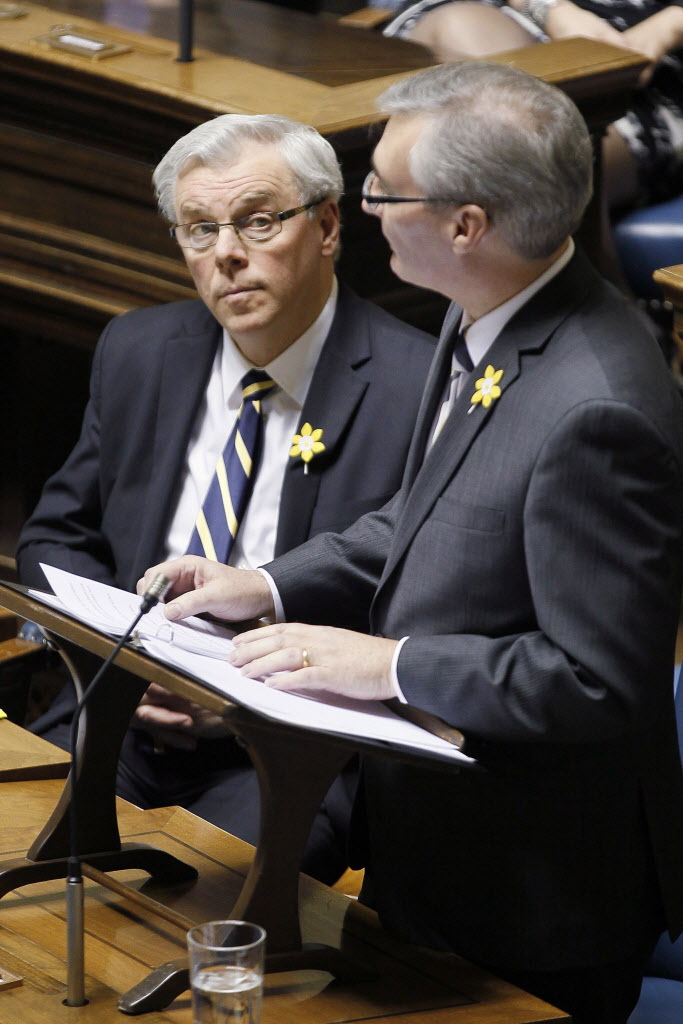
The beginning of the end of Premier Greg Selinger’s leadership started, ironically enough, on April Fool’s Day in 2013.
On that Monday, which was also Easter Monday, Selinger was calling a few influential members of his cabinet to let them know he had made a drastic decision related to the next provincial budget, to be tabled in just a few days.
Unbeknownst to all but one or two cabinet ministers, Selinger decided on his own the previous week to raise the provincial sales tax by one point to fund infrastructure. It was an idea that had been debated extensively among municipal and business leaders, many of whom wanted the tax raised. Despite this, Selinger had always dismissed the idea out of hand. Until now.
In those phone calls, and at a meeting of cabinet the next day, Selinger told his ministers the tax hike was going ahead so the province could increase the total amount of infrastructure funding and reap the benefits of the economic growth that would come with the investment without adding to the deficit.
That growth would, Selinger argued, buoy sagging provincial revenues and help keep the NDP government on target to eliminate the deficit by the 2016-17 budget.
Facing cabinet later that week, Selinger explained his rationale and then asked for complete unity in endorsing the decision. Many of the cabinet ministers were too shocked to say anything, sources said. Most of them had spent the weeks leading up to the budget scrambling to squeeze every last penny from their departmental budgets.
It was generally believed, the sources said, a large basket of small spending cuts and fee increases could boost the bottom line enough to get them through the fiscal year. Many also believed Selinger might consider pushing back the date for balancing the budget, which he had done the year before.
Government sources confirmed several ministers — including Theresa Oswald, Gord Mackintosh and Nancy Allan — objected to Selinger’s request that the decision be recorded in the minutes of the meeting as unanimous. Sources also said Jennifer Howard, who was house leader and family services minister at the time, said she was deeply concerned about the ability to get legislation enacting the tax increase and bypassing the need for a referendum through the legislature.
Several ministers asked the words “on division” be noted in the record, parliamentary language for a decision that is not unanimous. That set off an angry exchange between Selinger and his opponents that left many in the room shaken. The cabinet meeting had been a disaster.
But that was not the only hurdle Selinger had to overcome on the way to budget day. Traditionally, the premier affords caucus a full budget briefing before it is tabled in the legislature. In 2013, this was scheduled to happen on April 15, the day before the budget.
The sources said many of the ministers most opposed to the PST hike argued caucus would act as an important reality check for the premier. The MLAs were surely to react negatively given there was no communications strategy, nor was there a plan to rally the support of municipal and business leaders or help MLAs defend the decision in their constituencies.
However, sources said Selinger did not mention anything about the tax hike when briefing caucus. NDP MLAs only found out about it a few hours before then-finance minister Stan Struthers rose in the legislature to read the budget speech.
Selinger later explained he was worried about a leak of the tax information, sources said. However, his opponents in caucus believed the real reason was to prevent anyone from trying to talk him out of the plan.
What is perhaps remarkable is that even with the way Selinger sprung the PST plan on his own cabinet and caucus, there were no obvious signs of dissent in the wake of the budget. The NDP struggled mightily in its first full year to sell the tax hike to the public. But by the 2014-15 budget, there were some signs the public was focused more on the positive effect of the tax hike and less on the tax hike itself.
Selinger shuffled his cabinet in the fall of 2013, placing ministers such as Oswald (jobs and the economy) and Howard (finance) on point to promote the effects of the tax hike. With those two ministers on lead, the government’s message became focused. Municipal and business leaders began to speak in more favourable terms about the hike.
However, the wounds from the initial rollout of the tax hike had not entirely healed. The concern for Selinger was that his personal popularity began to fall below his party’s popularity. In politics, once a leader is less popular than the party he or she leads, it is a death knell. It means they are a drag on their party’s prospects.
And there had been other political concerns within the NDP. Selinger forced out longtime strategist Michael Balagus, Gary Doer’s chief of staff and the man who had managed the NDP’s remarkable 2011 election campaign.
Then came a string of minor political stumbles. From a scandal over the cabinet misuse of Winnipeg Jets season tickets to the painfully slow response to the Christine Melnick affair. Selinger’s critics within his own party were gaining new ammunition to challenge his leadership.
NDP sources said the pressure on Selinger picked up again in May when the prospect of an April 2016 election came into view. Many began to openly encourage him to do as Ontario premier Dalton McGuinty had done in the fall of 2012, and resign to allow a new leader to rebrand the party.
The concern, numerous sources noted, was not about the decision to raise the PST; many caucus sources indicated they had heard a remarkably positive reaction from constituents about the decision given the positive effect it was having on infrastructure.
The lingering concern was that even for those people who did not mind paying the tax increase, many felt they had been deceived by Selinger in the 2011 election when he promised he would never raise the PST.
Throughout May and the summer months, sources confirmed Selinger received unsolicited advice from cabinet ministers and MLAs asking him to consider stepping down. Several went as far as to ask him to participate in planning an orderly retirement. In all instances, however, Selinger listened calmly but refused to step down.
The standoff continued into late September and the caucus retreat in Brandon that appears to have ignited the current uprising in NDP ranks. At that meeting, poll results showing the party reaching “annihilation territory,” as the NDP pollster put it, sent a wave of panic through the caucus. This kicked off another wave of back-channel appeals to Selinger to resign. Appeals that ultimately became public in late October.
It has been said, particularly in this column, that effective political leadership typically involves a lot of central control. That is just the nature of the game. However, it has also been pointed out that power like that cannot be sustained without the confidence of the caucus and party membership on the whole. In other words, you don’t need consensus, but you need enough support that nobody challenges your authority to make tough decisions.
In this instance, Selinger forged ahead with a bold decision knowing it was risky, both to himself and his party. He clearly thought about it a long time, and no doubt the final decision was a difficult one.
However, for reasons that are still unclear, Selinger did not feel obligated to cultivate support in cabinet or caucus. In fact, it appears he may have made the decision to include this in the budget without formal cabinet approval.
As well, Selinger was unable to make a decision in a timely fashion to devise a strategy to sell it to the public and win the support of municipal and business leaders who were already on the record supporting a plan to raise the PST.
All along, it has been difficult to connect the gravity of Selinger’s mistakes with the gravity of the response from his dissidents. The decision by five of the most influential members of cabinet to resign, and publicly dare the premier to do similarly, is pretty serious stuff. For the most part, the dissidents made themselves look like impetuous whiners who were quitting their cabinet positions because they didn’t get their way.
What we see in a deeper analysis is a leader who, for reasons of expediency or blind ambition, forged ahead with a risky decision without first earning the trust and support of his own caucus.
Even worse, when asked about whether his caucus and cabinet supported the decision to raise the PST, Selinger refused to acknowledge the decision to raise the tax was really his alone. He also would not admit he imposed the decision on his cabinet rather than “suggest” it, as he has said many times.

In a recent interview, Selinger was asked if he felt a personal obligation to apologize for breaking his earlier promise not to raise the tax, and if that would help Manitobans focus less on his 2011 pledge and more on improvements to infrastructure.
Selinger said while he takes responsibility for the decision, ultimately, “It is cabinet that makes decisions. We had honest and thorough debates about (the PST).”
The irony here is the thing his cabinet ministers and MLAs wanted most — an explicit apology to Manitobans for breaking his word, and an acknowledgement that he alone had led his government to the PST decision — was also the thing that could have saved his relationship with voters and, ultimately, his leadership.
Now, it seems unlikely any act of contrition can save this premier.
dan.lett@freepress.mb.ca
Dan Lett is a columnist for the Free Press, providing opinion and commentary on politics in Winnipeg and beyond. Born and raised in Toronto, Dan joined the Free Press in 1986. Read more about Dan.
Dan’s columns are built on facts and reactions, but offer his personal views through arguments and analysis. The Free Press’ editing team reviews Dan’s columns before they are posted online or published in print — part of the our tradition, since 1872, of producing reliable independent journalism. Read more about Free Press’s history and mandate, and learn how our newsroom operates.
Our newsroom depends on a growing audience of readers to power our journalism. If you are not a paid reader, please consider becoming a subscriber.
Our newsroom depends on its audience of readers to power our journalism. Thank you for your support.
Dan Lett is a columnist for the Free Press, providing opinion and commentary on politics in Winnipeg and beyond. Born and raised in Toronto, Dan joined the Free Press in 1986. Read more about Dan.
Dan’s columns are built on facts and reactions, but offer his personal views through arguments and analysis. The Free Press’ editing team reviews Dan’s columns before they are posted online or published in print — part of the our tradition, since 1872, of producing reliable independent journalism. Read more about Free Press’s history and mandate, and learn how our newsroom operates.
Our newsroom depends on a growing audience of readers to power our journalism. If you are not a paid reader, please consider becoming a subscriber.
Our newsroom depends on its audience of readers to power our journalism. Thank you for your support.
Related Articles
NDP to face tough questions in fall session
Advertisement Advertise With Us
Advertisement Advertise With Us
History
Updated on Thursday, November 6, 2014 6:33 AM CST: Replaces photo, changes headline