

Exercise for healthy minds
Program a boon for seniors with forms of dementia

Advertisement
Read this article for free:
or
Already have an account? Log in here »
To continue reading, please subscribe:
Digital Subscription
One year of digital access for only $1.44 a week*
- Enjoy unlimited reading on winnipegfreepress.com
- Read the E-Edition, our digital replica newspaper
- Access News Break, our award-winning app
- Play interactive puzzles
*Billed as $5.77 plus GST every four weeks. After 52 weeks, price increases to the regular rate of $19.95 plus GST every four weeks. Offer available to new and qualified returning subscribers only. Cancel any time.
To continue reading, please subscribe:
Add Free Press access to your Brandon Sun subscription for only an additional
$1 for the first 4 weeks*
- Enjoy unlimited reading on winnipegfreepress.com
- Read the E-Edition, our digital replica newspaper
- Access News Break, our award-winning app
- Play interactive puzzles
*Your next Brandon Sun subscription payment will increase by $1.00 and you will be charged $17.95 plus GST for four weeks. After four weeks, your payment will increase to $24.95 plus GST every four weeks.
Read unlimited articles for free today:
or
Already have an account? Log in here »
Hey there, time traveller!
This article was published 01/12/2014 (4210 days ago), so information in it may no longer be current.
At the back of a classroom, a couple married many years ago rehearses lines from Shakespeare’s Romeo and Juliet. It’s the scene where the two star-crossed lovers first meet.
“Remember, Romeo, you have a crush on a young girl,” volunteer Alan Macintosh directs Henk Schippers, helping him get into character.
“But soft, what light through yonder window breaks? It is the east and Juliet is the sun,” he says to his Juliet, wife Marcia. The tenderness and love they portray cut through the fog they and others around them see — Henk has Alzheimer’s disease.
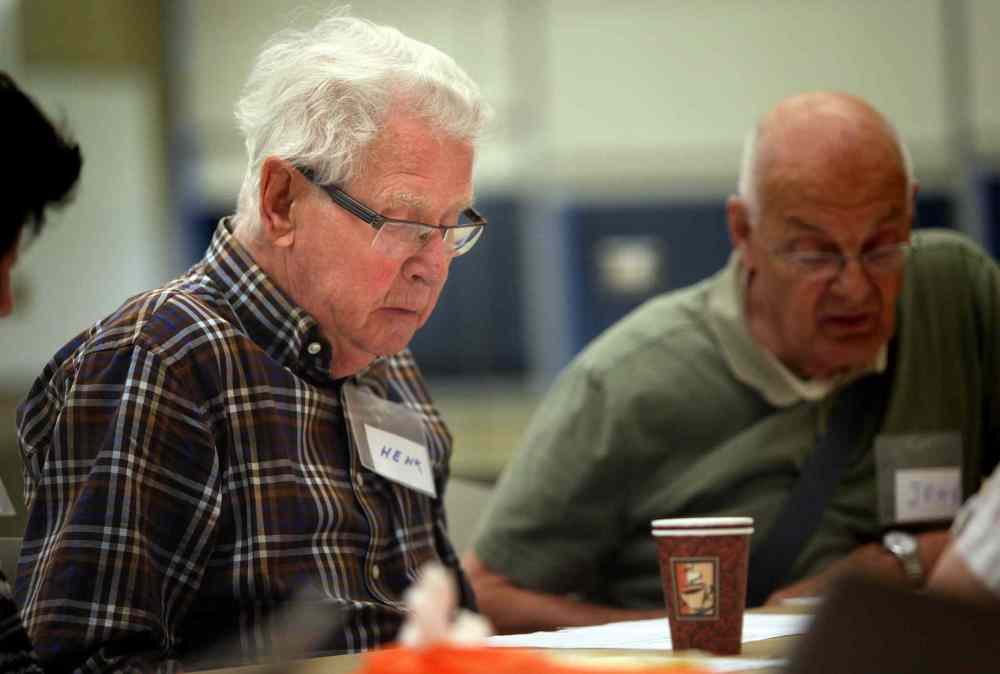
The Schippers’ role-playing is part of Minds in Motion, a new pilot program in Winnipeg by the Alzheimer Society of Manitoba. It combines physical and mentally stimulating activities for people with early to mid-stage signs of Alzheimer’s disease or other dementias. The eight-week program brings together 22 participants, half of whom have Alzheimer’s or dementia. The other half are their care partners — a spouse, friend or companion.
For people with a disease that tends to isolate them, it’s a chance to get out, meet some new people and have some fun with new activities and challenges.
It starts with close to an hour of physical exercise. Their instructor puts them through their paces with chair aerobics, calling out moves and directions like a choreographer on Broadway. Counting down from eight, she tells people to touch their noses when she gets to seven, say “hi” when she gets to four if they’re wearing glasses, and clap their hands if their shoes are black when she gets to two. It takes full concentration and co-ordination of someone with all their brain function.
“She makes you work,” said Betty Zandstra, who attends with her husband, John, who was diagnosed with Alzheimer’s less than two years ago.
Regular physical activity leads to a significant reduction in depression, an increased sense of independence and an improved quality of life, research shows. Zandstra said she’s seeing results. Rather than being isolated and cut off from friends, their social circle is expanding and they’re having fun, she said.
“It’s very good,” she said. “It’s so nice to do things together in a group.”
Getting out of their apartment to the program is good for her physical and mental health, too, Zandstra said. “He asks the same questions over and over again. Sometimes you lose patience.”
Evidence shows a socially involved, physically active and mentally challenging lifestyle can help to reduce the risk of developing dementia, or slow the progression of the disease, the Alzheimer’s Society says. Minds in Motion is tapping in to that.
After Wednesday’s physical workout, cool-down and snack break, it’s time for mental gymnastics. This day, there were three choices. Name that Tune has participants listen TV-show themes and try to remember the name of the program, what it was about, and the characters. Participant Carman recognizes the theme from the sitcom Three’s Company and can remember the name of country singer Tex Ritter but not the name of his son, John, who was the show’s star.
Next, it’s the theme from Get Smart. “Ring any bells?” asks Maria Mathews, manager of family education for the Alzheimer Society of Manitoba. “I’ve got no bells to ring!” jokes participant Dale.
At the opposite end of the room, the smart dialogue of Shakespeare comes to life with the reading of lines from Romeo and Juliet.
“I think people with Alzheimer’s need to be challenged,” said Macintosh, who volunteered in Scotland with Alzheimer’s sufferers before moving to Winnipeg.
‘But soft, what light through yonder window breaks?’
— Henk Schippers, reading his lines from Romeo and Juliet as part of Minds in Motion
“I’ve watched people playing dominoes and it’s fun, but for self-worth, you want to have something to challenge them.”
That’s not just for people with dementia, said the drama buff who heard about Minds in Motion and volunteered. A couple in the program playing Romeo and Juliet will connect in a way that’s new to them both, he said. “It gives people a kick.”
Having a program with normal social activities for people with Alzheimer’s to attend with their care partners sounds like a simple plan but often it’s tough for the caregivers, Mathews said.

“They’re too consumed doing ‘to’ and ‘for’ and not enough ‘with’ them,” she said.
Every week, there are choices and changes in activities, said Mathews. Keeping things new and a challenge keeps it fun and opens up possibilities for people to discover something they enjoy, she said.
“We don’t know what our strengths are,” Mathews said.
carol.sanders@freepress.mb.ca
Carol Sanders
Legislature reporter
Carol Sanders is a reporter at the Free Press legislature bureau. The former general assignment reporter and copy editor joined the paper in 1997. Read more about Carol.
Every piece of reporting Carol produces is reviewed by an editing team before it is posted online or published in print — part of the Free Press‘s tradition, since 1872, of producing reliable independent journalism. Read more about Free Press’s history and mandate, and learn how our newsroom operates.
Our newsroom depends on a growing audience of readers to power our journalism. If you are not a paid reader, please consider becoming a subscriber.
Our newsroom depends on its audience of readers to power our journalism. Thank you for your support.
Alzheimer’s, dementia cases to soar
In Manitoba
The number of Manitobans with Alzheimer’s disease or another dementia is more than 20,000 and growing. Within one generation — in 25 years — it is expected to reach more than 34,000.
In 2013, there were more than 4,500 new cases of Alzheimer’s or another form of dementia. By 2038, 9,350 new cases a year are expected.
The total economic burden of dementia in Manitoba is $885 million and expected to grow to $4.4 billion by 2038.
One in three Manitobans has a family member or close personal friend with Alzheimer’s disease or another dementia.
In Canada
Around 747,000 Canadians live with cognitive impairment, including dementia. This number will double to 1.4 million within one generation.
Today, the combined direct (medical) and indirect (lost earnings) costs of dementia total $33 billion per year. By 2040, this figure is expected to reach $293 billion per year. Canada’s health-care system is ill-equipped to deal with the staggering costs.
— source: Alzheimer Manitoba
Want to sign up
for Minds in Motion?
THE next eight-week Minds in Motion session starts in January and will be offered at the Wellness Institute at Seven Oaks General Hospital, the YMCA-YWCA on Fermor Avenue and at Headingley Seniors’ Services at 5353 Portage Ave. Registration begins in mid-December.
Carol Sanders
Legislature reporter
Carol Sanders is a reporter at the Free Press legislature bureau. The former general assignment reporter and copy editor joined the paper in 1997. Read more about Carol.
Every piece of reporting Carol produces is reviewed by an editing team before it is posted online or published in print — part of the Free Press‘s tradition, since 1872, of producing reliable independent journalism. Read more about Free Press’s history and mandate, and learn how our newsroom operates.
Our newsroom depends on a growing audience of readers to power our journalism. If you are not a paid reader, please consider becoming a subscriber.
Our newsroom depends on its audience of readers to power our journalism. Thank you for your support.
Advertisement Advertise With Us
Advertisement Advertise With Us
History
Updated on Monday, December 1, 2014 6:32 AM CST: Replaces photo