

Statue an enduring icon
Symbol of Eaton's empire was unveiled nearly 95 years ago
Advertisement
Read this article for free:
or
Already have an account? Log in here »
To continue reading, please subscribe:
Digital Subscription
One year of digital access for only $75*
- Enjoy unlimited reading on winnipegfreepress.com
- Read the E-Edition, our digital replica newspaper
- Access News Break, our award-winning app
- Play interactive puzzles
*Billed as $5.77 plus GST every four weeks. After 52 weeks, price increases to the regular rate of $19.95 plus GST every four weeks. Offer available to new and qualified returning subscribers only. Cancel any time.
Monthly Digital Subscription
$4.99/week*
- Enjoy unlimited reading on winnipegfreepress.com
- Read the E-Edition, our digital replica newspaper
- Access News Break, our award-winning app
- Play interactive puzzles
*Billed as $19.95 plus GST every four weeks. Cancel any time.
To continue reading, please subscribe:
Add Free Press access to your Brandon Sun subscription for only an additional
$1 for the first 4 weeks*
- Enjoy unlimited reading on winnipegfreepress.com
- Read the E-Edition, our digital replica newspaper
- Access News Break, our award-winning app
- Play interactive puzzles
*Your next Brandon Sun subscription payment will increase by $1.00 and you will be charged $17.95 plus GST for four weeks. After four weeks, your payment will increase to $24.95 plus GST every four weeks.
Read unlimited articles for free today:
or
Already have an account? Log in here »
Hey there, time traveller!
This article was published 07/12/2014 (4177 days ago), so information in it may no longer be current.
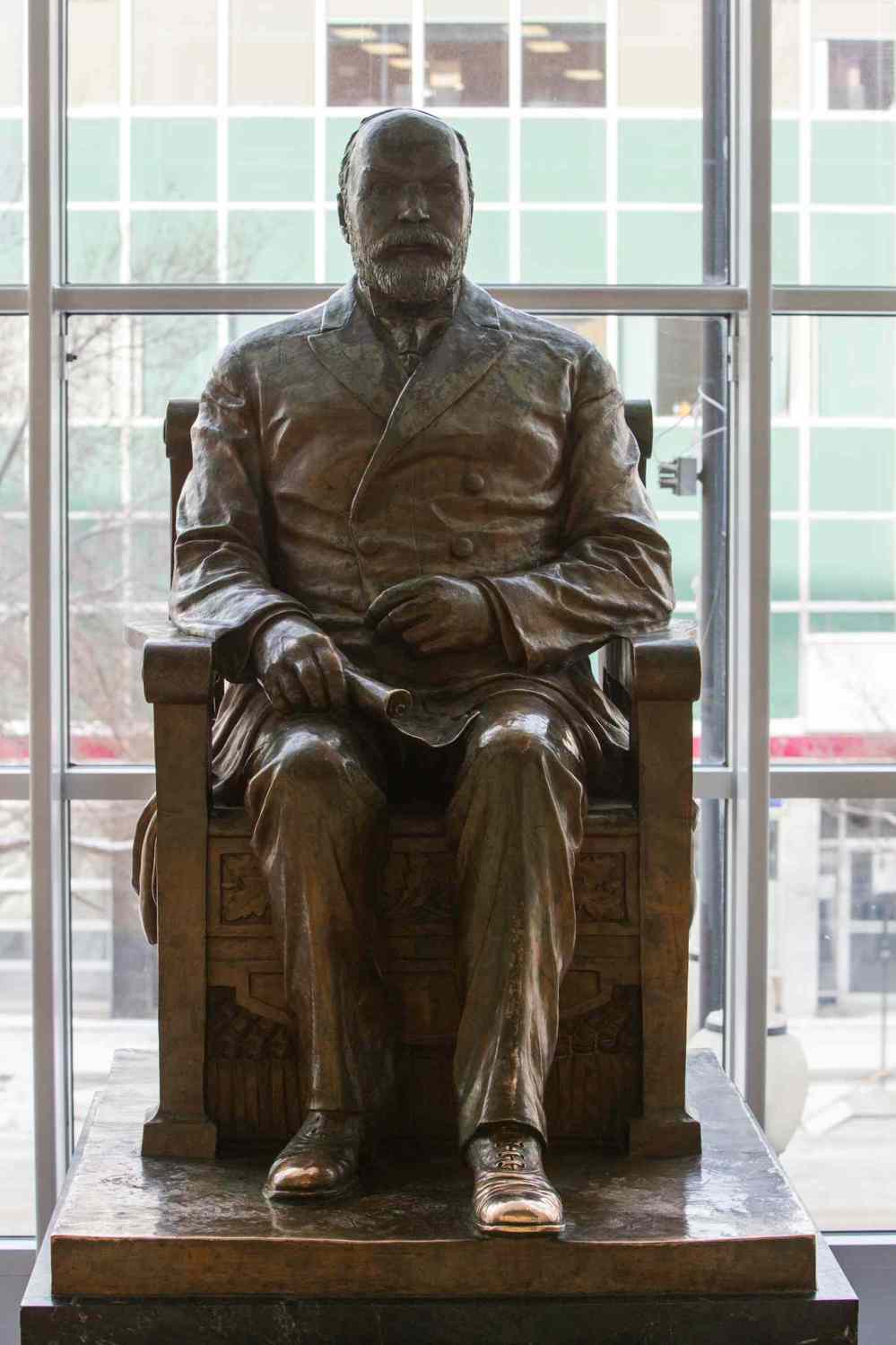
The Timothy Eaton statue located on the second level of the MTS Centre was unveiled 95 years ago this week and is one of the last public reminders of a company that once employed thousands of Winnipeggers in its retail, mail order and manufacturing operations.
It was part of a gift exchange of sorts commemorating the retail empire’s golden jubilee in 1919, a time when the mutual fondness between staff and management was running at an all-time high.
The First World War had just ended, in which 3,327 Eaton’s employees served, including 1,101 from the Winnipeg store. Of that number, 238 never returned. The company proved itself a model corporate citizen by not only guaranteeing soldiers’ jobs would be waiting for them when they returned, it also paid married men their full salary while they were on active duty, while single men received half salary. It was a gesture that cost the company more than $2.2 million.
While serving overseas, Eaton’s employees could visit any of its network of overseas buying offices to rest, write letters and read up on news from home. One Winnipeg employee wrote to head office: “It is an enviable state in the Canadian Army to be an employee of Eaton’s. Certainly the generous arrangements made by the firm for the boys save them untold worry and makes the bright thoughts of peace, when it comes, brighter still. For this boon, we are all profoundly grateful.”
In December 1918, just days before the company’s golden jubilee year began, Sir John Craig Eaton — the company’s president and youngest son of founder Timothy Eaton — announced that for the entire year, Eaton’s stores and factories would close at 1 p.m. on Saturdays, with the exception of June, July and August, when they would be closed all day. It was his way of honouring his father, who always instituted work hours that were shorter than the industry standard to allow employees to spend more time with their families.
For their part, Eaton’s employees collected enough money to commission a pair of identical bronze statues commemorating Timothy Eaton, one for the Toronto store and another for Winnipeg. The statues, 1.8 metres in height and weighing nearly 1,600 kilograms, show a stern but wise-looking Timothy in work mode, with papers in hand.
The artist was Ivor Rhys Lewis. The Welsh-born graduate of the Ontario School of Art was a Toronto-based painter, sculptor and amateur actor. He also happened to work in the Eaton’s advertising department, eventually rising to senior management and becoming a company director.
The unveiling of the sculptures was the finale of the jubilee year. The first took place at the Toronto store on Dec. 8, 1919 with Margaret Eaton, Timothy Eaton’s widow, at Sir John’s side. She is said to have cried when she saw the likeness. Mrs. Eaton did not make the journey to Winnipeg for the second unveiling. That was left to Sir John, his wife, Florence, and a delegation of company executives.
For Sir John, the trip to the Winnipeg store was a sort of homecoming. Though Timothy was alive when it opened in 1905, he was 70 and wheelchair bound. It was Sir John, who became vice-president in 1900, who was responsible for the Winnipeg venture, right down to selecting the site upon which to build the store. Winnipeg was considered “J.C.’s baby.”
His bullishness for Winnipeg continued long after the store opened. In 1916, he got approval from city council for a dramatic reconstruction of the company’s downtown site. It involved replacing the old brick store with a nine-storey, stone-clad building that would eventually run continuously from Portage Avenue to St. Mary Avenue, leaving a cut-out to allow Graham Avenue to pass through. At the time of the jubilee, Phase 2 of the project was in the final planning stages for the construction of a mail order building, which is now part of Cityplace.
The Winnipeg unveiling ceremony took place on Thursday, Dec. 11, 1919 at 8 a.m., a half hour before the store opened. Thousands of Eaton’s employees from the store and mail order division crammed the main floor to take part. The dignitaries took their place on a platform next to the covered statue and after the singing of O Canada, the curtain was pulled back.
The man who did the reveal was Harry McGee, the company’s second vice-president and its longest-serving employee, having started as a floor sweeper at the Toronto store in 1883. He worked with Sir John to get the Winnipeg store open and helped guide it through its formative years. It was McGee who addressed Sir John on behalf of the Winnipeg staff, saying, in part: “The staff at Winnipeg have wanted to express their appreciation of the consideration shown to them and decided that the most fitting way to do this would be to erect and place in this store a bronze statue of your father as a memorial and an inspiration to all those who shall see it, and with the desire of also recognizing your good judgment in establishing this business in Winnipeg.”
Sir John, who caught a bad cold en route to Winnipeg, was too hoarse to speak. While he sat, company secretary J. Vaughan read his response:
“To me it is most gratifying, and I am sure it will also be so to my mother, to know that the deeds of my father still live and will be perpetuated for all time by the erection of this magnificent memorial… The part of the staff at Winnipeg has played in commemorating the foundation of the business appeals especially to me, because I had the honour of proposing the establishment of the business here and selecting this site.”
Winnipeg store manager H.M. Tucker then announced the Winnipeg store’s hours for 1920 would be shortened by a half hour, closing at 5 p.m., matching the hours of the Toronto store. Also, the Saturday half-day and full-day closures would be continued for another year.
After a great cheer, there was a rush to get the store ready for the opening bell.
Sir John would never see the Winnipeg statue again, and his grand plan for the company’s Winnipeg property was never realized. He died of influenza in 1922 at the age of 45.
The Timothy Eaton statue, with its convenient location at the Portage Avenue entrance to the store about halfway between Hargrave and Donald streets, became a favourite meeting place for generations of Winnipeggers before setting off to shop or catch a movie. Many rubbed its left foot for good luck. That all changed, of course, in 1999, when the Eaton’s empire crumbled and the store closed.
In November 2000, the new owners of the vacant store allowed more than 500 former Eaton’s employees to have lunch with the statue before it was moved to its new home at Polo Park Shopping Centre. Sears Canada had purchased the defunct retailer’s assets and reopened the mall location under the Eaton’s name.

The “new Eaton’s” venture failed, and the store closed in the summer of 2002, leaving the statue’s fate in limbo. On behalf of the Eaton family, Fred Eaton, Timothy’s great-great grandson, notified Sears Canada they wanted the statue returned to them, having found a home for it in St. Marys, Ont., near where Timothy Eaton opened his first two stores. (The Toronto store’s statue, which was moved to Eaton Centre in 1977, had already been relocated to the Royal Ontario Museum.)
There was great sentiment to keep the Winnipeg statue in Winnipeg, so the province stepped in and brokered a deal in May 2002. The family would turn over its ownership to the province on the conditions it received heritage status protection and a “site of significance” would be found for it. That site came courtesy of True North Entertainment, which was in the process of constructing the MTS Centre arena on the site of the demolished Eaton’s store.
On April 21, 2004, a crane lifted the statue and its marble base into the second-floor concourse of the MTS Centre, placing Timothy Eaton metres above the spot where he had sat for 81 years.
Christian Cassidy writes about local history at his blog West End Dumplings.
History
Updated on Sunday, December 7, 2014 10:02 AM CST: Adds photo
Updated on Sunday, December 7, 2014 12:53 PM CST: Adds slideshow
Updated on Monday, December 8, 2014 1:56 PM CST: Corrects spelling of Ivor Rhys Lewis's name