

Westman homes rank highest in the country for radon
Advertisement
Read this article for free:
or
Already have an account? Log in here »
To continue reading, please subscribe:

Digital Subscription
One year of digital access for only $205*
- Enjoy unlimited reading on winnipegfreepress.com
- Read the E-Edition, our digital replica newspaper
- Access News Break, our award-winning app
- Play interactive puzzles
*First annual payment billed as $205.00 + GST for one year. This annual subscription will automatically renew at $233.00 + GST every 52 weeks (10% off the regular annual price of $259.35). Offer available to new and qualified returning subscribers only. Cancel any time.
To continue reading, please subscribe:
Add Free Press access to your Brandon Sun subscription for only an additional
$1 for the first 4 weeks*
- Enjoy unlimited reading on winnipegfreepress.com
- Read the E-Edition, our digital replica newspaper
- Access News Break, our award-winning app
- Play interactive puzzles
*Your next Brandon Sun subscription payment will increase by $1.00 and you will be charged $17.95 plus GST for four weeks. After four weeks, your payment will increase to $24.95 plus GST every four weeks.
Read unlimited articles for free today:
or
Already have an account? Log in here »
Hey there, time traveller!
This article was published 08/12/2014 (4292 days ago), so information in it may no longer be current.
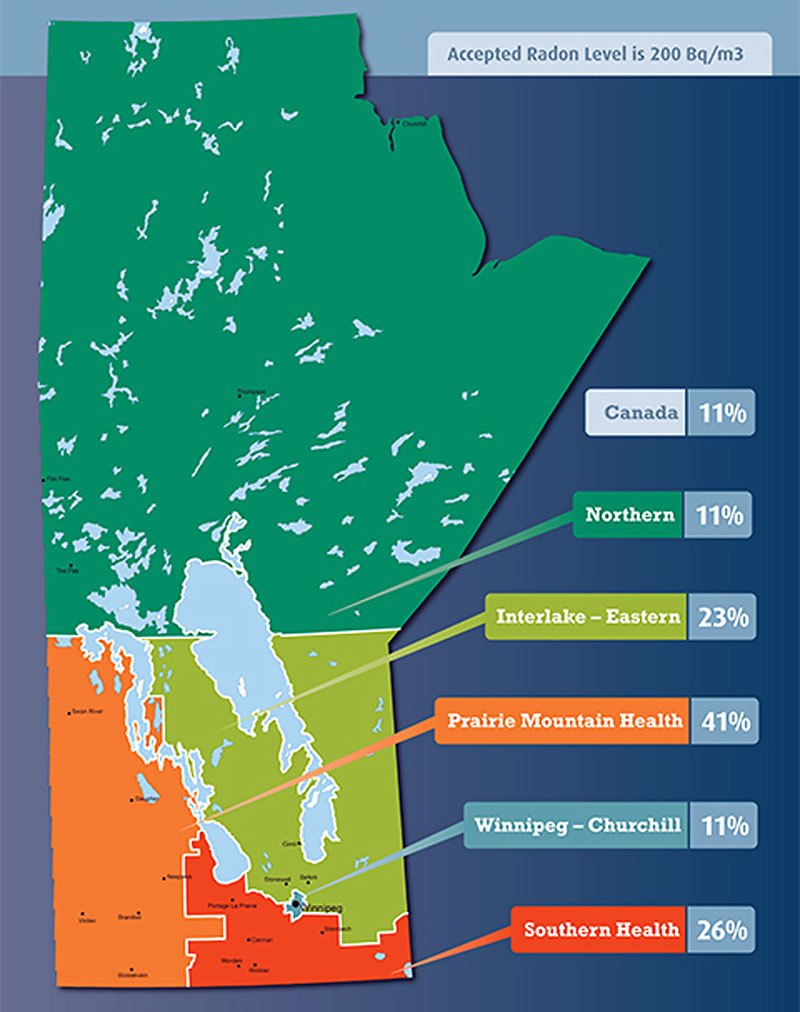
Brandon — More than 40 per cent of homes in the Prairie Mountain Health region contain higher than accepted levels of radon.
Erin Crawford, with the Canadian Cancer Society’s Manitoba Division, said because of its soil composition, Manitoba homes are more likely to have a buildup of radon gas.
“It’s something that a lot of people haven’t heard of and they don’t know what it is,” she said. “They don’t know that it’s radioactive and it causes cancer.”
When exposed to elevated levels for a long period of time, the colourless, odourless, radioactive gas is proven to increase a person’s chance of getting lung cancer.
The gas tends to enter homes through cracks and gaps in the floors and walls of the basement.
It is the second-leading cause of lung cancer, only trailing smoking.
“There are a number of people that have quit smoking cigarettes because of the risk for lung cancer that don’t even know they are being exposed to something that also causes lung cancer,” Crawford said.
Manitoba has the second-highest incidence of radon above Health Canada’s 200 becquerels per metre cubed.
Across the province, 23.7 per cent of homes are above 200 Bq/m3 — broke down as 21.1 per cent of homes ranging between 200-600 Bq/m3 and the remaining 2.6 per cent of homes above 600 Bq/m3, according to a 2012 Health Canada study.
In Westman however, the numbers are staggeringly higher. In the former Brandon Regional Health Authority, 44.3 per cent of the 79 homes that were tested were found to be above Health Canada’s guidelines — the highest percentage in the country.
In the former Parkland Regional Health Authority, 43.4 per cent of the 122 homes were above the standard — the second highest in the country.
Crawford said those at greatest risk are people who spend significant amounts of time in the basement areas of homes. This includes Manitobans renting basement apartments or those with children in basement daycares. All should be tested for radon.

“If your home does have high radon levels, the problem can be fixed, usually within a day,” Crawford said. “But first, you need to test your home.”
Test kits can be picked up at most hardware stores, according to Crawford, and cost $30. They can also be purchased online through the Canadian Cancer Society.
November was Radon Awareness Month.
ctweed@brandonsun.com
Twitter: @CharlesTweed