

Floating cattails to lake’s rescue
Man-made marshes could reduce algae
Advertisement
Read this article for free:
or
Already have an account? Log in here »
To continue reading, please subscribe:
Monthly Digital Subscription
$1 per week for 24 weeks*
- Enjoy unlimited reading on winnipegfreepress.com
- Read the E-Edition, our digital replica newspaper
- Access News Break, our award-winning app
- Play interactive puzzles
*Billed as $4.00 plus GST every four weeks. After 24 weeks, price increases to the regular rate of $19.95 plus GST every four weeks. Offer available to new and qualified returning subscribers only. Cancel any time.
Monthly Digital Subscription
$4.99/week*
- Enjoy unlimited reading on winnipegfreepress.com
- Read the E-Edition, our digital replica newspaper
- Access News Break, our award-winning app
- Play interactive puzzles
*Billed as $19.95 plus GST every four weeks. Cancel any time.
To continue reading, please subscribe:
Add Free Press access to your Brandon Sun subscription for only an additional
$1 for the first 4 weeks*
*Your next subscription payment will increase by $1.00 and you will be charged $16.99 plus GST for four weeks. After four weeks, your payment will increase to $23.99 plus GST every four weeks.
Read unlimited articles for free today:
or
Already have an account? Log in here »
Hey there, time traveller!
This article was published 24/01/2015 (4068 days ago), so information in it may no longer be current.
Something as simple as a portable marsh could help save Lake Winnipeg.
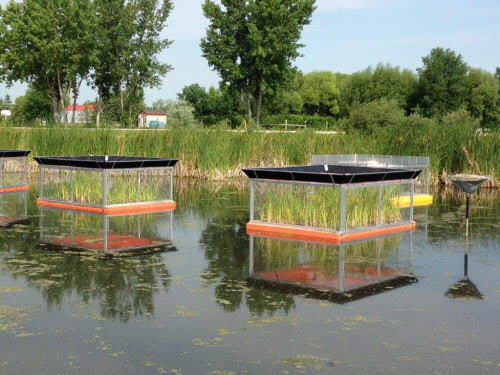
The idea is being studied at FortWhyte Alive and has shown it can draw potentially harmful algae-causing nutrients from lake water.
The trick is developing a large, platform-like marsh system for the 26,000-hectare Netley-Libau Marsh at the south end of Lake Winnipeg.
And make some money at it.
Conservation and Water Stewardship Minister Gord Mackintosh said while still early, it’s entirely possible these man-made floating islands — the ones at FortWhyte are made out of recycled grocery store bread trays — could be one solution to begin to reverse years of damage to the province’s largest lake.
“The thinking is that floating islands of cattails could be concentrated into super-wetlands with the added benefit that they are resilient to flooding and can be deployed in deep water,” Mackintosh said Wednesday.
The same process can also be used on City of Winnipeg retention ponds, he added.
The scientists behind the idea, including University of Manitoba biologist Dr. Gordon Goldsborough and the International Institute for Sustainable Development’s Hank Venema and Richard Grosshans, call them bio-platforms –floating, living ecosystems.
They say what they hope to do is use these bio-platforms, arranged much like freight cars in a rail yard, to renew the function of the marsh as a filter for Lake Winnipeg, where a combination of past mistakes and high water levels has depleted the marsh’s natural vegetation to the point of no return.
“Without the vegetation, all you really have is a big bowl of muddy water, and that’s what Netley-Libau Marsh has become,” Goldsborough said.
The marsh is also now too deep to support the restoration of natural vegetation, so the idea of creating of a floating marsh was hatched, he said. So far, the bio-platforms at FortWhyte have supported the growth of cattails, which have survived the winter to regenerate in the spring.
The trick is harvesting the mature cattails to remove the nutrients they sponge up, turning the top of plants into a biofuel that can be burned for heating, but also maintaining the bottom of the plants on the platforms.
“These things are just a magnet for wildlife,” Goldsborough said. “The ducks love them. The muskrats love them.”
Grosshans said the plan calls for the cattails to be harvested on a large commercial scale with them being processed into small cubes or pellets that can be burned for heat.
“Right now, the easiest market is for the replacement of coal,” Grosshans said. (The province’s ban on coal for heating takes effect July 1, 2017.) “Cattail is an excellent biomass heat source, like wood.”
Goldsborough said the platforms will need two more years of study at FortWhyte before they appear at the Netley-Libau Marsh. By that time, researchers will have a final design for a larger platform, likely built out of metal.
“Imagine a larger platform that just floats at or just below the water surface,” he said. “If you were standing at a distance, probably all you will see is a tuft of cattails.”
Venema said removing nutrients using cattail platforms is significantly cheaper than conventional waste-water treatment systems.
“And if you add in the energy benefit, we think the business case for this is really good,” he said. “You’ve got the energy benefit and you’ve got the water-quality benefit and you’ve got the carbon emissions reduction benefit from not burning coal.”

Mackintosh added the province has contributed about $180,000 to the project, which is also supported by the Lake Winnipeg Foundation.
Foundation member Alex Salki said more has to be done to protect the marsh, because the damage to it over the decades has been severe.
“It’s essentially controlled by the lake and the Red River,” he said. “We don’t understand completely how those two elements affect the marsh.”
He said what could undermine efforts to restore the marsh is the slow march of invasive species into the lake. Zebra mussels were found in the lake more than a year ago, and the fear is that more damaging quagga mussel may not be far behind. Zebra mussels need to attach to hard surfaces underwater to thrive, like rocks, but quagga mussels can live on both hard and soft substrates such as sand and mud.
bruce.owen@freepress.mb.ca