

You’ve got three minutes… Talk about your years of research
Competition forces grad students to be concise

Advertisement
Read this article for free:
or
Already have an account? Log in here »
To continue reading, please subscribe:

Digital Subscription
One year of digital access for only $205*
- Enjoy unlimited reading on winnipegfreepress.com
- Read the E-Edition, our digital replica newspaper
- Access News Break, our award-winning app
- Play interactive puzzles
*First annual payment billed as $205.00 + GST for one year. This annual subscription will automatically renew at $233.00 + GST every 52 weeks (10% off the regular annual price of $259.35). Offer available to new and qualified returning subscribers only. Cancel any time.
To continue reading, please subscribe:
Add Free Press access to your Brandon Sun subscription for only an additional
$1 for the first 4 weeks*
- Enjoy unlimited reading on winnipegfreepress.com
- Read the E-Edition, our digital replica newspaper
- Access News Break, our award-winning app
- Play interactive puzzles
*Your next Brandon Sun subscription payment will increase by $1.00 and you will be charged $17.95 plus GST for four weeks. After four weeks, your payment will increase to $24.95 plus GST every four weeks.
Read unlimited articles for free today:
or
Already have an account? Log in here »
Hey there, time traveller!
This article was published 18/02/2015 (4218 days ago), so information in it may no longer be current.
Dr. Robin Visser can explain in three minutes how a deadly lung disorder that dooms dozens of newborn babies worldwide each day can someday be cured.
In three minutes? In language laypeople can understand? Seriously?
Indeed, seriously. You say “no way,” but Visser says “way.”
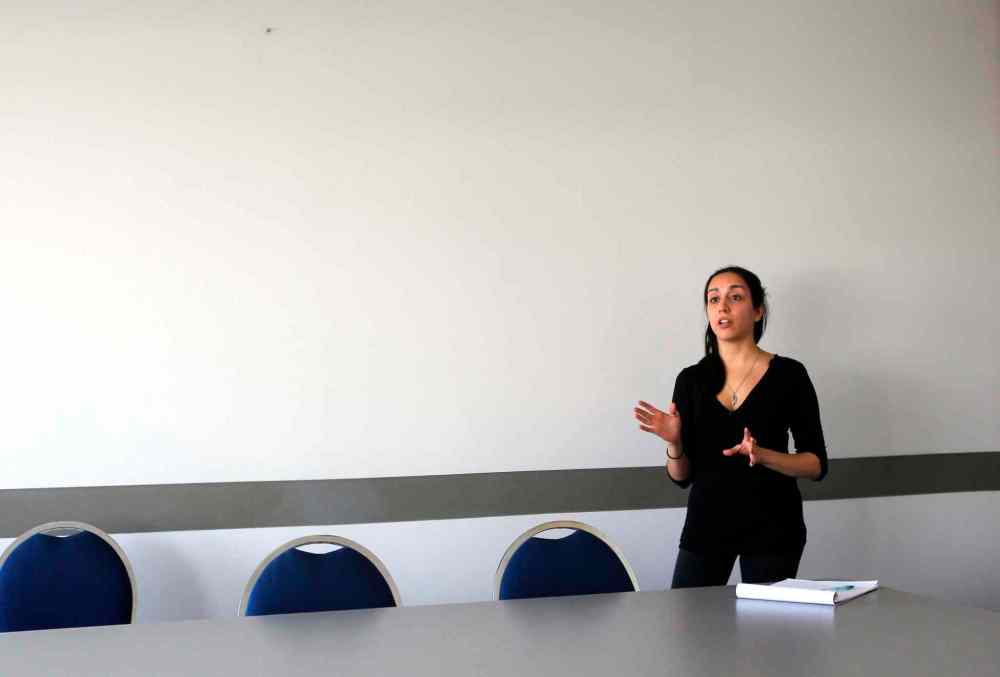
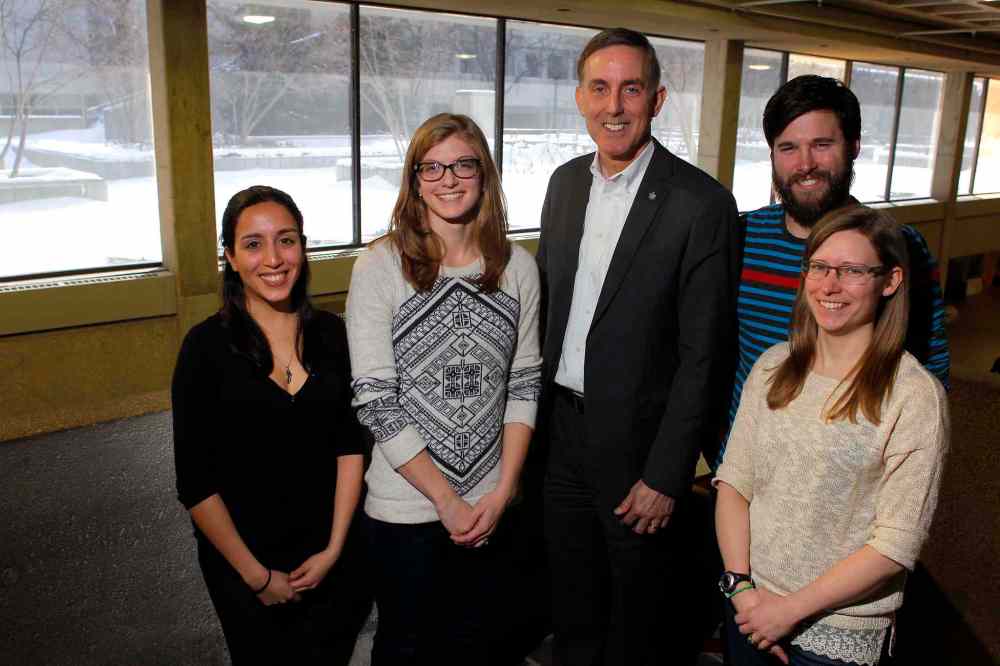
So do 11 other of the top graduate students at the University of Manitoba, who’ll compete Wednesday, Feb. 25 at 7 p.m. at St. John’s College in the Three-Minute Thesis. The competition challenges master’s and doctoral students to summarize years of research into three minutes — in words any of us can understand.
Visser is from Ontario, doing her residency here while pursuing a master’s degree in surgery — her thesis examining a possible way to overcome congenital diaphragmatic hernia.
Whoops, let’s try again, in plain English.
“As parents, you will never forget your child’s first cry on the day they were born — unless they didn’t cry at all,” Visser explained Tuesday in a practice run.
CDH affects the baby’s lungs, leaving the child too small and very stiff, she said. The research she’s undertaking with lab mice could lead to clinical trials that could lead to ways to catch those problems in the womb and enlarge the baby’s lungs before birth.
Then there’s biosystems engineering master’s candidate Garret Munch, who declared: “Biofuels are cool — my favourite is biodiesel.”
Alas, biofuels produce waste products that can be difficult with which to deal.
But — there has to be a “but” requiring research — River East Collegiate grad Munch believes there’s a way those waste products can be used to grow yeast and be turned back into more biofuels. To find out how, you’ll have to attend the 3MT finals.
Meanwhile, “I’d like you all to think about how you got to school today,” began Gail Ferguson, pursuing a master’s degree in natural resource management.
Almost every transportation method, even the green ones, involved some use of mined metal, a $1.3-billion annual industry in Manitoba, most of that affecting indigenous lands.
“There is a lack of clarity on land use and jurisdiction,” said Ferguson, who graduated in environmental studies and geology at Binghamton University in New York, then came here to join her fiancé.
“Recognizing aboriginal rights may have an impact on the business world,” she said. “Think how you would feel if you saw a stranger in your backyard… the stranger might have a work permit.”
Ever heard of Kurdistan? How about Balochistan?
The latter is in southern Iran, and its people are a minority discriminated against in their own country, suffering just as the Kurds do, but without international attention, said Gelareh Manghebati.
“Everyone knows the Kurdish people, no one has heard about Balochistan,” said Manghebati, who came to Canada from Iran in 2007 and is doing her master’s degree in peace and conflict-resolution studies.
“Nothing breaks my heart like ethnic conflict — the same diversity celebrated here, kills there,” she said.
Manghebati’s research is examining the link inequality, discrimination and uneven distribution of wealth have on creating a terrorist from a person who “can’t be born evil… doesn’t have a different DNA than other people.”
nick.martin@freepress.mb.ca
Finalists (in no particular order)
Dustin Scott Kehler
Applied Health Sciences (Doctoral)
Advisor: Dr. Todd Duhamel
Is Exercise Healthy for Older Adults before Surgery? The Exercise PREHAB Study
Gail Ferguson
Natural Resources Institute (Master’s)
Advisor: Prof. Thomas Henley
Whose backyard is it anyway? Aboriginal, government and mining industry relationships
Garret Munch
Biosystems Engineering (Master’s)
Advisor: Dr. Nazim Cicek
Putting Waste to Work: Producing Biodiesel using Yeast and Industrial Wastes
Robin Visser
Department of General Surgery (Master’s)
Advisor: Dr. Richard Keijzer
miRacles for Babies with Abnormal Lungs
Aibek Samakov
Natural Resources Institute (Master’s)
Advisor: Dr. Fikret Berkes
Sacred Sites: Conservation of Nature through Mechanisms Rooted in Culture
Robert Bertrand
Chemistry (Doctoral)
Advisor: Dr. John Sorenson
Exploring the Treasure Trove of Lichen Natural Molecules
Steven Harms
Civil Engineering (Master’s)
Advisor: Dr. James Blatz
Temporary Flood Protection: Developing New Ways to Protect our Communities
Teresa Looy
Natural Resources Institute (Master’s)
Advisor: Dr. John Sinclair
The Tomatoes Taste Better: Adult Learning Outcomes through Participation in Community Gardening
Gelareh Manghebati
Arthur V. Mauro Centre for Peace and Justice (Master’s)
Advisor: Dr. Sean Byrne
The Role of Financial and Social Inequality in Terrorist Activities in Iranian Balochistan
Rebecca (DeLong) Dielschneider
Immunology (Doctoral)
Advisor: Dr. Spencer Gibson
Lysosomes as Targets in Leukemia
Vanessa Palmer
Biomedical Engineering (Master’s)
Advisor: Dr. Melanie Martin
Improving the Outcome of MS using MR

Diego Rodriguez Herrera
Physics and Astronomy (Master’s)
Advisor: Dr. Stephen Pistorius
Using Radio Waves for Breast Cancer Detection
Nick Martin
Former Free Press reporter Nick Martin, who wrote the monthly suspense column in the books section and was prolific in his standalone reviews of mystery/thriller novels, died Oct. 15 at age 77 while on holiday in Edinburgh, Scotland.
Our newsroom depends on a growing audience of readers to power our journalism. If you are not a paid reader, please consider becoming a subscriber.
Our newsroom depends on its audience of readers to power our journalism. Thank you for your support.
Event preview
Three Minute Thesis Competition
- Finals: February 25, 7-9 p.m. (doors open at 6:30 p.m.)
- Robert B. Schultz Theatre
- St. John’s College, University of Manitoba
- 92 Dysart Road, Fort Garry Campus
Nick Martin
Former Free Press reporter Nick Martin, who wrote the monthly suspense column in the books section and was prolific in his standalone reviews of mystery/thriller novels, died Oct. 15 at age 77 while on holiday in Edinburgh, Scotland.
Our newsroom depends on a growing audience of readers to power our journalism. If you are not a paid reader, please consider becoming a subscriber.
Our newsroom depends on its audience of readers to power our journalism. Thank you for your support.
Advertisement Advertise With Us
Advertisement Advertise With Us
History
Updated on Wednesday, February 18, 2015 10:44 AM CST: Corrects date of Three-Minute Thesis to Wednesday, Feb. 25 at 7 p.m.
Updated on Wednesday, February 18, 2015 1:39 PM CST: Adds more info on event, finalists