

School zones on ex-cop’s radar
Says lowering speed limits a way for city to cover policing costs
Advertisement
Read this article for free:
or
Already have an account? Log in here »
To continue reading, please subscribe:
Digital Subscription
One year of digital access for only $75*
- Enjoy unlimited reading on winnipegfreepress.com
- Read the E-Edition, our digital replica newspaper
- Access News Break, our award-winning app
- Play interactive puzzles
*Billed as $5.77 plus GST every four weeks. After 52 weeks, price increases to the regular rate of $19.95 plus GST every four weeks. Offer available to new and qualified returning subscribers only. Cancel any time.
Monthly Digital Subscription
$4.99/week*
- Enjoy unlimited reading on winnipegfreepress.com
- Read the E-Edition, our digital replica newspaper
- Access News Break, our award-winning app
- Play interactive puzzles
*Billed as $19.95 plus GST every four weeks. Cancel any time.
To continue reading, please subscribe:
Add Free Press access to your Brandon Sun subscription for only an additional
$1 for the first 4 weeks*
- Enjoy unlimited reading on winnipegfreepress.com
- Read the E-Edition, our digital replica newspaper
- Access News Break, our award-winning app
- Play interactive puzzles
*Your next Brandon Sun subscription payment will increase by $1.00 and you will be charged $17.95 plus GST for four weeks. After four weeks, your payment will increase to $24.95 plus GST every four weeks.
Read unlimited articles for free today:
or
Already have an account? Log in here »
Hey there, time traveller!
This article was published 07/04/2015 (4062 days ago), so information in it may no longer be current.
A former Winnipeg police officer says lowering speed limits in school zones was mostly about making money to cover the growing police budget.
Len Eastoe, who argues in traffic court for clients fighting tickets, says the 30 km/h limit was more about photo enforcement making more money for the city to put toward the police budget. In recent years, salary increases and overtime have driven up police operating costs.
Eastoe, of Traffic Ticket Experts in Winnipeg, said former mayor Sam Katz and city council never presented evidence there was an issue of children being hit by vehicles on their way to and from school.

“The government did this specifically to bolster the numbers they are getting out of photo enforcement,” Eastoe said. “Why? Why did we need this? Where were all the accidents to support this that we needed this to protect the children?
“We don’t have the stats. That’s the bad part about this. It’s totally maddening that they do it for the reasons they do it and they expect the public to just open wide so they can shovel it all in, and we just keep taking it.”
Winnipeg’s reduced-speed school zones appear to be a bonanza for a cash-strapped city hall.
Traffic-ticket revenue was $14.6 million in 2014, up from $11.6 million in 2013.
Police photo-radar units began enforcing the daytime 30 km/h speed limit in October 2014. From then until the end of last February, more than 21,400 tickets were issued.
That number does not include the number of speeding tickets issued by individual officers. There are about 300 schools designated as reduced speed zones.
Fines start at $181.50 for drivers going 10 km/h over the posted speed limit and rise depending on the speed of the vehicle. Drivers caught going 20 km/h over the limit get hit with a $312.25 fine.

Winnipeg introduced the lower school-zone limit last fall as a way to protect younger children. At the time, Winnipeg was the only major city in Western Canada that did not have a reduced speed limit around schools.
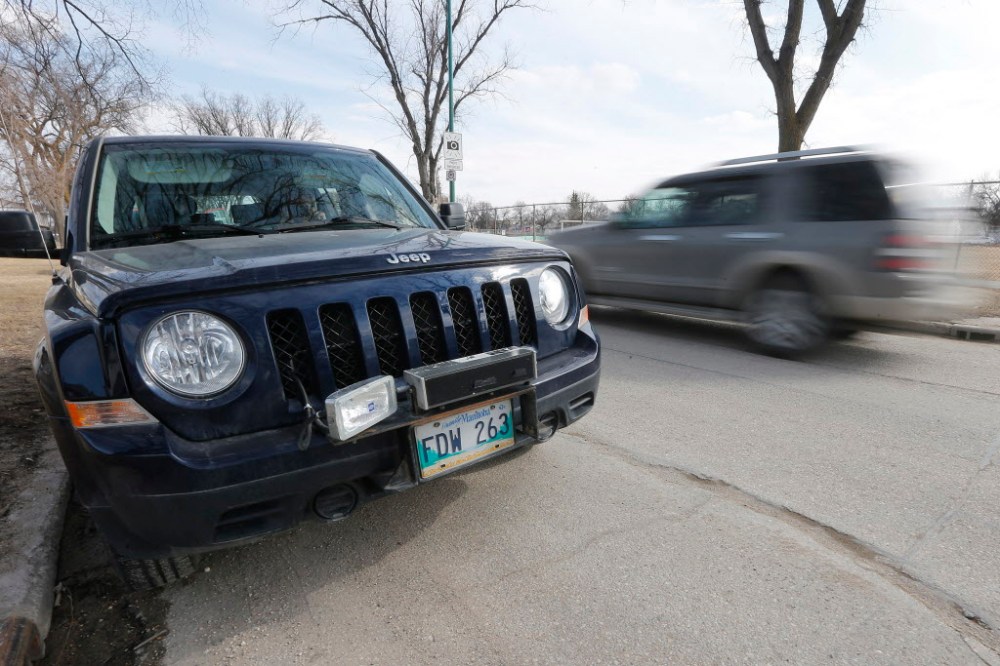
Winnipeg Police Service Staff Sgt. Rob Riffel, commander of the central traffic unit, said photo enforcement of school zones is carried out by 10 mobile photo-radar units, operated under the contract the city has with Xerox Business Solutions Canada Inc.
Riffel said the high number of violations seen to date in school zones could lead to an overall increase in photo enforcement offences for 2015. He said once drivers get used to the zones, the number of offences will plateau and then start to drop off, much like with the intersection red-light cameras several years ago. Once drivers recognized which intersections had cameras, traffic violations decreased.
“We hope to see the numbers go down once people start realizing where the zones are,” Riffel said. “I think it will just be a matter of time. Like any other (speed-limit) sign, subconsciously you’ll see it and you’ll act accordingly.”
bruce.owen@freepress.mb.ca
History
Updated on Tuesday, April 7, 2015 6:48 AM CDT: Replaces photo