

Poverty not just in inner city
Affluent areas show pockets of need
Advertisement
Read this article for free:
or
Already have an account? Log in here »
To continue reading, please subscribe:
Monthly Digital Subscription
$1 per week for 24 weeks*
- Enjoy unlimited reading on winnipegfreepress.com
- Read the E-Edition, our digital replica newspaper
- Access News Break, our award-winning app
- Play interactive puzzles
*Billed as $4.00 plus GST every four weeks. After 24 weeks, price increases to the regular rate of $19.95 plus GST every four weeks. Offer available to new and qualified returning subscribers only. Cancel any time.
Monthly Digital Subscription
$4.99/week*
- Enjoy unlimited reading on winnipegfreepress.com
- Read the E-Edition, our digital replica newspaper
- Access News Break, our award-winning app
- Play interactive puzzles
*Billed as $19.95 plus GST every four weeks. Cancel any time.
To continue reading, please subscribe:
Add Free Press access to your Brandon Sun subscription for only an additional
$1 for the first 4 weeks*
- Enjoy unlimited reading on winnipegfreepress.com
- Read the E-Edition, our digital replica newspaper
- Access News Break, our award-winning app
- Play interactive puzzles
*Your next Brandon Sun subscription payment will increase by $1.00 and you will be charged $17.95 plus GST for four weeks. After four weeks, your payment will increase to $24.95 plus GST every four weeks.
Read unlimited articles for free today:
or
Already have an account? Log in here »
Hey there, time traveller!
This article was published 21/04/2015 (4038 days ago), so information in it may no longer be current.
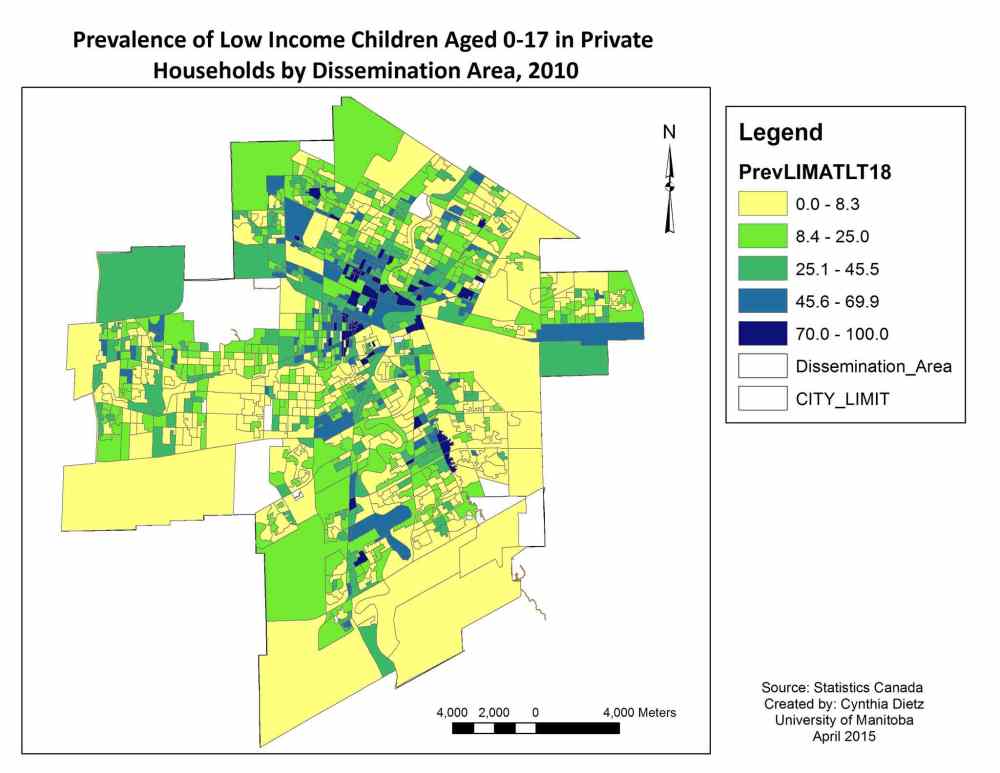
Child poverty might be worst in the inner city, but new research shows surprising pockets in some of the city’s most affluent areas.
New data, compiled by University of Manitoba researchers and released today, shows high rates of child poverty where most would expect, in much of William Whyte, Point Douglas, Elmwood and Spence. In those areas, well over two-thirds of children live below the poverty line.
But the numbers also highlight pockets of child poverty in the city’s southern reaches, including areas along the southern stretch of Pembina Highway and along St. Anne’s Road south of Fermor Avenue. In the townhomes, apartments and small houses between St. Anne’s and the Seine River, the child poverty rate tops 80 per cent in some cases.
“This is an inner-city problem but not only an inner-city problem,” said Sid Frankel, a professor of social work at the University of Manitoba.
Manitoba has the second-highest child poverty rate in Canada, one that hasn’t improved much in 25 years. Frankel noted Statistics Canada data shows 40 per cent of poor children in Manitoba are from families in which at least one parent is working full-time.
Ron Brown, president and CEO of the Boys and Girls Clubs of Winnipeg Inc., said it’s no surprise to him that clusters of child poverty exist in otherwise wealthy areas. His agency long ago spotted a need in those kinds of areas, most recently in River Heights, where a new club serves many children who live in a nearby Manitoba Housing complex.

“It’s the same as you might find in the inner city,” said Brown. “Our city is very diverse. Most of us see the diversity, who do front-line work.”
The Boys and Girls Club has a large, well-established program at Victor Mager School, one of the city’s most diverse schools, home to many children new to Canada. The school also serves families who live in nearby Manitoba Housing townhomes or low-income apartments and make up one of the suburban pockets of child poverty. A few blocks northeast of the school includes poverty rates on par with the inner city.
Based on the new data, maps were created by University of Manitoba GIS Environmental Studies librarian Cynthia Dietz for local poverty groups such as the Social Planning Council of Winnipeg. Researchers used Statistics Canada’s after-tax low-income measure as their poverty line. For a single parent with one child, that puts the threshold at a yearly income of about $28,000.
maryagnes.welch@freepress.mb.ca

History
Updated on Tuesday, April 21, 2015 6:33 AM CDT: Adds map