

Homeless people suffer disproportionately higher rates of violent crime
Not having a safe place to go home to, the homeless are constantly exposed to crime
Advertisement
Read this article for free:
or
Already have an account? Log in here »
To continue reading, please subscribe:

Digital Subscription
One year of digital access for only $205*
- Enjoy unlimited reading on winnipegfreepress.com
- Read the E-Edition, our digital replica newspaper
- Access News Break, our award-winning app
- Play interactive puzzles
*First annual payment billed as $205.00 + GST for one year. This annual subscription will automatically renew at $233.00 + GST every 52 weeks (10% off the regular annual price of $259.35). Offer available to new and qualified returning subscribers only. Cancel any time.
To continue reading, please subscribe:
Add Free Press access to your Brandon Sun subscription for only an additional
$1 for the first 4 weeks*
- Enjoy unlimited reading on winnipegfreepress.com
- Read the E-Edition, our digital replica newspaper
- Access News Break, our award-winning app
- Play interactive puzzles
*Your next Brandon Sun subscription payment will increase by $1.00 and you will be charged $17.95 plus GST for four weeks. After four weeks, your payment will increase to $24.95 plus GST every four weeks.
Read unlimited articles for free today:
or
Already have an account? Log in here »
Hey there, time traveller!
This article was published 27/04/2015 (4163 days ago), so information in it may no longer be current.
How many times a year do you experience crime? If you’re lucky, you don’t. Only 25 per cent Canadians experience crime every year, and most is non-violent crime.
But if you’re homeless – by definition already unlucky – those numbers are shockingly different.
Eighty per cent of people who are homeless experience crime every year, and more than once per year, says Stephen Gaetz, a professor at York University and the director of research-based Homeless Hub.
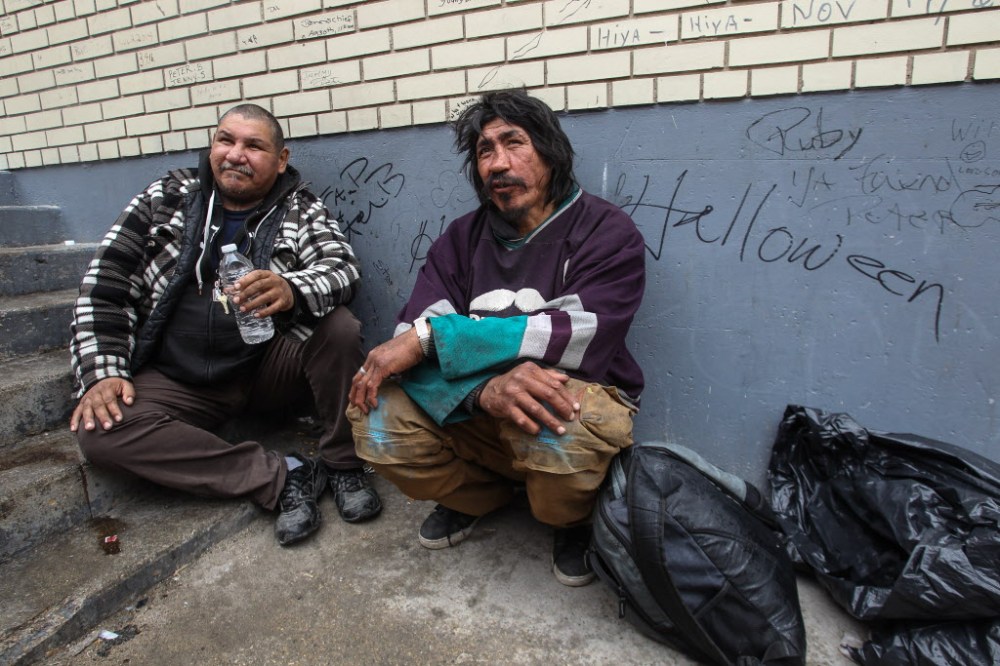
On average, forty per cent experience violent crime, and it happens about three times a year, statistics show.
The numbers are shocking.
This all begs the question: what does it mean to face violence as a homeless person? Why does it happen?
The 2011 Winnipeg Street Health report is the most recent and most conclusive report on the status of homeless people in Winnipeg. At the time of the report, 40 per cent of respondents said they experienced physical violence in the last year, and up to three times per year. The percentage rises to 46 per cent among women.
Christina Maes Nino worked on the report, and is now a community animator at the Social Planning Council of Winnipeg.
“There tends to be a limited safety net for people (facing homelessness). That’s why they’re homeless, they already fell through that safety net,” Nino said.
Gaetz said the root cause of violence is the perception that homeless people are beneath us. He calls violence against people facing homelessness a “hate crime.”
“When you have a climate of hatred, whether it’s driven by poverty, racism, or anti-homelessness, it’s not surprising that at the end of that you’re going to get fairly serious hate crimes,” Gaetz said.
Carolann Bar, executive director at Raise the Roof, an organization that studies homelessness in Canada, said people who are homeless are more often victims than criminals.
“The general public might think that people who face homelessness are actually perpetrators of crime, but most research and most statistics available indicate that people who are homeless are at greater risk of violence and attack, obviously because they don’t have a safe place to go home to,” Barr said.
Although ending homelessness will help stop violence, Nino said it isn’t enough.
“It’s not just a roof over someone’s head. It’s that social support and the valuing of all members of our community regardless of the circumstances that have befallen them,” Nino said.

Gaetz said violence is high because “by definition,” people who are homeless have no safe places.
“One of the greatest things that any human being can have is a door that can close and lock,” he said. “When you’re homeless, you don’t. You’re constantly exposed to strangers.”
Barr said people often see homelessness as the “other,” and so resist helping. This perpetuates violence, and even causes violence.
“It’s a topic that in a different population, we would be very alarmed about and acting really quickly,” Barr said.
kathleen.saylors@freepress.mb.ca