

A duty-free duty to travellers
Emerson shop at border the first one in Canada outside an airport
Advertisement
Read this article for free:
or
Already have an account? Log in here »
To continue reading, please subscribe:
Digital Subscription
One year of digital access for only $75*
- Enjoy unlimited reading on winnipegfreepress.com
- Read the E-Edition, our digital replica newspaper
- Access News Break, our award-winning app
- Play interactive puzzles
*Billed as $5.77 plus GST every four weeks. After 52 weeks, price increases to the regular rate of $19.95 plus GST every four weeks. Offer available to new and qualified returning subscribers only. Cancel any time.
Monthly Digital Subscription
$4.99/week*
- Enjoy unlimited reading on winnipegfreepress.com
- Read the E-Edition, our digital replica newspaper
- Access News Break, our award-winning app
- Play interactive puzzles
*Billed as $19.95 plus GST every four weeks. Cancel any time.
To continue reading, please subscribe:
Add Free Press access to your Brandon Sun subscription for only an additional
$1 for the first 4 weeks*
- Enjoy unlimited reading on winnipegfreepress.com
- Read the E-Edition, our digital replica newspaper
- Access News Break, our award-winning app
- Play interactive puzzles
*Your next Brandon Sun subscription payment will increase by $1.00 and you will be charged $17.95 plus GST for four weeks. After four weeks, your payment will increase to $24.95 plus GST every four weeks.
Read unlimited articles for free today:
or
Already have an account? Log in here »
Hey there, time traveller!
This article was published 01/05/2015 (4043 days ago), so information in it may no longer be current.
EMERSON — Trivia question: Where was the first duty-free shop in Canada outside of an airport?
The place name above gives it away so here’s an added question: What year did it open?
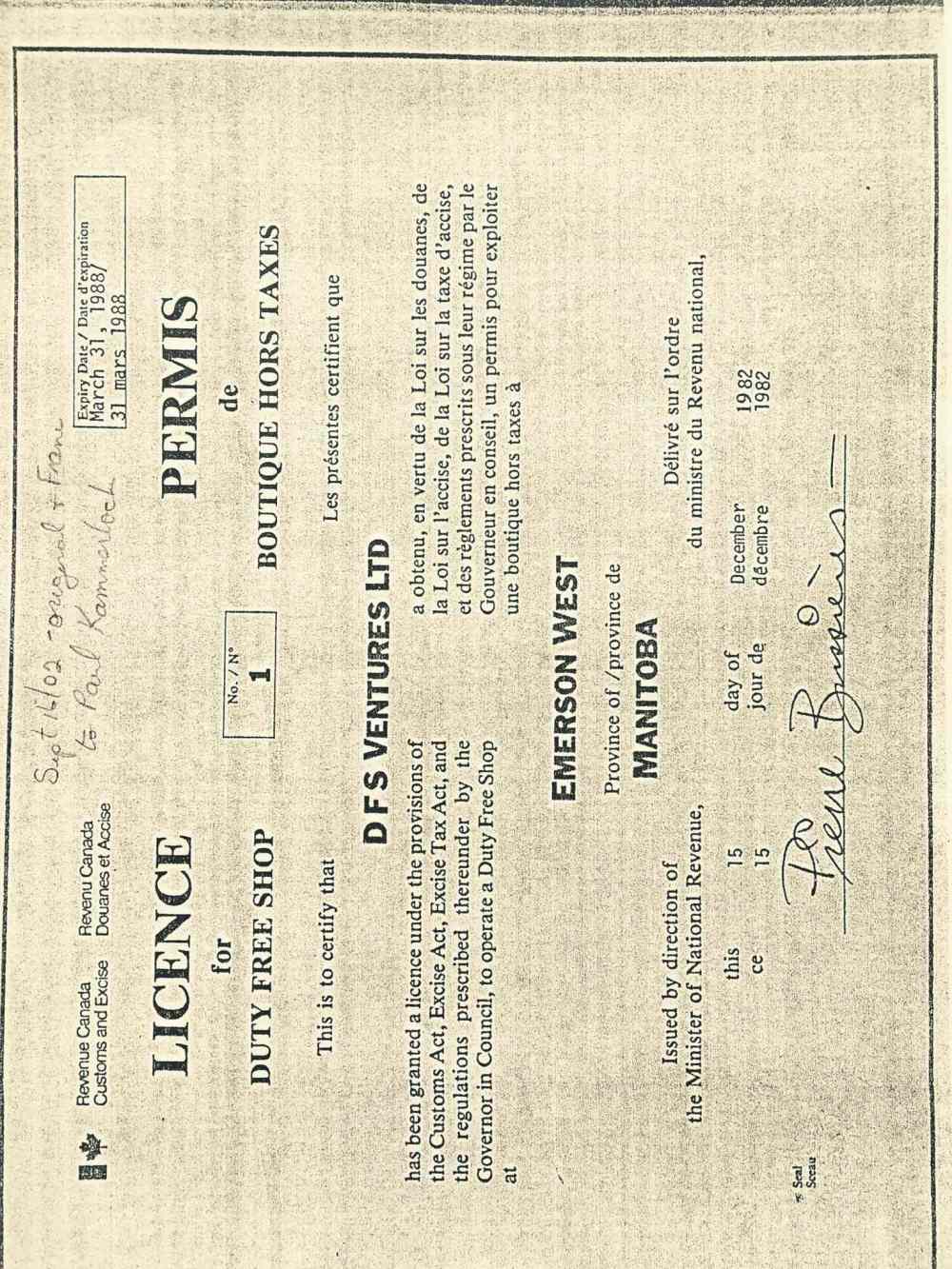
Mike Resch opened the first “land” duty-free shop in the country in Emerson on Dec. 15, 1982. He still has his original licence with the “No. 1” to prove it.

“It was part of a pilot project. There were only six licences issued: in B.C., Alberta, Saskatchewan, Manitoba, Quebec and New Brunswick,” explained Resch, 69. “The reason Ontario wasn’t given one was because the federal government couldn’t come to an agreement with the bridge owners, who wanted their own shops.”
Resch is originally from Germany, where he was a ski enthusiast, regularly crossing the border into Austria and making purchases at duty-free stores. When he moved to Emerson, he wondered why there were no duty-free shops beyond those in airports. The first duty-free shop in the world opened in Shannon Airport in Ireland in 1947.
Resch joined a lobbying effort by the tourism industry in the late 1970s to increase traveller money spent on the Canadian side through duty-free stores, says son Simon, who manages the Emerson Duty Free Shop.
But it was a rough start for the duty-free shops in the early 1980s. Canadian travel to the United States quickly fell off when the Canadian dollar plunged to the low 70-cent US level.
That hurt because Canadians account for most of Resch’s duty-free business. In 2000, Americans returning home from visiting Canada made up 25 per cent of sales at the Emerson Duty Free Shop. It’s now just four per cent, said Resch. The rest is Canadians entering the United States, who stop by for duty-free liquor, tobacco, perfume or other products, for consumption while away.
‘It was part of a pilot project. There were only six licences issued: in B.C., Alberta, Saskatchewan, Manitoba, Quebec and New Brunswick’
“We have never managed to attract Americans to Manitoba like the rest of the country,” Resch said.
Part of the reason is Canada spends so little marketing itself, said Resch. While Canada once provided more than $100 million to the tourism industry to market itself around the world, federal spending has cut that to just $58 million, according to Travel Manitoba figures.
In fact, no federal money has been spent marketing Canada in the U.S. in recent years. With an election coming, Ottawa promised in last week’s budget to restore some money for marketing in the U.S., but did not commit to a specific dollar figure. “We should spend $150 million just in the States,” Resch said.
Resch did his own marketing prior to 9/11, attending trade shows and sporting events in such places as Grand Forks and Fargo in North Dakota, and Detroit Lakes, Minn., and addressed their chambers of commerce. He even promoted with an American counterpart, Hal Gershman, of Happy Harry Bottle Shops in Grand Forks and Fargo. Resch saw his American sales double between 1985 and 2000.
But the American business vanished after the 2001 terror attacks in the U.S. and has not come back. Americans are patronizing their own country much more than in the past, Resch said. Waiting times have also increased at the border by 200 to 300 per cent when returning to Canada, due to elevated security fears, he said.
Resch founded the Federal Duty-free Association, which has 28 members today. He also spearheaded the program in which foreign visitors could get GST repayment on goods taken back home, as well as on accommodation, from duty-free shops. That got Americans into his store. They spent 60 per cent of the repaid GST in his duty-free shop, Resch said — proof the program was successful in getting visitors to spend more money in Canada. Ottawa cancelled the program four years ago.
Resch also struck a deal with Manitoba Liquor & Lotteries years ago that allowed him to negotiate his own liquor prices with distillers. The result is some fabulously discounted liquor prices, thanks to buying larger volumes, despite still having to pay a 40 per cent mark-up to the Crown corporation.

It’s a similar story for cigarettes.
“When I opened the store in 1982, a carton of cigarettes (eight packs) was $6.40,” Resch said.
Today, his price is $80 for premium brands and $61.80 for less expensive brands such as Canadian Classic. In Winnipeg, a carton now sells for $120 to $140, with a carton of Canadian Classic selling for $118 a carton at some Domo gas bars.

The shop is open every day from 6 a.m. to 11 p.m., and employs about 35 people in summer and 25 the rest of the year. There are 33 licensed duty-free shops across the country. Manitoba also has shops at Boissevain and Sprague.
bill.redekop@freepress.mb.ca