

Work to begin on Battle of Seven Oaks Monument National Historic Site
Advertisement
Read this article for free:
or
Already have an account? Log in here »
To continue reading, please subscribe:

Digital Subscription
One year of digital access for only $205*
- Enjoy unlimited reading on winnipegfreepress.com
- Read the E-Edition, our digital replica newspaper
- Access News Break, our award-winning app
- Play interactive puzzles
*First annual payment billed as $205.00 + GST for one year. This annual subscription will automatically renew at $233.00 + GST every 52 weeks (10% off the regular annual price of $259.35). Offer available to new and qualified returning subscribers only. Cancel any time.
To continue reading, please subscribe:
Add Free Press access to your Brandon Sun subscription for only an additional
$1 for the first 4 weeks*
- Enjoy unlimited reading on winnipegfreepress.com
- Read the E-Edition, our digital replica newspaper
- Access News Break, our award-winning app
- Play interactive puzzles
*Your next Brandon Sun subscription payment will increase by $1.00 and you will be charged $17.95 plus GST for four weeks. After four weeks, your payment will increase to $24.95 plus GST every four weeks.
Read unlimited articles for free today:
or
Already have an account? Log in here »
Hey there, time traveller!
This article was published 04/05/2015 (4129 days ago), so information in it may no longer be current.
Work begins this week on a north Main Street to properly recognize of the most seminal events in the province’s history.
The Battle of Seven Oaks Monument National Historic Site at Main Street and Rupertsland Avenue will become an interpretive park. Construction of the park will be finished in the summer and an event marking the bicentennial of the Battle of Seven Oaks is planned for June, 19, 2016.
The new park is expected to cost $350,000, with funding coming from the province, federal government, City of Winnipeg, Manitoba Métis Federation and the Winnipeg Foundation. The official unveiling of the park is Tuesday at 11:30 a.m. at the site.
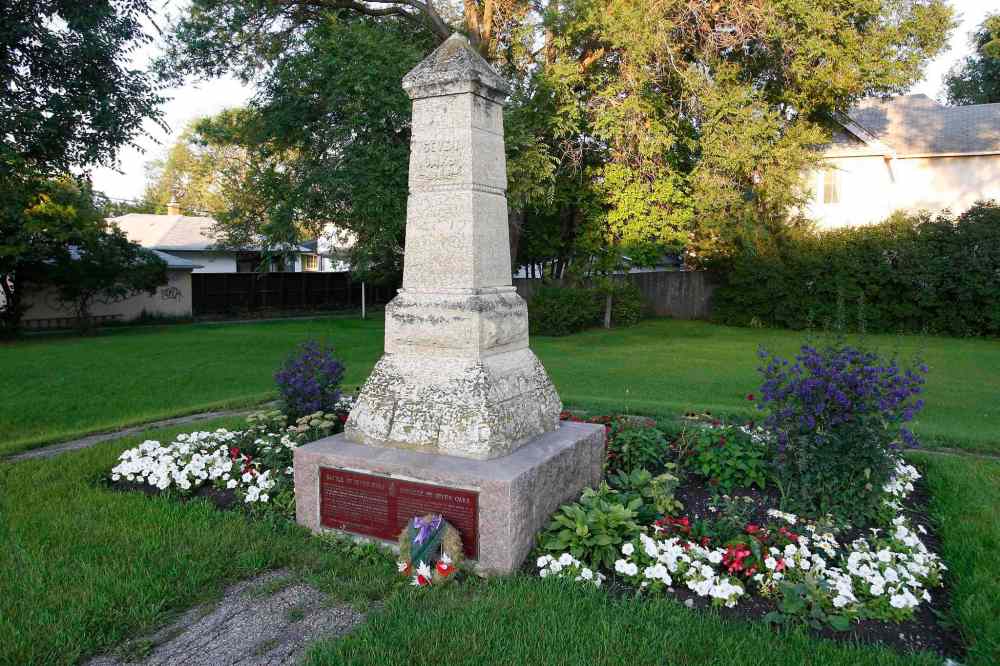
Seven Oaks Monument Committee chair Gary Jackson said today the project is the culmination of about eight years of work led by students at Governor Semple School, and will be built around the original marker to the battle at the site.
“This is the kids’ neighborhood. This is the school named after one of the people who died there,” Jackson said today. “The kids kind of wondered what happened to the other half of the story. The original monument only tells one part of it.
“There’s the Selkirk settlers side, or the people who lost the battle, but then there’s Métis side, and there’s nothing that says anything about that.”
Student Danielle Mesojednik, 17, is one of the original students, who started researching the battle when she was in Grade 4, and has stayed involved in the new monument’s planning.
“It’s always fascinated me how a small project that some kids did can be so revolutionary, and how we can change an entire monument and change a story,” she said.
The new park will be built around existing moment and six interpretive panels created by Parks Canada, which owns the site, will be installed telling the story of the battle. It will also be fully landscaped with new paths, lighting and benches.
The area’s MLA, Justice Minister Gord Mackintosh, said the new park also signifies what he called the amazing cooperation of people from different walks of life, including the Seven Oaks School Division and local historians and archivists.
The battle was the worst of several skirmishes between the Hudson’s Bay Company and the North West Company, rival fur-trading companies in Western Canada, as they fought each other to control the lucrative trade in beaver, silver fox and otter pelts. It happened on June 19, 1816 on what was then called Frog Plain, but known as West Kildonan today.
A number of Métis men with the NWC, led by Cuthbert Grant, were travelling to a meeting with other NWC traders to sell them a load of pemmican, the fur trader’s version of today’s high-protein energy bar, but made with bison fat.
Under a recent decree, Grant and his men weren’t supposed to be dealing in pemmican. The valuable pemmican was ostensibly supposed to be saved for the new settlers, so riders with HBC headed out from Fort Douglas, then near the Alexander Docks, north along the Red River towards where the Green Brier Inn is now. Leading them was Robert Semple, who was governor of the HBC. Semple soon found out he was outnumbered about three to one.

One of Semple’s men — they were mostly Scottish and Irish — fired his weapon at the Métis. The Métis fired back. In the ways of the wild Canadian West, the Métis fell to the ground to reload. The HBC men thought they had wiped them out and raised their arms in a victory cheer. That’s when the Métis stood up again and blasted the HBC men, killing 22. Two Métis were killed. The gunfire lasted no more than 15 minutes. Most of those killed were buried on the battlefield.
The British government called an inquiry into the deaths. It was headed by Lt.-Col. William Coltman. He found the first shot was fired by the HBC men. Grant and a number of NWC employees were charged with murder and larceny in trials held at York in Upper Canada in October 1818. All were acquitted.
The two fur companies merged in 1821.
Historians consider the battle the first major event on the Prairies that established the Métis as their own people.
bruce.owen@freepress.mb.ca