

First Nation evacuees protest their fourth year of exile after floods forced them out
Four flood evacuees die far from home
Advertisement
Read this article for free:
or
Already have an account? Log in here »
To continue reading, please subscribe:
Digital Subscription
One year of digital access for only $1.44 a week*
- Enjoy unlimited reading on winnipegfreepress.com
- Read the E-Edition, our digital replica newspaper
- Access News Break, our award-winning app
- Play interactive puzzles
*Billed as $5.77 plus GST every four weeks. After 52 weeks, price increases to the regular rate of $19.95 plus GST every four weeks. Offer available to new and qualified returning subscribers only. Cancel any time.
To continue reading, please subscribe:
Add Free Press access to your Brandon Sun subscription for only an additional
$1 for the first 4 weeks*
- Enjoy unlimited reading on winnipegfreepress.com
- Read the E-Edition, our digital replica newspaper
- Access News Break, our award-winning app
- Play interactive puzzles
*Your next Brandon Sun subscription payment will increase by $1.00 and you will be charged $17.95 plus GST for four weeks. After four weeks, your payment will increase to $24.95 plus GST every four weeks.
Read unlimited articles for free today:
or
Already have an account? Log in here »
Hey there, time traveller!
This article was published 09/05/2015 (4182 days ago), so information in it may no longer be current.
Protesters who have endured their fourth year of exile from their Interlake First Nations were circulating grim news on Friday: Four more evacuees from Lake St. Martin First Nation died this month.
The deaths of the four women in the space of a few short days was the talk among older women on the sidewalk as younger adults and children picketed in the street outside the federal Aboriginal Affairs office in Winnipeg.
Dozens of people who were evacuated from the Interlake First Nations of Lake St. Martin and Little Saskatchewan gathered outside Aboriginal Affairs on Hargrave Street before moving on to the legislature.
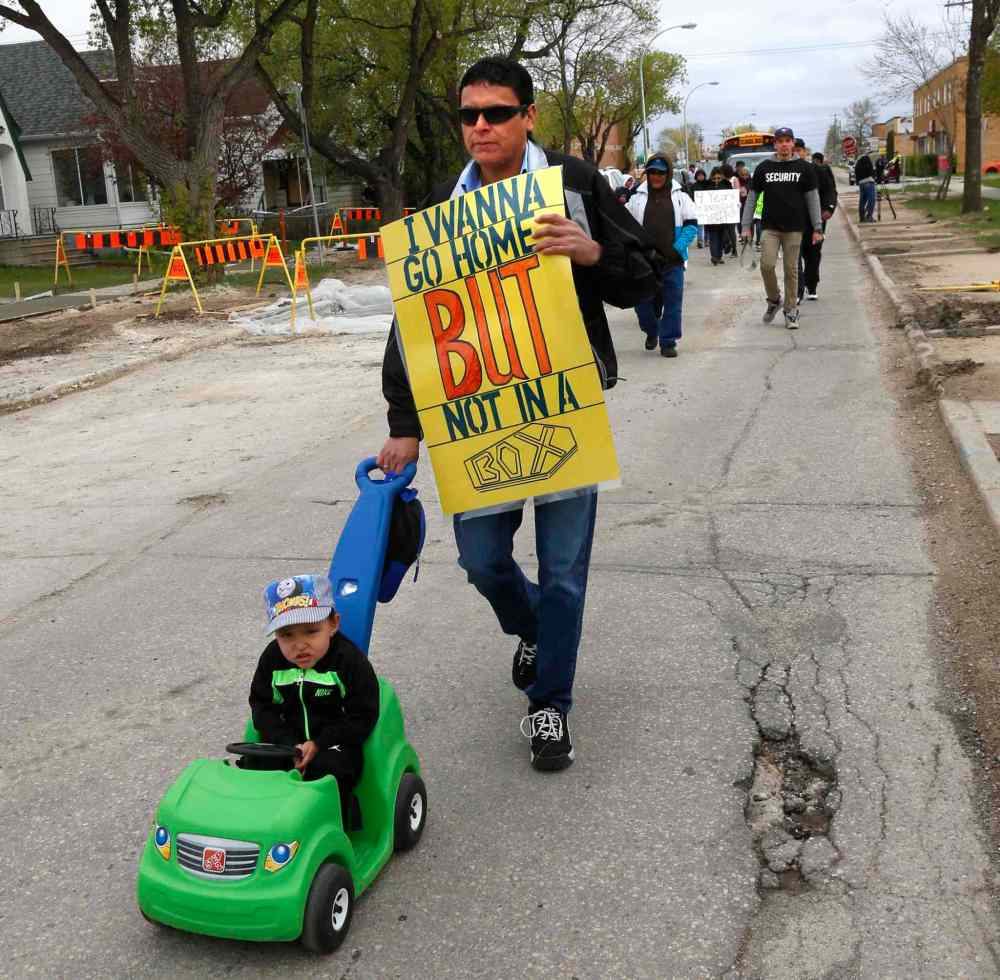
“We are asking the public to assist us, to push the government on this operation to return home,” Lake St. Martin Chief Adrian Sinclair told reporters. “You can see the people here. They want answers. They’re grassroots people. They’re suffering in the city.”
In 2011, to save Winnipeg and Portage la Prairie, plus thousands of acres of farmland, provincial authorities diverted an unprecedented amount of water from the Assiniboine River to Lake Manitoba and through the Fairford Dam to Lake St. Martin, flooding the First Nations.
Four years later, some 1,200 evacuees still live in apartments and home rentals, their rents paid by the Canadian Red Cross, which runs its aid services under contract with the federal government.
Another 374 evacuees from Little Saskatchewan are also in Winnipeg, some still in hotels for the past four years.
Altogether, there are 2,000 First Nation flood evacuees housed in rentals in Winnipeg. Four years of evacuation costs now total $122 million as of May, a federal spokeswoman confirmed Friday.
Of the four women who died this month, a story about one of them stood out. The woman, named Marilyn, was 57 years old and the day before her death she’d met briefly with Canada’s most powerful indigenous leader.
“She was an evacuee, and she’d been on dialysis,” explained her friend, Myrle Ballard, a University of Manitoba academic who is also from Lake St. Martin.
“She was telling the national chief (Perry Bellegarde) just the day before that she wanted to go home. The next day she died,” Ballard said. “She went home. In a box.”
The plight of evacuees is rife with sad stories, the women said.
Chiefs and government officials report there have been plenty of meetings to find a way to get people back home, but there are also stumbling blocks, including the bureaucracy itself and the massive scope of the resettlement.
Little Saskatchewan leaders say talks there have been stalled since last November over a controversial easement the province insists the First Nation leaders sign. They say if they sign, they could lose 80 per cent of the reserve land base to future flooding.

With half the population living on the reserve and the other half in houses and hotels in Winnipeg, Little Saskatchewan leaders countered with a demand their resettlement package should include new houses for more than simply the evacuees. They also want homes for the kids who’ve grown up on the streets of Winnipeg since 2011 and now have their own families. They also want new homes for the people who stayed behind on the reserve.
That amounts to a brand-new community for the entire population of about 600 people.
“I’m getting to the point of doing roadblocks or something. The cottage owners in this province who were affected by the flood are already back home, after two years. So why does it take our First Nations four years and we didn’t see one house built in our community yet?” Coun. Darrell Shorting said.

He said he’s attended one meeting with the federal appointee to the file and the provincial representative since January. Another meeting is planned for next week.
“The meetings fall on deaf ears,” Shorting said.
There are a lot of evacuees who also disagree with that hard line.
They don’t want to give away their land but they insist leaders should settle the evacuees first, never mind housing for people who stayed behind in 2011.
alexandra.paul@freepress.mb.ca