

Environment ministers address climate change
Advertisement
Read this article for free:
or
Already have an account? Log in here »
To continue reading, please subscribe:
Digital Subscription
One year of digital access for only $1.44 a week*
- Enjoy unlimited reading on winnipegfreepress.com
- Read the E-Edition, our digital replica newspaper
- Access News Break, our award-winning app
- Play interactive puzzles
*Billed as $5.77 plus GST every four weeks. After 52 weeks, price increases to the regular rate of $19.95 plus GST every four weeks. Offer available to new and qualified returning subscribers only. Cancel any time.
To continue reading, please subscribe:
Add Free Press access to your Brandon Sun subscription for only an additional
$1 for the first 4 weeks*
- Enjoy unlimited reading on winnipegfreepress.com
- Read the E-Edition, our digital replica newspaper
- Access News Break, our award-winning app
- Play interactive puzzles
*Your next Brandon Sun subscription payment will increase by $1.00 and you will be charged $17.95 plus GST for four weeks. After four weeks, your payment will increase to $24.95 plus GST every four weeks.
Read unlimited articles for free today:
or
Already have an account? Log in here »
Hey there, time traveller!
This article was published 23/06/2015 (4138 days ago), so information in it may no longer be current.
Canada’s environment ministers admit it’s been a long time since they jointly turned their attention to climate change, but they vow to change their ways.
The ministers wrapped up a two-day meeting in Winnipeg today devoted mainly to greenhouse gas (GHG) reduction — the first time the issue has taken centre stage at one of their annual gatherings in about a decade.
Former Winnipeg mayor and now Ontario Environment and Climate Change Minister Glen Murray sounded a bit sheepish as he acknowledged the long period that had elapsed since ministers have actually met formally on the issue.
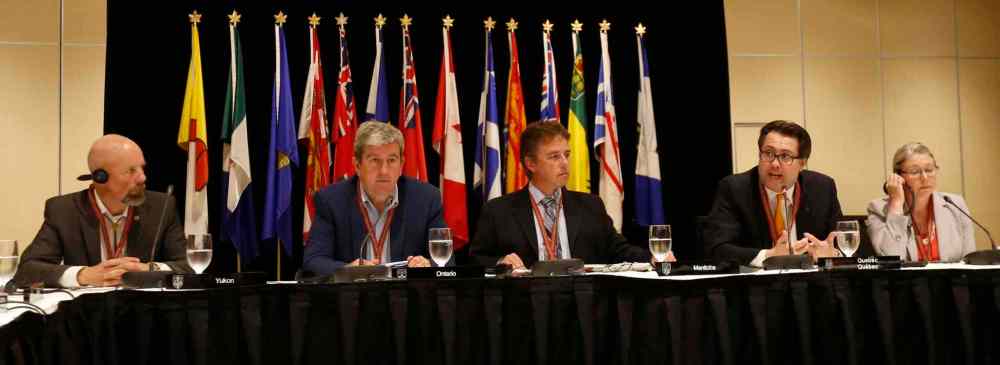
“When you say that with your out-loud voice, it sounds a bit shocking,” he told a wrap-up news conference at the Fairmont Hotel.
The ministers announced they have formed a committee to look into ways governments can co-operate on GHG reduction.
Provincial and territorial ministers also said that the federal minister — Leona Aglukkaq — made a rare appearance at one of their meetings, although she departed before the session wound up.
“The next year is going to be a very, very important one in terms of climate change,” said Quebec minister David Heurtel, referring to the Summit of the Americas meeting in Toronto next month and a pivotal United Nations conference in Paris in December.
“This conference was very useful because it shows that we can collaborate — and we want to collaborate — on this important issue,” he said.
But apart from an agreement to form a committee and some self-congratulation, the ministers were short on specifics.
Last month, Aglukkaq was in Winnipeg to announce that Canada intended to reduce GHG emissions by 30 per cent below 2005 levels by 2030. Ontario has set a much tougher target of reducing emissions by 37 per cent below 1990 levels by 2030.
Manitoba has yet to set a new emissions target after failing to meet previously set goals. Conservation and Water Stewardship Minister Tom Nevakshonoff, who hosted the ministerial meeting, said the province would unveil its new target sometime before the Paris conference.

Several Canadian environment ministers, including all three Prairie ministers, are brand new to their portfolios.
Alberta Environment and Parks Minister Shannon Phillips said a new NDP government has pledged to “do better” on climate change than past provincial administrations. She promised Alberta will “exercise leadership” in climate change on the national and international stage.
Meanwhile, Alberta and Ontario officially joined Manitoba in a broad alliance to address cross-border water quality issues by signing the Lake Friendly Accord.
The Manitoba government and Lake Winnipeg south basin mayors and reeves announce the accord and the Lake Friendly Stewards Alliance in 2013. The goal of the initiatives is to reduce phosphorus and nitrogen loading in waterways in Manitoba and beyond. The Canadian and Manitoba governments have signed on, as has the state of Minnesota. Other signatories include the Red River Basin Commission, Lake Winnipeg Foundation, Manitoba Hydro, the University of Manitoba and the Canadian Water Resources Association.
larry.kusch@freepress.mb.ca
Related Articles
Give Hydro’s new boss elbow room
Advertisement Advertise With Us
Advertisement Advertise With Us
History
Updated on Tuesday, June 23, 2015 4:41 PM CDT: Writethru.