

About time: City procrastinated before introducing first parking meters
Advertisement
Read this article for free:
or
Already have an account? Log in here »
To continue reading, please subscribe:
Monthly Digital Subscription
$1 per week for 24 weeks*
- Enjoy unlimited reading on winnipegfreepress.com
- Read the E-Edition, our digital replica newspaper
- Access News Break, our award-winning app
- Play interactive puzzles
*Billed as $4.00 plus GST every four weeks. After 24 weeks, price increases to the regular rate of $19.95 plus GST every four weeks. Offer available to new and qualified returning subscribers only. Cancel any time.
Monthly Digital Subscription
$4.99/week*
- Enjoy unlimited reading on winnipegfreepress.com
- Read the E-Edition, our digital replica newspaper
- Access News Break, our award-winning app
- Play interactive puzzles
*Billed as $19.95 plus GST every four weeks. Cancel any time.
To continue reading, please subscribe:
Add Free Press access to your Brandon Sun subscription for only an additional
$1 for the first 4 weeks*
*Your next subscription payment will increase by $1.00 and you will be charged $16.99 plus GST for four weeks. After four weeks, your payment will increase to $23.99 plus GST every four weeks.
Read unlimited articles for free today:
or
Already have an account? Log in here »
Hey there, time traveller!
This article was published 16/08/2015 (3885 days ago), so information in it may no longer be current.
When Carl C. Magee, a newspaper publisher from Oklahoma City, invented the parking meter in 1932, he probably didn’t realize what a cash cow he had created for cities.
The guinea pig for Magee’s invention was his hometown. Oklahoma City installed 174 parking meters on a trial basis in July 1934. By the end of September, they had already collected US$4,523 in revenue, exceeding the US$4,002 purchase price.
Other American cities took notice, and by the end of the decade, 155 of them were using Magee’s invention.

On this side of the border, cities such as Winnipeg, Toronto and Ottawa studied their use in the late 1930s but went no further. After the Second World War, though, parking meters were on the agendas of many Canadian cities, as their downtowns ground to a halt because of traffic congestion.
The postwar housing boom sent tens of thousands of people into the suburbs to live, while most of the jobs remained in the downtown cores. Existing public-transportation systems weren’t up to the challenge. They had been starved of funding because of wartime steel rationing and the fact most of the suppliers of rolling stock had been converted to wartime industrial production. It would take years just to bring these systems back to where they were before the war, much less expand into new territory.
One of the results was a spike in automobile ownership. City-specific statistics are hard to find, but Statistics Canada has compiled historical vehicle-registration data by province. In 1945, the year the war ended, there were 80,860 private passenger vehicles registered in Manitoba. That number rose to 112,149 in 1947 and 139,836 by 1949.
Many of those vehicles ended up in the city’s core, looking for a place to park.
Brandon was the first city in Manitoba to install parking meters, on Aug. 1, 1947. They ordered 200 on a trial basis for Rosser Avenue and Ninth and 10th streets. The meters generated nearly $7,000 in revenue in their first year, and, because of their impact on parking congestion, received a 70 per cent approval rating from downtown merchants. The city happily ordered hundreds more.
Winnipeg’s decision to install parking meters was not as straightforward as Brandon’s.
The responsibility for downtown parking didn’t fall under any one council committee, so for three years the issue bounced around from committee to committee, none of them wanting to make a final decision. At a finance committee meeting in late 1947, exasperated alderman Charles Simonite declared: “We should decide if we are going to use parking meters and make thorough plans. We’ve played around for years and done things piecemeal.”
That attitude helped spark the creation of a special subcommittee tasked with studying the introduction of parking meters. It convinced a majority of council to hire an outside consultant with experience in implementing a downtown-wide congestion plan in a similar-sized city.
J.C. Vincent was the recently retired assistant chief engineer of Minneapolis, which had already made great strides in tackling its downtown-parking problems. Winnipeg had long studied Minneapolis as a possible model, at one point even dispatching the city engineer there for a weeklong fact-finding mission.
‘I can find a place to park on Portage Avenue now. I never saw anything in my life like that before’
— alderman John Blumberg
The Vincent report was presented to council in August 1948. It recommended the city install 1,200 parking meters, covering most of the downtown and Exchange District. It also addressed the off-street parking situation and found the city was in need of 1,200 new spaces. Vincent felt the city should take the lead in constructing the necessary parkades, then pool all its parking revenues into a single parking authority to pay for future maintenance and meter purchases.
Vincent’s report went beyond parking to address other issues he felt led to traffic congestion. He recommended the elimination of diagonal parking, better pedestrian controls such as walk/wait lights, the creation of specific truck routes throughout the city and the elimination of parking on some streets during rush hour.
The report was met with approval from most councillors and senior city administrators. Both the Free Press and Tribune touted it as a solid plan in their editorials. Even the once-wary Winnipeg Chamber of Commerce got on board after polling downtown merchants to find 335 out of 401 supported a parking-meter trial.
The main opposition to the plan, aside from a handful of councillors, was the Manitoba Motor League. For years, it had railed against parking meters, calling them an additional tax on businessmen, and was against the loss of existing parking spaces that would result from the changeover from diagonal to parallel parking.
In July 1949, the city finally called for tenders for 300 parking meters to use on a trial basis. Four companies responded, but one was rejected outright because of the high cost of its machines. The remaining contenders were tested, under the supervision of Vincent, for everything from mechanical durability to cold-weather operation. In the end, the winner was Mi-Co Meters Canada, the Montreal-based subsidiary of a New York state company.
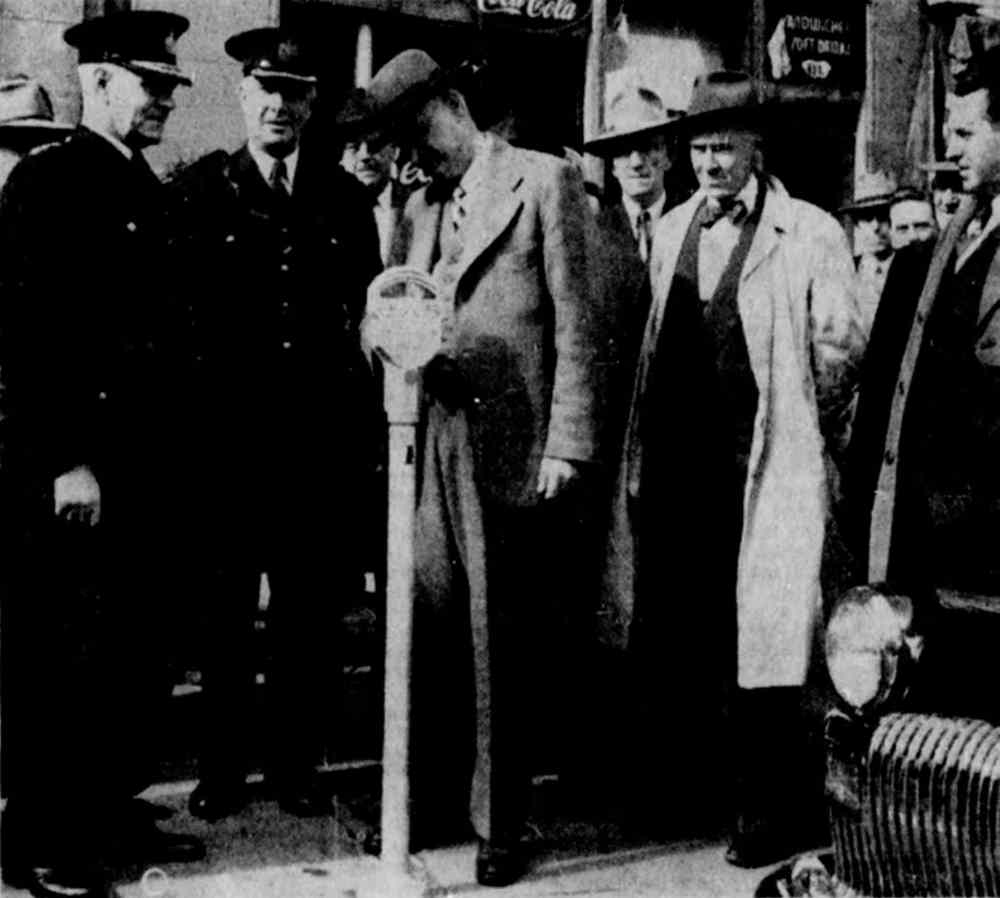
City crews took a week to install the devices, and on Oct. 6, 1949, mayor Garnet Coulter held a “first nickel” ceremony, plugging a meter on Main Street while flanked by city officials. The meters would go into effect on Oct. 11, giving the city five days to explain to the public how the system worked.
Meters were installed on Portage Avenue from Donald to Main streets, on Main from Bannatyne to Graham avenues and on all streets intersecting Portage between Donald and Main. The rate was one cent per 12 minutes or five cents for an hour, except in front of the post office, where it was restricted to 12 minutes maximum. Meters were in operation Monday to Friday, from 9 a.m. to 6 p.m.
By all measures, the parking meters were a success.
Newspapers ran photos of once-jammed blocks that now featured open parking spaces. Alderman John Blumberg, a reluctant supporter of the devices, said he was amazed the normal practice of having to circle a city block five or six times to get a parking space was gone. He asked at a committee meeting: “Where have all the cars that used to clutter Portage Avenue disappeared to? I can find a place to park on Portage Avenue now. I never saw anything in my life like that before.”
Weekly revenue figures showed the meters were on target to bring in the anticipated $30,000 in their first year of operation. Even the city’s parking-meter mechanic, appropriately named Roy Charge, reported a 98 per cent operation rate. Most of the issues he had to deal with were people forgetting to turn the knob on the meter and the odd slug or button deposited into the coin slot.
The city heeded some of Vincent’s other recommendations, which also helped with overall congestion. Diagonal parking was gone, and parking was eliminated on some streets during rush hour. Pedestrian signals began appearing at intersections, a network of truck routes was created and five lots were identified and approved for purchase as off-street parking locations.

The city was so satisfied with the results that in June 1950, before the trial period ended, it purchased and installed 300 additional meters, extending them along Portage Avenue to Memorial Boulevard and introducing them to Lombard Avenue, Notre Dame Avenue, Rory Street and McDermot Avenue. In November, another 300 went into operation on parts of Ellice Avenue, Albert Street, Arthur Street, Princess Street, William Avenue and King Street, bringing the city’s total parking-meter count to 900.
As the city rushed to install more meters, some noted a key recommendation from the Vincent report had not materialized. The money from the parking meters was going into the city’s general revenue account instead of a special parking agency. As a result, those five parcels of land the city identified for off-street parking were never purchased, and the cost of new meters was coming from taxpayers instead of motorists. The Free Press warned in an editorial: “Motorists will not take kindly to the parking meters as a mere a tax collection device.”
The city, though, was hooked. Mayor George Sharpe told a lunch audience in 1951 the parking-meter revenue for 1950 was “about $90,000,” exceeding even the most optimistic expectations. A few months later, the city installed another 600 meters.
Christian Cassidy writes about local history on his blog, West End Dumplings.