

Trees Winnipeg turning its attention to emerald ash borer
Advertisement
Read this article for free:
or
Already have an account? Log in here »
To continue reading, please subscribe:
Digital Subscription
One year of digital access for only $1.44 a week*
- Enjoy unlimited reading on winnipegfreepress.com
- Read the E-Edition, our digital replica newspaper
- Access News Break, our award-winning app
- Play interactive puzzles
*Billed as $5.77 plus GST every four weeks. After 52 weeks, price increases to the regular rate of $19.95 plus GST every four weeks. Offer available to new and qualified returning subscribers only. Cancel any time.
To continue reading, please subscribe:
Add Free Press access to your Brandon Sun subscription for only an additional
$1 for the first 4 weeks*
- Enjoy unlimited reading on winnipegfreepress.com
- Read the E-Edition, our digital replica newspaper
- Access News Break, our award-winning app
- Play interactive puzzles
*Your next Brandon Sun subscription payment will increase by $1.00 and you will be charged $17.95 plus GST for four weeks. After four weeks, your payment will increase to $24.95 plus GST every four weeks.
Read unlimited articles for free today:
or
Already have an account? Log in here »
Hey there, time traveller!
This article was published 02/09/2015 (3929 days ago), so information in it may no longer be current.
Trees Winnipeg is embarking on a new path to protect the city’s trees and urban forests.
The non-profit organization will focus its efforts on the battle against the invasive emerald ash borer beetle and discontinue its city-wide banding program against canker worms this fall.
For the past 15 years, Trees Winnipeg has been wrapping about 8,000 city tree trunks on an annual basis with bands covered in sticky Tanglefoot that stop the wingless female moths from crawl up the tree trunk to mate and lay eggs in the upper tree in the spring and fall.
“What we expect is that cankerworm populations are going to be at an all-time low. That’s partially due to the combined city-wide, tree-banding effort and also the City of Winnipeg’s very effective spray program,” said Kerienne La France, the Trees Winnipeg executive director, noting the cankerworm population is also at the end of its cycle right now.
She said the bad news is that populations of the forest tent caterpillar and elm spanworm are “going to be exploding in the next year or two.”
Tree banding only affects cankerworms because those moths don’t have wings and have to crawl up the tree trunks and get stuck in the bands. The egg-laying moths of the other species fly right over them.
She said the good news is the city’s spray program, however, will manage forest tent caterpillar, elm spanworm and cankerworms.
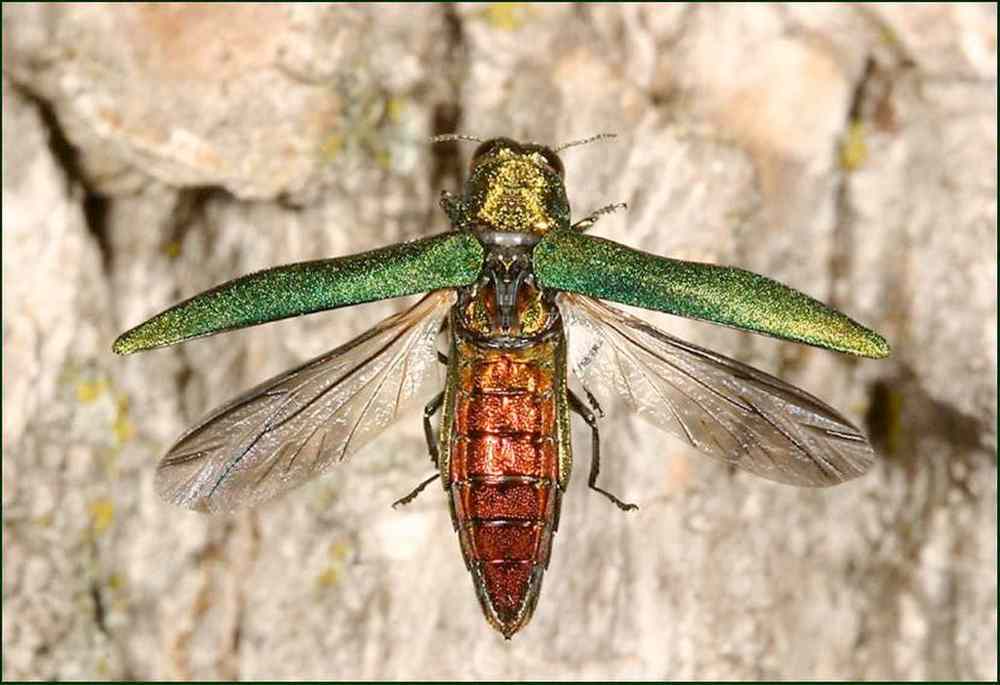
The bad news is that the emerald ash borer, also called EAB, is an invasive species of beetle from Asia that has Manitoba surrounded.
Keeping that bug out of Manitoba and other invasives out of Manitoba will be the focus this fall for Trees Winnipeg.
“Emerald ash borer (beetle) has not been identified in Winnipeg or Manitoba at all yet but it is in Ontario and Minnesota,” La France said.
“We do expect it to come. We were hoping our Winnipeg winters would be severe enough to keep it at bay but it’s from Siberia so we don’t think that’s going to happen. It attacks all ash trees and considering that at least 40 percent of our urban forest is ash, that’s going to be as significant as dutch elm disease was for elms.”
She said Trees Winnipeg has been monitoring the EAB’s invasion of Ontario, Quebec, Michigan and Minnesota and “the devastation it’s been causing.”
“The best thing is prevention, to not move ash firewood into Manitoba and burn it locally. We really think that the beetle will migrate to Manitoba because of firewood movement,” La France said.
She said Trees Winnipeg is also monitoring for the beetle since 2011 using large green triangular traps that can be seen hanging from some trees in various throughout the city. So far, all traps are empty.

She said the gypsy moth (B.C., Ontario and Quebec) and Asian longhorned beetle (Ontario) are other invasive species that have not yet been identified in Manitoba but are of concern due to their proximity.
La France said it is important to note that tree banding does not fight dutch elm disease. Pruning dead branches and not storing elm fire wood help protect elm trees.
She said some banding will be done by Trees Winnipeg on some significant trees on private property that won’t be sprayed by the city and some heritage trees on Winnipeg School Division property that could be at risk.
Several private companies are still providing tree banding services and supplies. Go to www.savetheelms.mb.ca for more information.
ashley.prest@freepress.mb.ca