

Work being done inside and out on aging legislature
Advertisement
Read this article for free:
or
Already have an account? Log in here »
To continue reading, please subscribe:
Monthly Digital Subscription
$1 per week for 24 weeks*
- Enjoy unlimited reading on winnipegfreepress.com
- Read the E-Edition, our digital replica newspaper
- Access News Break, our award-winning app
- Play interactive puzzles
*Billed as $4.00 plus GST every four weeks. After 24 weeks, price increases to the regular rate of $19.95 plus GST every four weeks. Offer available to new and qualified returning subscribers only. Cancel any time.
Monthly Digital Subscription
$4.99/week*
- Enjoy unlimited reading on winnipegfreepress.com
- Read the E-Edition, our digital replica newspaper
- Access News Break, our award-winning app
- Play interactive puzzles
*Billed as $19.95 plus GST every four weeks. Cancel any time.
To continue reading, please subscribe:
Add Free Press access to your Brandon Sun subscription for only an additional
$1 for the first 4 weeks*
*Your next subscription payment will increase by $1.00 and you will be charged $16.99 plus GST for four weeks. After four weeks, your payment will increase to $23.99 plus GST every four weeks.
Read unlimited articles for free today:
or
Already have an account? Log in here »
Hey there, time traveller!
This article was published 16/09/2015 (3881 days ago), so information in it may no longer be current.
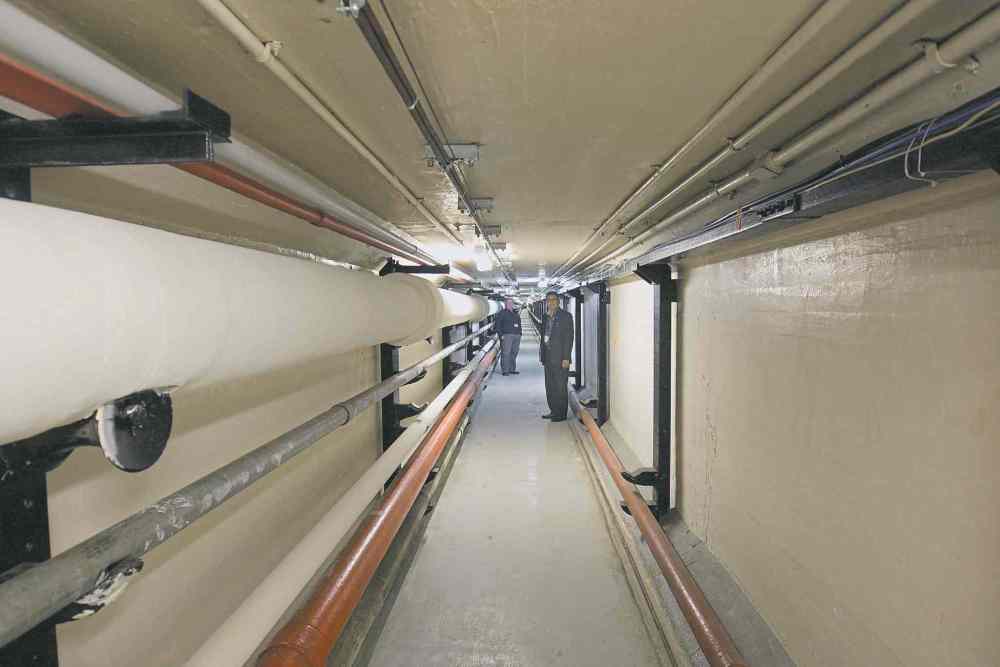
Ken Duncan stops about midway along our trip through the tunnel and points to its white-painted ceiling.
Look, the province’s deputy chief engineer says, when they poured the concrete they used wood slats for its form. It means it was built before plywood was invented.
This narrow underground corridor runs between the Manitoba Legislative Building and the central powerhouse building on Memorial Boulevard near York Avenue, a distance of nearly 280 metres.
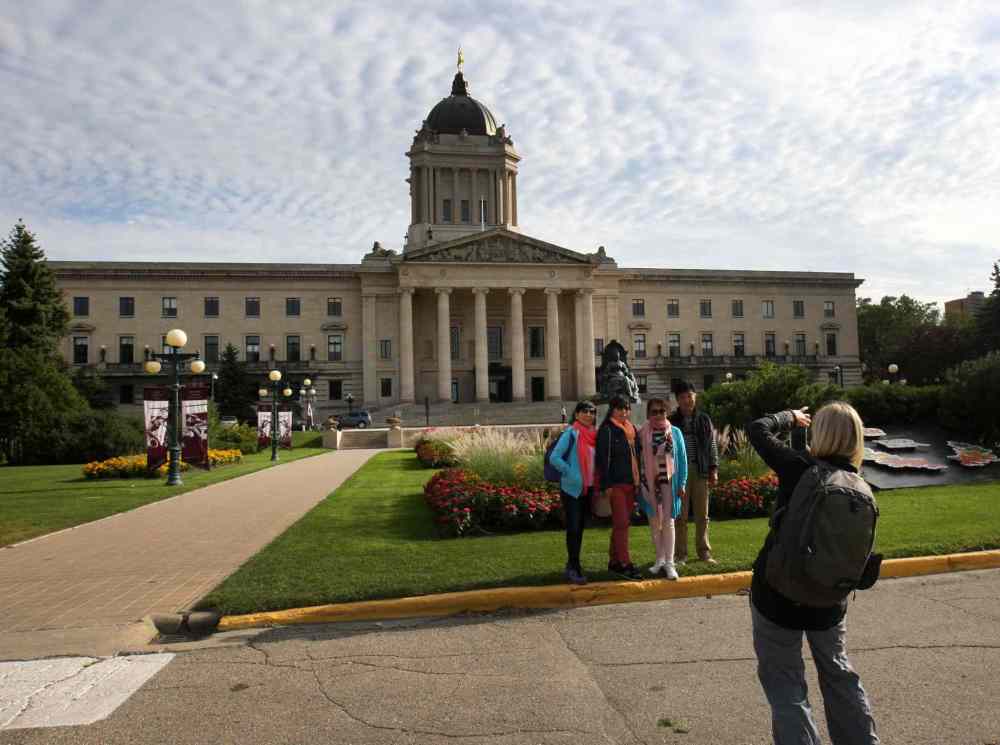
The legislative building marks its centennial in 2020, which means a lot of focus has been put on keeping it in tip-top condition. Its distinctive dome, or tower, was upgraded in 2002 when the Golden Boy was removed and regilded, and the interior roof above the grand staircase was repaired and repainted in 2012.
But the powerhouse is about five years older than the building itself, and the tunnel has seen a lot of wear and tear over most of the past century. The tunnel and its pipes help deliver steam heat from the powerhouse’s huge boilers to the legislative building and Government House during the winter.
While much of the recent restorative work is concentrated on the legislative building, other upgrades are currently underway behind the scenes to ensure what was first built almost a century ago continues to hum without interruption. Other work is planned to take place over the next three years.
THE BIG JOB
Without a doubt, the legislative chamber is the centrepiece of the building. For the most part, it looks a lot like it did when it first opened in July 1920, although a newer sound system was recently installed, and before that a new royal blue carpet.
Work is currently being done in the public gallery, installing better handrails, overhead lighting and lighting to the stairs. It is to be completed early in the new year.
Maria Mendes, the province’s director of project services, says the upgrades will protect the building’s heritage.
What’s most worrying is the condition of the ceiling murals above the assembly floor. They’re fading — badly, in some cases. Details have blurred, and the vibrancy of colours has been dulled by dust and time. They need to be expertly retouched and preserved.
That means erecting scaffolding above where MLAs sit — not an easy job when the house is in session. One idea was for MLAs to move off-site for a few weeks. In other words, the legislative assembly would be temporarily set up in a rented warehouse, where its members would debate legislation and pass laws.
Speaker Darryl Reid kiboshed that idea immediately. Reid, who presides over whatever happens in the chamber, basically said the mural restorers would have to work around MLAs.
Chris Hauch, assistant deputy minister of accommodation services, says the work in the chamber will be spread out over time to meet the needs of government.
“We have thought of a concept of doing some scaffolding that would allow the work to take place while house is in session, but we haven’t really talked with government about that yet,” Hauch says. “You can’t stop government from happening.”
THE OTHER BIG JOB
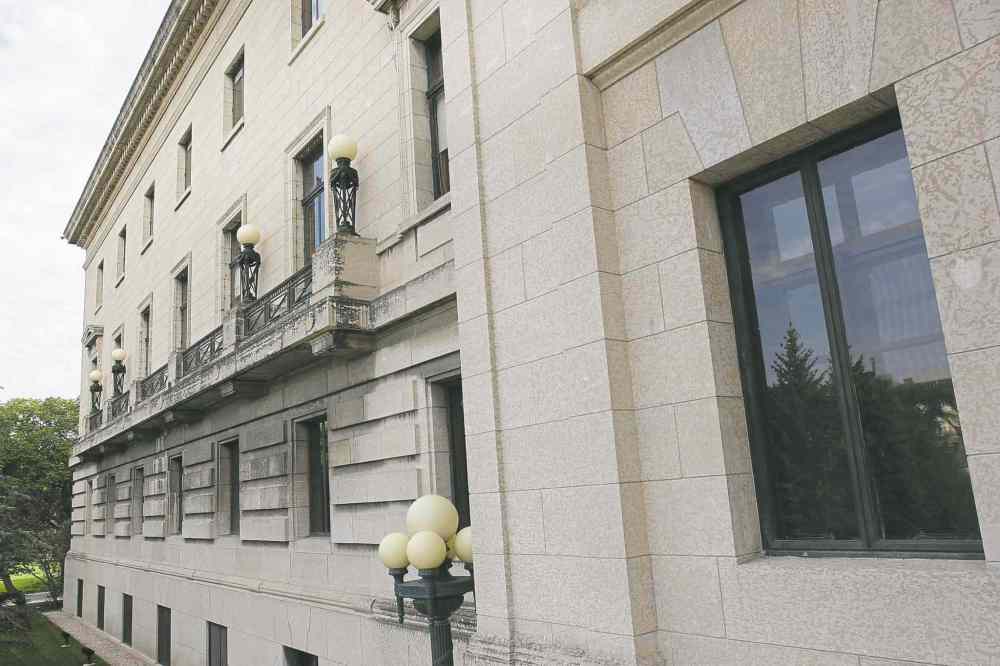
When the legislative building opened its doors 95 years ago, it was referred to the Manitoba Free Press as the “magnificent pile on Broadway” and a “grand pile of masonry.”
Certainly, over the years, generations of Manitobans have come to cherish the building and its beauty. It’s now become a popular backdrop for high school graduation and wedding photos.
This summer, exploratory work started on examining every nook and cranny of the building’s exterior to see what had to be done to bring it back to what it looked like on opening day — July 16, 1920.
Susan Clubine, the province’s manager of capital projects, says more exploratory work will take place this fall with the consultant to submit their final report and recommendations on how to best proceed early in the new year. Remedial work is scheduled for next summer.
In the meantime, the entire exterior been digitally photographed. That allows for the electronic production of detailed line drawings, something the province did not have previously.
“Design wasn’t advanced then,” Hauch says of the building’s planning and construction. Excavation work began in 1913.
The province also doesn’t have any renderings of the legislative building’s foundation, Susanne Parent, the province’s director of operations says.
A while ago, officials took a core sample of the base of one of the building’s elevators, Parent said. The drill bored through about 1.8 metres of solid concrete, enough to satisfy them the foundation was for the most part as solid as the day it was built.
“Everything is turning 100 years old or about to, so we have to look at it,” Parent said.
Hauch says in preliminary exterior examination, no urgent problems were detected other than a tilting limestone urn on the west side of the building. It has since been fixed.
“We expect no imminent calamities,” he says. “The biggest thing we face is preventative maintenance.”
UNDERGROUND
Duncan stops for a moment in the tunnel to point to the big, white pipes, reminding us a lot of the cancer-causing asbestos piping has either been removed or safely covered. The price tag for the work is about $250,000.
The tunnel also has to be examined to make sure it’s structurally sound, he says.
“Back then, they just did things,” he says, adding the builders didn’t document a lot of the work. “We’re going to find out before we need to find out.”
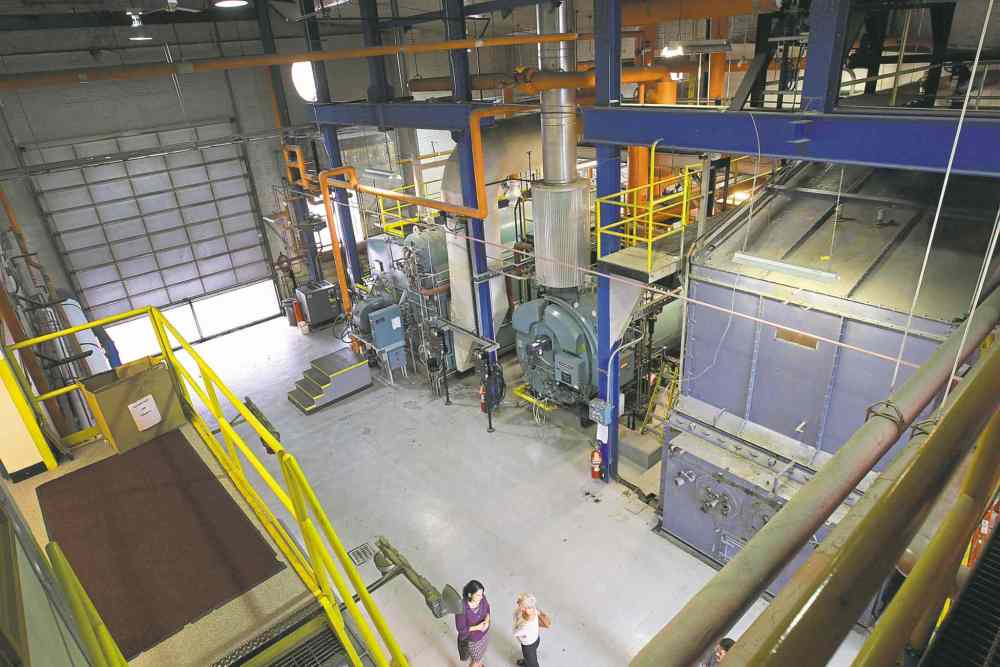
The tunnel leads to the powerhouse building, which was built in 1915 under the government of the day’s plan to have one building to supply heat and cooling to all government buildings in the area. Besides heating the legislative building and Government House, where Lt.-Gov. Janice Filmon and her husband, Gary, live, the powerhouse heats and cools the Law Courts, the judges’ chambers in the Old Land Titles Building, the Woodsworth Building and the Manitoba Archives Building. The powerhouse also supplies heat and emergency power to the Winnipeg Remand Centre.
To keep the powerhouse working each day of the year, its three massive gas-fired steam boilers have to be maintained around the clock. The oldest of these boilers was installed in 1967-68. Coal-fired boilers are no longer used. Only one remains, and it hasn’t been used since the 1950s.
“The oldest ones are the best-performing and lasting the longest,” Parent says, adding eventually — there’s no exact timeline yet — the old blue coal-fed boiler will be dismantled and replaced with a new boiler.
MEMORIAL PARK FOUNTAIN
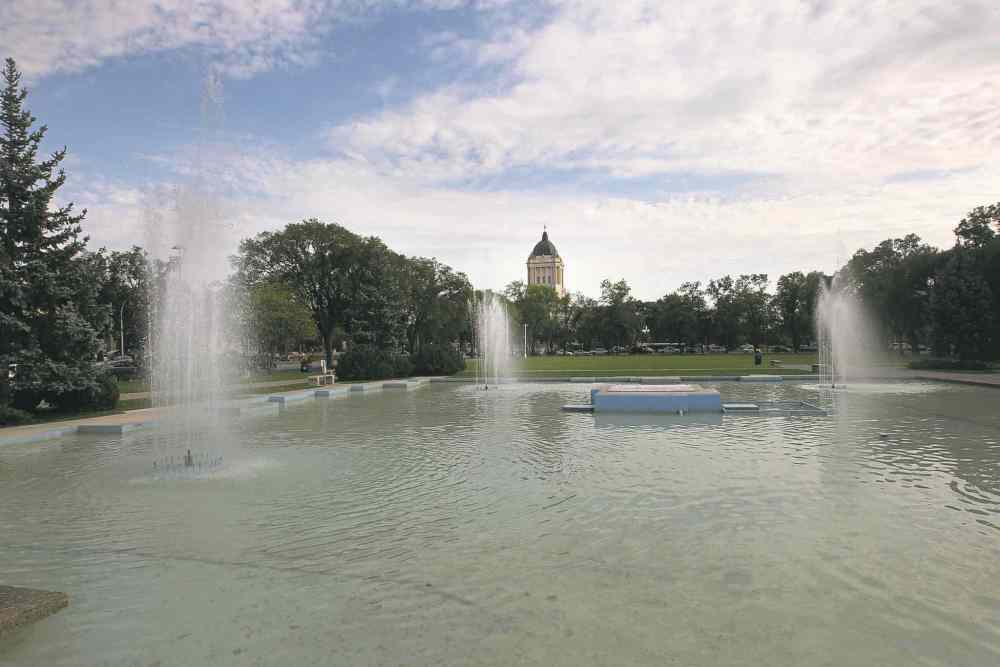
Jean Dorge, the province’s grounds manager, and Mazhar Anjum, the province’s district manager, say the iconic reflecting pool and water fountain is running on parts made in the early 1960s.
The park and fountain were opened on Sept. 28, 1962, by premier Duff Roblin and lieutenant-governor Errick Willis, “to the spirit of the soldier, the spirit of the pioneer and the spirit of the citizen.”

More than 50 years later, the automated fountain needs a major upgrade. Part of it was shut down several years ago.
When it opened, coloured lights in an aurora borealis pattern played at night, and the once-high-powered jets sent water shooting about nine metres in the air.
Not any more.
Dorge and Anjum say the plan is to completely retrofit the fountain with new, code-compliant mechanics and restore it to its original glory, all in time for the legislative building’s 2020 centennial.
bruce.owen@freepress.mb.ca
History
Updated on Wednesday, September 16, 2015 7:46 AM CDT: Changes photo, changes headline