

Elections Canada looking into reports of photocopied ballots on First Nations
Advertisement
Read this article for free:
or
Already have an account? Log in here »
To continue reading, please subscribe:
Monthly Digital Subscription
$1 per week for 24 weeks*
- Enjoy unlimited reading on winnipegfreepress.com
- Read the E-Edition, our digital replica newspaper
- Access News Break, our award-winning app
- Play interactive puzzles
*Billed as $4.00 plus GST every four weeks. After 24 weeks, price increases to the regular rate of $19.95 plus GST every four weeks. Offer available to new and qualified returning subscribers only. Cancel any time.
Monthly Digital Subscription
$4.99/week*
- Enjoy unlimited reading on winnipegfreepress.com
- Read the E-Edition, our digital replica newspaper
- Access News Break, our award-winning app
- Play interactive puzzles
*Billed as $19.95 plus GST every four weeks. Cancel any time.
To continue reading, please subscribe:
Add Free Press access to your Brandon Sun subscription for only an additional
$1 for the first 4 weeks*
*Your next subscription payment will increase by $1.00 and you will be charged $16.99 plus GST for four weeks. After four weeks, your payment will increase to $23.99 plus GST every four weeks.
Read unlimited articles for free today:
or
Already have an account? Log in here »
Hey there, time traveller!
This article was published 26/10/2015 (3812 days ago), so information in it may no longer be current.
OTTAWA — Elections Canada is trying to determine how many poll workers had to resort to photocopying ballots on Election Day because there weren’t enough provided on First Nations to keep up with demand from voters.
A spokesman for the agency told the Free Press Monday it is working with its returning officers to pinpoint the accuracy of anecdotal media reports that several polling stations on reserves ran out of ballots. At least half a dozen First Nations in four provinces, including one in Manitoba, reported running out of ballots when turnout was unexpectedly high.
John Enright told the Free Press in a written statement Elections Canada has followed up with returning officers and “all indications are that no electors were denied the opportunity to vote as a result of a polling station running low on ballots.”
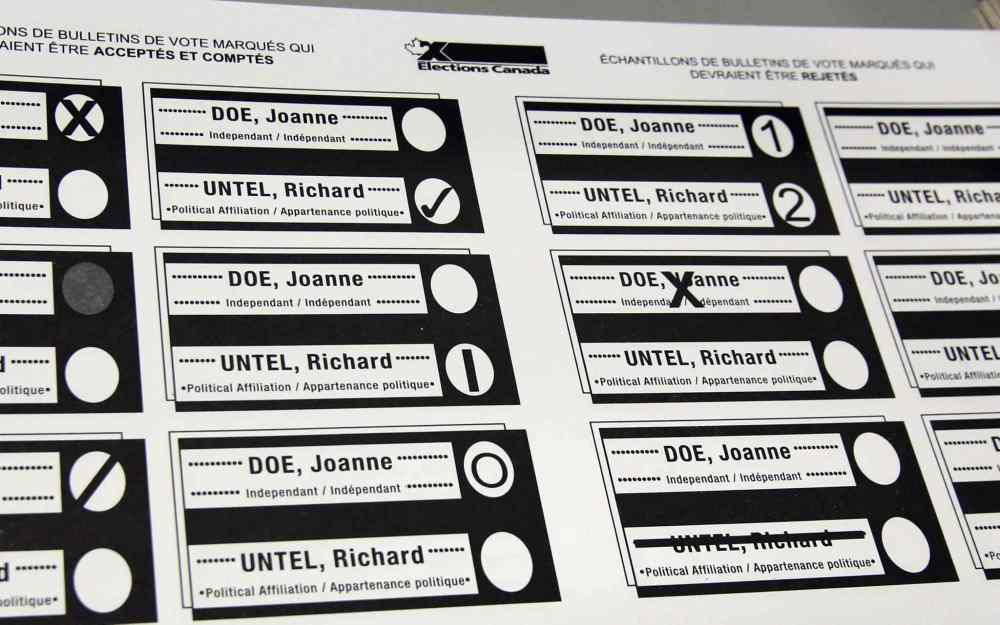
However, he said the agency is still confirming with its workers if any did indeed resort to photocopying ballots on Election Day. Photocopying ballots is allowed under the Canada Elections Act as a contingency measure.
Initially he said there was no interruption in the voting process because of a shortage of ballots, but later Monday said voting was delayed by 20 minutes on the Siksika Nation near Calgary while additional ballots were brought to the polling station.
Indigenous author and journalist Wab Kinew said his home community of Onigaming First Nation in northwestern Ontario had to send a band member to nearby Kenora to get more ballots when things started to run low.
“Let’s be clear, this wasn’t an Elections Canada worker who got the extra ballots, this was a random dude from the (reserve),” he said. “Elections Canada was unprepared.”
Elections Canada determines the number of ballots to provide each poll based on the number of electors preregistered at that poll, plus five per cent, rounded up to the nearest 25. So if 100 voters are preregistered, the poll will receive 125 ballots. But Niki Ashton, the NDP MP re-elected in Churchill-Keewatinook Aski, said a formula that works for urban centres or rural Canadian polling stations doesn’t take into account the realities of reserves, where preregistration is lower than elsewhere.
She said she also heard complaints that Elections Canada hadn’t properly trained poll workers on reserves, and there wasn’t enough support to help them.
“Elections Canada needs to step it up when it comes to elections on First Nations,” said Ashton.
Kinew said running out of ballots is “a great problem to have” in some ways because it is a sign of an engaged electorate, but at the same time he said it should not happen.
The Assembly of First Nations has asked Elections Canada to review what happened so it can be prevented in the future. Kinew said Elections Canada can’t possibly know for sure if someone decided not to stick around to wait for more ballots and said there is also a concern that the message sent to first-time voters on reserves was that nobody expected them to show up in the first place.

“The message is that we don’t expect indigenous people to vote so we don’t prepare for them,” said Kinew.
In the past, turnout among First Nations voters has been among the lowest in the country. In 2011, on-reserve turnout was 40.3 per cent compared with 61.1 per cent for the population as a whole.
The on-reserve vote last week hasn’t yet been calculated as poll-by-poll results are still trickling in. However, in ridings with large numbers of reserves, turnout soared.
In Churchill-Keewatinook Aski, for example, where almost three in four voters is indigenous, turnout went from 43.3 per cent in 2011 to 63.7 per cent last week. In Kenora, where about half the registered voters in 2011 were indigenous, turnout went from 58.8 per cent in 2011 to 72.1 per cent in 2015.