

Construction obstruction
Experts say tendering process curbs building season; offer solutions to speed up process
Advertisement
Read this article for free:
or
Already have an account? Log in here »
To continue reading, please subscribe:
Monthly Digital Subscription
$1 per week for 24 weeks*
- Enjoy unlimited reading on winnipegfreepress.com
- Read the E-Edition, our digital replica newspaper
- Access News Break, our award-winning app
- Play interactive puzzles
*Billed as $4.00 plus GST every four weeks. After 24 weeks, price increases to the regular rate of $19.95 plus GST every four weeks. Offer available to new and qualified returning subscribers only. Cancel any time.
Monthly Digital Subscription
$4.99/week*
- Enjoy unlimited reading on winnipegfreepress.com
- Read the E-Edition, our digital replica newspaper
- Access News Break, our award-winning app
- Play interactive puzzles
*Billed as $19.95 plus GST every four weeks. Cancel any time.
To continue reading, please subscribe:
Add Free Press access to your Brandon Sun subscription for only an additional
$1 for the first 4 weeks*
*Your next subscription payment will increase by $1.00 and you will be charged $16.99 plus GST for four weeks. After four weeks, your payment will increase to $23.99 plus GST every four weeks.
Read unlimited articles for free today:
or
Already have an account? Log in here »
Hey there, time traveller!
This article was published 07/11/2015 (3783 days ago), so information in it may no longer be current.
It’s a rite of spring: workers in orange vests, traffic cones and closed-off lanes appear across the city, grinding traffic to a halt as construction season descends upon Winnipeg.
From the seemingly never-ending construction around Polo Park on St. James Street to the Sturgeon Road bridge, it is omnipresent. But those in the construction industry say Winnipeg could be doing it better and more efficiently.
Imagine having a construction season lasting six weeks longer, meaning projects can start and finish in the same year. Imagine having shorter disruptions. Imagine more projects getting completed.
Those are all possible, according to Chris Lorenc, president of the Manitoba Heavy Construction Association, and others, if the city revamps its system. For Lorenc, having projects identified, tendered and approved earlier, which would allow workers to start right after the May long weekend and work until November, would reap the biggest benefit.
Lorenc would like the complex design, tender, bid and build process for every project simplified.
“If I want a tuxedo because I need to go to a wedding on July 5, do I wait until July 4 to get my tuxedo, when I have no opportunity to get a price? Or am I going to look for it in April or May and make the deal that’s best for me?”
Money isn’t necessarily the problem. The province has committed $5.5 billion for infrastructure over five years, newly elected Prime Minister Justin Trudeau promised $60 billion for projects across the county in the next 10 years. The City of Winnipeg budget includes $640 million for local and regional road renewal in the next six years.
However, getting the work done on time and in one season appears to be a problem. The city was unable to spend $16 million of its road budget this year. That’s after failing to spend more than $20 million of the 2014 budget.
The Free Press spoke to city engineers, members of the construction industry and city councillors to pinpoint how the city can improve the road-building process.
Why can’t we just close a street?
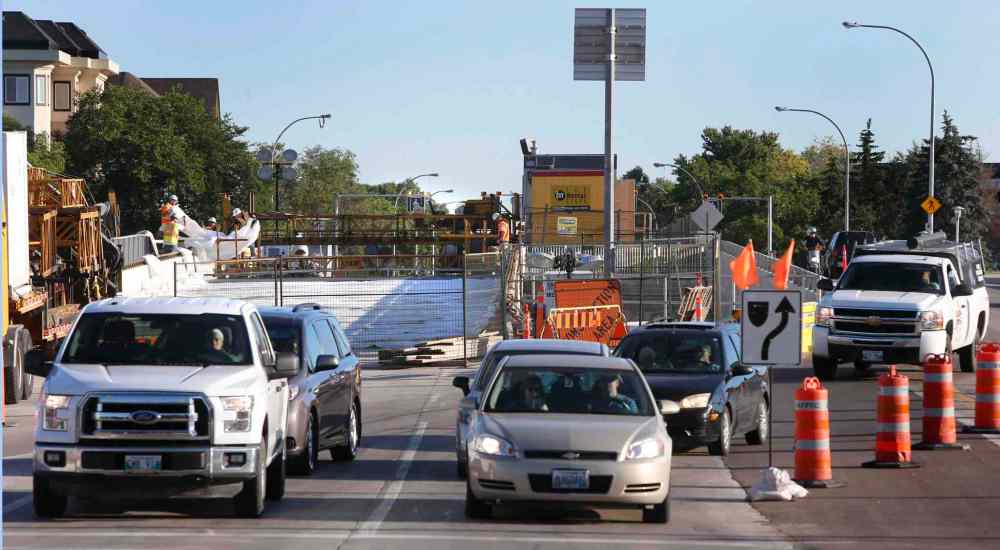
Forcing Winnipeggers to detour from their given route is an unpopular idea, but the construction industry says it has a big payoff. There would be a significantly shorter disruption period, cheaper contract costs and workers would have access to a safe worksite.
Peter Withoos, a principal with M.D. Steele Construction, a builder of bridges and underpasses, gave an example of how the this practice could benefit Winnipeggers. During the rehabilitation of the Pembina Highway overpass at the south Perimeter Highway a few years ago, the company was forced to break the two-year project into sections to maintain traffic flow on and below the bridge.
“You stretch out the contracting into two years as opposed to doing it in one year,” Withoos said. “But if we did it for one year, the bridge would have been closed and traffic routing would’ve been a nightmare. We are restricted in terms of how they reroute traffic around the site.”
Lorenc argues it would allow crews to work quickly and safely and would save on costs.
“It would probably be done weeks ahead, you are still going to have traffic disruption… but would you rather have two months of traffic interruption or six weeks?” he asked. “The public ask why is it taking so long? Well what the public needs to understand is that we do it in the exact way the contract allows us.”
Michelle Stainton, a city engineer, said it would have to be done on a project-by-project basis.
“We close local streets often. On regional streets though, it is rare. You have to consider you are affecting businesses and major traffic routes,” she said, noting the uproar that occurred when Plessis Road was closed. “It shaved months and months off our delivery time, but it was not without pain.”
The major Transcona artery was closed in the summer of 2013 from Dugald Road to Kernaghan Avenue as part of a $77-million road-widening and underpass-construction project, much to the chagrin of a vocal group of drivers incensed by the project’s delay and traffic headaches. Two lanes of Plessis Road were finally reopened late last month.
“That’s very frustrating when you’re driving all the way around and spending more money on gas and more time and nothing’s happening with the road and you can’t use it,” a motorist told the Free Press in 2014.
Tender early
Going to tender, which allows private contractors to bid on projects, is arguably the most important first step in making your trip down St. James Street smoother.
While the province released its 2016 tender list on Friday, the city, beyond a three-year list of regional road repair plans, has yet to pass a budget and get its ducks in a row before its construction proposals for the season are revealed.
“We wait for (the province’s tender) list every year because that lists helps us. It can change, but at least it gives us a guideline as to what they are going to tender for the coming year,” Withoos said. “I think what the contractors have to realize is that if you put out a major project in July, by the time you get a contract go-ahead, that gives you a very short window to complete that work.”
Everyone agrees the city issues tenders too late. The construction industry scrambles to assemble the crew and equipment needed to fulfil the city’s needs for the season.
The city has attempted to get tenders out earlier — typically in April or May, Stainton said. But beginning the work earlier can be problematic. City engineers are in charge of planning the release of contracts for next year’s work, but in the late summer and early fall they’re busy working on the city’s construction projects for the existing year, she said.
“We’re working with a whole bunch of balls in the air, the underground, there’s traffic everywhere, if there’s construction on one road we have to be careful and not jump the gun and work on a route that is going to snarl someone else’s alternative route,” she said. “The one thing I think we can do is get our engineering contracts out earlier, and that is something we try to do… but to do that at the right time, we would need to be drafting and issuing requests for proposals in the late summer and that’s our busiest time for construction.”
Other ideas:
Switching to a three-year capital budget
Public works chairwoman Coun. Janice Lukes says that’s the goal. She wants to see the city move away from passing its capital budget annually. A three-year budget would give the administration and industry more time to prepare, knowing what funds have been allotted and what projects are upcoming.
“It’s all about planning. If you can plan ahead, you have a better understanding of the finances… and resources from a staffing perspective,” Lukes said.
Former finance chairman Coun. Russ Wyatt wants to see the city release its capital budget report, in order to see what projects council can authorize ahead of passage of the capital budget next year. Current finance chairman Coun. Marty Morantz said the public service is expected to ask for the city to authorize spending on a few projects this month, but most likely for larger multimillion-dollar projects.
Switching to standardized contracts
Ron Hambley, the president of the Winnipeg Construction Association, believes fewer projects would go off the rails budget-wise or be delayed if the city used standardized contracts, much like Hamilton, Toronto, Saskatoon and provincial government departments. It was one of the first requests the association made when Mayor Brian Bowman was elected last year. There has been no movement so far. The contracts — created by the Canadian construction documents committee — are “tried and tested” and would make projects run smoother and more efficiently, Hambley said.
The city prefers its contracts be written in-house, and believes standardized contracts do not protect the city effectively.
“What is in there is how changes are dealt with, the cost of changes and how disputes are resolved, insurance and bonding,” Hambley explained, adding there are contractors who won’t bid on city projects because they don’t use standardized contracts. “The best contractor in the city could deal with one (a non-standardized contract) and it was a nightmare, and then just decides not to come back.”
Tender projects in one package
Lorenc wants the city to focus on doing a large swath of streets in one shot — as opposed to tendering projects on a patchwork basis, such as splitting a large regional road project into two contracts. It could potentially save tens of thousands of dollars and time, he said.
“The streets are in such a crappy condition, that doing patchwork doesn’t give you any advantage,” Lorenc said. “It’s an efficiency game, it is getting more value for the dollar.”
kristin.annable@freepress.mb.ca
History
Updated on Saturday, November 7, 2015 9:31 PM CST: Fixes typo